

Sanctions screening is a critical process for businesses to avoid penalties and reputational risks by ensuring compliance with global regulations. Here’s a breakdown of the top techniques you should know:
- Risk-Based Screening: Focuses on context and assigns risk scores to prioritize high-risk entities, improving accuracy and reducing false positives.
- Automated Fuzzy Matching: Accounts for name variations, typos, and transliterations, using algorithms to identify potential matches and minimize unnecessary alerts.
- Real-Time Screening with AI: Monitors transactions instantly, leveraging AI to update and cross-check data continuously, reducing delays and false positives.
- Manual Review and Escalation: Adds human judgment to flagged cases, ensuring nuanced decisions and compliance with regulatory requirements.
- Regular Audits and List Updates: Keeps systems aligned with evolving sanctions lists, ensuring timely identification of risks and adherence to regulations.
These techniques, when combined, create a robust framework for sanctions compliance, helping businesses manage risks effectively while meeting stringent regulatory standards.
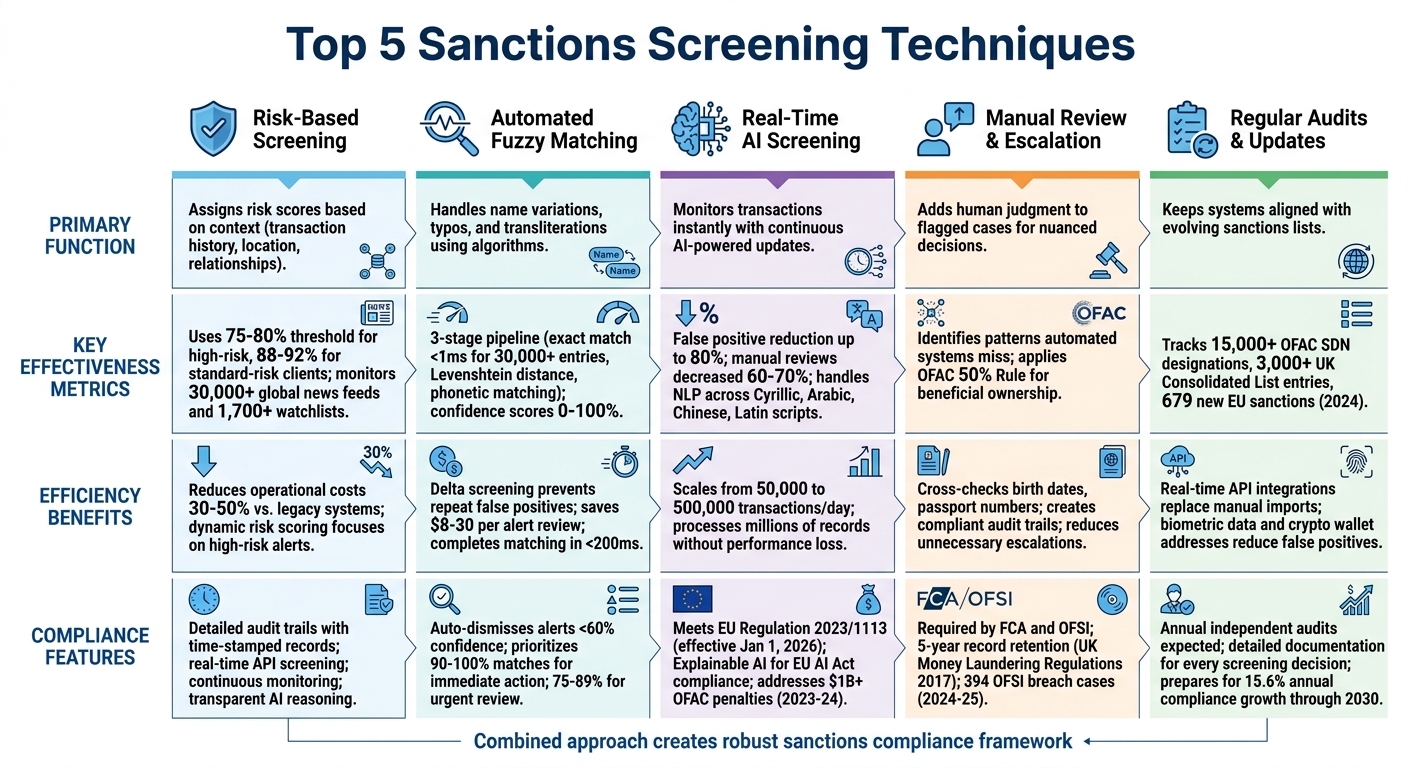
5 Sanctions Screening Techniques Comparison: Effectiveness, Efficiency, and Compliance
Conduct Sanctions Screening with These Simple Steps | RapidAML

sbb-itb-2d170b0
1. Risk-Based Screening
Risk-based screening takes a smarter approach by analyzing context rather than relying solely on name-matching. It assigns risk scores based on factors like transaction history, geographic location, relationships, and the severity of associated sanctions. For instance, a customer operating in a high-risk, sanctioned jurisdiction might trigger an alert at a lower similarity threshold – say, 75–80% – while standard-risk clients would only flag at 88–92%. This method not only improves accuracy but also cuts down on manual reviews by reducing unnecessary false alerts. It lays the groundwork for the more advanced efficiencies we’ll explore later.
Effectiveness in Identifying Sanctioned Entities
This system uses a layered approach, combining tools like fuzzy matching, entity resolution, and cross-referencing critical identifiers such as date of birth, nationality, and corporate affiliations. By analyzing these details, it can separate genuine matches from false positives. For example, when screening corporate clients, the system doesn’t just stop at the immediate counterparty. It digs deeper, identifying ultimate beneficial owners (UBOs) further up the corporate structure. This aligns with the "50% Rule", which treats entities owned 50% or more by a sanctioned individual as sanctioned themselves.
Efficiency in Reducing False Positives
Risk-based screening flips the traditional model by focusing on the most likely threats. Through dynamic risk scoring, it evaluates transaction context and alert history, allowing compliance teams to concentrate on high-risk alerts instead of wasting time on every flag. This targeted approach can lead to significant savings, cutting operational costs by 30% to 50% compared to older, less sophisticated systems.
Scalability for Large Datasets
Modern platforms built for risk-based screening are cloud-native and designed for handling massive datasets efficiently. Using AI and machine learning, these systems continuously improve matching accuracy while keeping false positives to a minimum – even when processing millions of records. Top-tier platforms can monitor over 30,000 global news feeds for adverse media and integrate data from more than 1,700 global watchlists, all while maintaining real-time performance.
Compliance with Regulatory Requirements
Beyond technical capabilities, these systems are built to meet strict regulatory standards. Regulators now view risk-based screening as the gold standard. Key compliance features include maintaining detailed audit trails with time-stamped records of every decision, enabling real-time API screening for payment flows instead of relying on outdated daily batch imports, and ensuring continuous monitoring to update customer evaluations whenever sanctions lists change. Transparent AI is also crucial, as it provides clear reasoning behind match decisions, ensuring regulators have full visibility into the process.
2. Automated Fuzzy Matching
Automated fuzzy matching is designed to overcome the limitations of exact matching by accounting for name variations, typos, and transliterations. For instance, an exact match might fail if someone enters "Vladmir Putin" instead of "Vladimir Putin" or when dealing with different Latinized spellings of names originally written in scripts like Cyrillic or Arabic. Fuzzy matching, however, uses algorithms to measure how similar two strings are, rather than requiring an exact match. This lays the groundwork for a more layered and nuanced matching process.
Effectiveness in Identifying Sanctioned Entities
To handle name variations effectively, advanced systems use a three-stage pipeline. The process begins with exact matching, which checks for literal matches and known aliases. This step is lightning-fast, completing in less than a millisecond for databases containing over 30,000 entries. If no exact match is found, the system moves to the next stage: the Levenshtein distance method, which calculates the number of character changes needed to transform one name into another. The final stage employs phonetic matching algorithms, such as Soundex or Metaphone, which match names based on how they sound. For example, the French transliteration "Poutin" would still match "Putin" despite the spelling difference.
These systems also assign confidence scores ranging from 0% to 100% to rank the matches. High-priority alerts (90–100%) are flagged for immediate action, while matches scoring 75–89% require urgent review by a human analyst. Medium-confidence matches (60–74%) are examined further only if additional data, such as nationality or date of birth, aligns. Alerts scoring below 60% are often auto-approved, allowing analysts to focus on higher-risk cases.
Efficiency in Reducing False Positives
Although fuzzy matching is powerful, it can result in false positive rates exceeding 99%. To address this, systems incorporate secondary data filtering. For example, when a potential match is flagged, additional identifiers like date of birth, nationality, or address are cross-checked. If a name match lacks a corresponding date of birth match, the system can auto-dismiss the alert, significantly reducing unnecessary reviews.
Another key strategy is delta screening, which is particularly useful for batch processing. Instead of rechecking the entire database daily, delta screening generates alerts only for new matches that weren’t flagged in previous runs. This prevents compliance teams from wasting time on the same false positives repeatedly. Considering that each alert can cost between $8 and $30 to review depending on complexity, this approach can lead to significant cost savings.
Scalability for Large Datasets
To handle massive datasets efficiently, fuzzy matching systems use blocking techniques to reduce computational demands. A common method is prefix blocking, which narrows down the database by keeping only names that share initial characters or similar phonetic codes. This can shrink a dataset of over 30,000 entries to just 200–500 candidates. With this reduced pool, the system can then apply more resource-intensive fuzzy matching algorithms without slowing down. A well-tuned system can complete a three-stage matching process in under 200 milliseconds, enabling real-time API lookups during payment processing instead of relying solely on overnight batch operations.
3. Real-Time Screening with AI and Machine Learning
AI-powered real-time screening takes the place of outdated batch processes by evaluating transactions instantly and keeping customer statuses up to date. This method improves on traditional risk-based and fuzzy matching techniques by addressing their shortcomings in timeliness and adaptability. For instance, the Office of Foreign Assets Control (OFAC) updates its sanctions lists multiple times each week, making nightly synchronization inadequate. Furthermore, starting January 1, 2026, Regulation (EU) 2023/1113 will require payment service providers to verify originator and beneficiary data against sanctions lists in real time. This approach ensures better performance, efficiency, scalability, and compliance, as explored in the sections below.
Effectiveness in Identifying Sanctioned Entities
AI systems enhance real-time alerts by tackling linguistic and cultural challenges that traditional methods often miss. Using natural language processing (NLP), these systems can recognize transliterations across scripts like Cyrillic, Arabic, Chinese, and Latin, identify aliases, and uncover hidden transactional patterns. They also ensure customer data is continuously updated as new information becomes available. Machine learning tools can instantly extract data from websites, portals, and other sources, ensuring the screening process uses the latest information.
Efficiency in Reducing False Positives
AI significantly cuts down on false positives by analyzing the context of transactions, including geography and historical alerts, rather than relying solely on name matches. For example, a mid-sized digital bank previously found that fewer than 0.3% of its 1,200 daily manual alerts led to genuine matches. After implementing AI, false positive rates dropped by up to 80%, and manual reviews decreased by 60–70%. Additionally, Explainable AI (XAI) provides clear reasoning for match decisions, allowing compliance teams to resolve false alerts quickly with documented evidence.
Scalability for Large Datasets
Scalability is critical, and AI excels in managing growth, such as increasing transaction volumes from 50,000 to 500,000 per day without losing efficiency. Machine learning algorithms can process vast datasets and compare millions of records without performance issues. AI agents also streamline alert triage and data normalization, avoiding bottlenecks as transaction volumes grow.
Compliance with Regulatory Requirements
Regulatory bodies increasingly prefer real-time monitoring and API integrations over static daily imports. AI systems address these demands by providing transparency and interpretability, especially under frameworks like the EU AI Act, which classifies AI in financial risk assessment as "high-risk" and requires strict documentation and human oversight. When selecting AI vendors, it’s crucial to choose systems with Explainable AI capabilities to ensure human involvement in decision-making and maintain detailed audit trails for threshold settings. The financial stakes are high – OFAC’s civil enforcement actions for sanctions violations exceeded $1 billion between 2023 and 2024, highlighting the importance of strong compliance measures.
4. Manual Review and Escalation
While automated tools are powerful, they can’t replace the nuanced judgment that humans bring to the table. Manual reviews add a layer of insight that technology alone often misses. Even with the most advanced systems, trained analysts are essential for identifying subtle discrepancies. This second stage of sanctions screening allows experts to closely examine flagged alerts, helping to separate genuine risks from false positives. Humans are particularly skilled at spotting patterns – like typos, phonetic variations, or complex transliterations – that might slip past automated systems. This ensures that flagged cases are carefully scrutinized before moving into deeper investigations.
Effectiveness in Identifying Sanctioned Entities
Human reviewers bring context and intuition to the process, filling the gaps left by automated systems. For example, an automated tool might not connect "Mohammad" with "Mohammed", but an analyst can easily recognize the variation. This is especially critical when working with high-risk clients, where even minor alerts require careful attention to avoid missing genuine threats. Additionally, manual reviews are vital for applying the OFAC 50% Rule, which involves analyzing beneficial ownership to determine if entities controlled by sanctioned individuals should also be flagged.
Efficiency in Reducing False Positives
Manual review builds on automated alerts to improve accuracy and reduce unnecessary escalations. Analysts take a risk-based approach, cross-checking additional information like birth dates or passport numbers instead of relying solely on name matches. This approach not only enhances precision but also ensures that all decisions are well-documented, creating a clear and compliant audit trail.
Compliance with Regulatory Requirements
Human oversight is a key part of meeting regulatory expectations. While AI can handle initial screenings, regulators still require human validation for critical decisions. Agencies like the Financial Conduct Authority (FCA) and the Office of Financial Sanctions Implementation (OFSI) mandate thorough documentation of each alert clearance, especially during supervisory reviews. Records must also be kept for at least five years under the UK’s Money Laundering Regulations 2017. With OFAC civil penalties exceeding $1 billion in 2023–24 and OFSI handling 394 suspected breach cases in 2024–25, the stakes for ensuring robust manual review processes are incredibly high.
5. Regular Audits and List Updates
Sanctions lists are always evolving. For instance, the OFAC SDN List had surpassed 15,000 designations by March 2026, while the UK Consolidated List included over 3,000 individuals and entities. In 2024 alone, the European Union introduced 679 new financial sanctions. With geopolitical dynamics shifting so quickly, someone cleared during onboarding could appear on a sanctions list just months later. That’s why continuous monitoring isn’t just helpful – it’s essential.
Effectiveness in Identifying Sanctioned Entities
Continuous monitoring ensures you’re immediately alerted to updates in sanctions lists. This means sanctioned entities or individuals can be flagged in real time, which is critical given how fast international relations can change. A business partner today could be sanctioned tomorrow, and staying ahead of these changes is key to avoiding compliance risks.
Efficiency in Reducing False Positives
Modern sanctions lists now include biometric data, crypto wallet addresses, and digital identity markers. These additions significantly cut down on false positives. Advanced screening tools can now differentiate between a sanctioned individual and someone with a similar name, saving time and reducing unnecessary investigations.
Scalability for Large Datasets
Handling thousands of daily transactions requires systems that can scale effortlessly. Real-time API integrations have replaced outdated manual data imports, enabling seamless updates. For example, Regulation (EU) 2023/1113 mandates payment service providers to check transactions against EU sanctions lists in real time. These scalable solutions not only streamline operations but also prepare organizations for rigorous compliance audits.
Compliance with Regulatory Requirements
Efficiency is only part of the equation – regulatory compliance is non-negotiable. Advanced screening systems, paired with robust audit trails and regular independent reviews, ensure compliance standards are met. Regulators like the FCA and OFSI require detailed documentation for every screening decision, including justifications for clearing false positives. Under the UK’s Money Laundering Regulations 2017, records must be retained for at least five years.
The stakes are high: OFAC issued over $1 billion in civil penalties during 2023–24, and OFSI reviewed 394 suspected breaches in 2024–25. Annual independent audits have become an expectation, helping to identify gaps in screening logic and ensuring that matching parameters remain accurate as datasets expand. This proactive approach not only meets current standards but also positions systems to handle future regulatory shifts effectively.
Conclusion
An effective sanctions screening system blends several key elements: risk-based analysis, fuzzy matching, AI-powered real-time monitoring, manual oversight, and ongoing audits. Together, these components create a well-rounded framework. Risk-based screening ensures resources are directed toward the highest priorities, automated fuzzy matching processes daily transactions efficiently, AI and machine learning identify new and evolving risks, manual reviews add the regulatory-required human judgment, and regular audits help adapt to changing lists and regulations.
The secret to success lies in seamless integration. By connecting screening tools with CRMs through real-time APIs, you can break down data silos and automate repetitive tasks. This allows compliance teams to dedicate their time to more complex investigations. Alastair Lauder, KYC and Sanctions Programme Lead at WTW, highlighted this shift:
By implementing Maxsight, we moved from manual, one-size-fits-all checks to a risk-based approach – automating, where possible, to focus resources on high-risk customers.
Start by conducting a gap analysis to measure your current practices against regulatory expectations. Fine-tune fuzzy matching thresholds based on customer risk profiles to improve alert accuracy. Be sure to document all alert decisions to maintain the audit trail regulators expect. These steps help establish a proactive approach in an era of increasing compliance demands.
The stakes are high. Global demand for compliance frameworks is projected to grow at an annual rate of 15.6% through 2030, while enforcement actions – like OFAC’s $1 billion in civil penalties during 2023–24 – highlight the need for robust systems. Now is the time to implement these techniques to meet current standards and stay ahead of future regulatory changes.
This comprehensive approach not only strengthens sanctions compliance but also bolsters overall financial risk management. For businesses navigating international trade, managing sanctions risks is essential for safeguarding accounts receivable. Accounts Receivable Insurance provides tailored trade credit insurance solutions, offering an extra layer of protection against non-payment, bankruptcy, and political risks in both domestic and global markets.
FAQs
How do I set the right fuzzy-matching threshold?
To determine an effective fuzzy-matching threshold for sanctions screening, it’s crucial to strike a balance between catching true matches and reducing false positives. A lower threshold casts a wider net, capturing more potential matches but also increasing the likelihood of false positives. On the other hand, a higher threshold narrows the focus to exact matches, which might miss some relevant results.
The ideal threshold depends on your organization’s risk tolerance and operational requirements. Regular testing and validation of your system are essential to ensure you maintain the right balance between precision and efficiency.
When is real-time sanctions screening required vs batch screening?
Real-time sanctions screening is essential when quick detection is a priority – think situations like processing transactions or onboarding new customers. On the flip side, batch screening comes into play for scheduled reviews of existing accounts or transactions, often to ensure compliance with regulatory standards. Each approach is tailored to fit different compliance needs based on timing and operational objectives.
What should an audit trail include to satisfy regulators?
An audit trail plays a crucial role in documenting every step of sanctions screening activities. It should include details such as:
- The specific lists that were reviewed
- The results of the screening
- Any actions taken based on those results
- Updates or changes made to the screening process
Keeping these records ensures transparency, helps prove compliance with regulations, and provides a clear record for review if needed.