

Export compliance is not just about avoiding fines – it’s about protecting your business and maintaining smooth operations. In 2024, the Bureau of Industry and Security (BIS) pursued 26 criminal cases, with penalties reaching up to $1 million and 20 years in prison. Non-compliance can also lead to shipment delays, export bans, and reputational damage. Here’s a quick overview of the top risks to monitor:
- Product Misclassification: Errors in product classification can delay shipments and incur fines up to $374,474 per violation.
- License Issues: Missing or incorrect export licenses can result in fines exceeding $1 million and even loss of export privileges.
- Restricted Party Violations: Transactions with restricted parties or countries can lead to severe penalties and operational disruptions.
- Poor Documentation: Incomplete or inaccurate records weaken compliance efforts and increase audit risks.
- Ignoring Red Flags: Failing to investigate suspicious transactions can result in heavy penalties and legal trouble.
- High-Risk Destinations: Exports to countries like China and Iran require extra scrutiny to avoid violations.
- Screening Gaps: Outdated or inadequate screening processes can expose your business to sanctions and fines.
Each of these risks carries steep financial and legal consequences. To stay protected, businesses should implement strong compliance programs, automate screening processes, and maintain accurate records. Below, we break down these risks and how to mitigate them effectively.
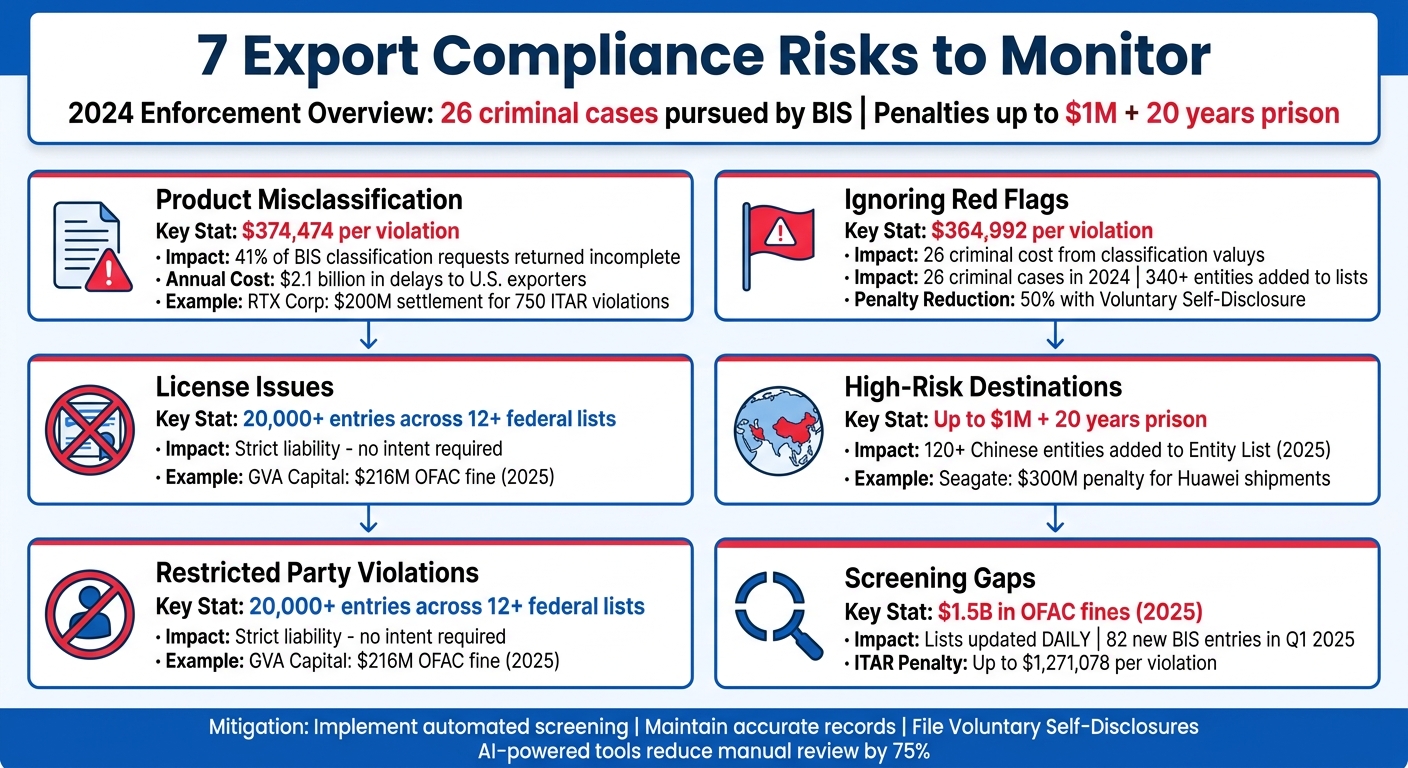
7 Export Compliance Risks: Penalties and Financial Impact
Denied Party Screening: The Export Compliance Risk
sbb-itb-2d170b0
1. Incorrect Product Classification
Getting product classification right is at the heart of export compliance. It determines whether your product requires an export license, based on its technical specifications – not its marketing description or product name. In FY2024, 41% of classification requests submitted to the Bureau of Industry and Security (BIS) were returned as "incomplete", a statistic that’s remained unchanged for three years. These errors aren’t just paperwork issues – they cost U.S. exporters around $2.1 billion annually due to shipment delays and license processing holdups. The key to avoiding these issues? Rely on precise technical data, not sales or marketing terms. Let’s unpack the technical, legal, and financial consequences of classification mistakes.
Impact on Legal Compliance
The Commerce Control List (CCL) applies "threshold logic." This means that if a single technical parameter exceeds a specified limit, your product gets assigned an Export Control Classification Number (ECCN). A common misstep is relying on marketing terms instead of measured technical data. Daniel Morse, an expert in ECCN determinations, explains:
"The commerce control list doesn’t care what marketing calls your product. It cares about nine technical parameters, and whether those parameters cross specific thresholds".
In one notable case from 2023, a $14 million shipment was delayed for six weeks because the engineering team provided an imprecise performance metric. BIS required the exact Adjusted Peak Performance (APP) calculation, precision weighting, and specific measurement conditions to determine if the shipment qualified under ECCN 4A003.b. This costly delay could have been avoided with accurate and complete documentation upfront.
These legal missteps don’t just create headaches – they directly translate into serious financial risks.
Potential Financial Risks
The financial penalties for classification errors are steep. Civil penalties for Export Administration Regulations (EAR) violations can reach $374,474 per offense, while International Traffic in Arms Regulations (ITAR) violations can go up to $1,271,078 per violation or twice the transaction value, whichever is higher. Criminal penalties are even harsher, with fines of up to $1 million per violation and prison sentences of up to 20 years. The Commerce Department has also removed previous caps on administrative penalties, tying them to transaction values. For high-value shipments, this makes the stakes even higher.
Beyond fines, classification mistakes can disrupt operations. For example, exporters often overlook controlled components within larger systems, such as a high-performance processor inside an industrial controller. What matters is the component’s maximum capability, not its typical use. This distinction is critical – off-the-shelf products rated for extreme temperatures (-67°F to +257°F) face stricter controls than identical items with standard operating ranges.
Ease of Mitigation and Monitoring
A systematic classification process can help avoid these risks. Follow the "Order of Review" outlined in Supplement 4 to Part 774 of the EAR to eliminate specific ECCNs before defaulting to EAR99. Always base classifications on actual test results, not "typical" values from sales materials. To stay organized, keep a "classification worksheet" for every product, documenting the technical thresholds you used.
Don’t rely solely on annual consolidated lists – threshold changes to the CCL occur 3–4 times a year, meaning these lists can quickly become outdated. For added certainty, consider submitting a CCATS request to BIS for a formal determination. Many companies now use AI-powered tools to automate ECCN classification, analyzing technical data sheets against regulatory criteria. These tools have been shown to reduce manual review workloads by up to 75%, significantly improving efficiency.
2. Missing or Incorrect Export Licenses
Once your product classification is accurate, the next step is determining whether an export license is required. This involves evaluating four key factors: product classification, destination, end user, and intended end use. Overlooking any of these can lead to severe compliance issues. Take, for instance, the case of RTX Corporation. In August 2024, the company agreed to a $200 million settlement with the State Department to address 750 alleged ITAR violations. These violations stemmed mainly from Rockwell Collins misclassifying ITAR-controlled items as EAR-controlled.
Impact on Legal Compliance
Export laws operate under a "strict liability" framework for administrative penalties. This means the government doesn’t need to prove intent to violate the law. Each individual shipment, email containing technical data, or file transfer can count as a separate violation. Criminal penalties, on the other hand, require evidence of willfulness. As David Noah, President of Shipping Solutions, explains:
"Willful ignorance is not a defense".
If something seems suspicious – like a customer being vague about the intended use of a product or requesting an unusual shipping route – you are legally obligated to pause and investigate before proceeding.
The consequences of non-compliance can be devastating. Denial of export privileges is often referred to as a "death sentence" for companies. Rachel Whitfield, a compliance expert, notes:
"Denial of export privileges effectively kills a company’s ability to participate in international trade".
Such bans can last up to 10 years following a criminal conviction and prevent any involvement in transactions governed by U.S. export regulations.
Potential Financial Risks
Violations carry steep financial penalties. Civil fines can range from hundreds of thousands to over a million dollars, while criminal penalties can reach as high as $1 million and 20 years in prison. The Department of Commerce has removed caps on administrative penalties for non-egregious violations, linking fines to the value of transactions. This makes high-value shipments especially risky.
Consider these examples: In July 2025, Cadence Design Systems faced a $140.6 million penalty for 61 EAR violations, including $95 million to BIS and $118 million in criminal penalties (offsets applied). The violations involved employees using front companies to export to Chinese military end-users on the Entity List. Similarly, in September 2025, Luminultra Technologies paid $685,051 for exporting EAR99 items to Iran through a Dubai freight forwarder. Although the items themselves weren’t classified under a specific ECCN, the destination required a license under EAR section 746.7(e).
Beyond the fines, compliance failures can disrupt daily operations and strain resources.
Operational Disruptions
Delays in license processing can wreak havoc on business operations. For instance, Haas Automation reached a $2,544,781 settlement in January 2025 for transactions with sanctioned parties – $1,044,781 with OFAC and $1,500,000 with BIS. These penalties not only hit finances but also freeze shipments and damage customer relationships. Terminal49 sums it up well:
"A license that is ignored operationally is not a control; it is an unclosed risk".
Interagency reviews can introduce unpredictable delays, so it’s wise to factor licensing lead times into your order management processes. Additionally, "deemed exports" – sharing controlled technology with foreign nationals within the U.S. – require coordination between HR and IT to avoid violations.
Ease of Mitigation and Monitoring
Reducing these risks starts with systematic measures. Use the Commerce Country Chart and your product’s ECCN to check if a license is needed for a specific destination. Document the reasoning behind every "no license required" (NLR) determination. For frequent shipments, automate screening processes to catch last-minute updates from OFAC or BIS.
It’s also crucial to establish "stop-ship" authority, allowing compliance teams to halt transactions if red flags appear, even if it affects revenue. Tailor training to specific roles – engineers should understand the risks tied to technical data, while sales teams need to spot end-use concerns. If a violation is discovered, file a Voluntary Self-Disclosure (VSD) immediately. Prompt and honest reporting can reduce administrative penalties by up to 50%.
While enterprise compliance software can cost upwards of $200,000 annually, there are budget-friendly options designed for small and medium-sized businesses. Investing in these tools and processes can save companies from costly mistakes down the line.
3. Dealing with Restricted Parties or Countries
Wrong party transactions can lead to enforcement actions from multiple U.S. agencies. A single misstep might violate OFAC sanctions, BIS export controls, and even trigger a Department of Justice investigation. Adding to the complexity, restricted party lists now include over 20,000 entries spread across more than 12 federal agency lists. To ensure compliance, constant screening is essential.
Impact on Legal Compliance
U.S. export laws operate under a strict liability framework for administrative penalties. This means that even unintentional violations or those caused by negligence can result in penalties. The Bureau of Industry and Security (BIS) explains:
"The BIS Affiliates Rule… created ‘an affirmative duty to determine the ownership of other parties to the transaction’ and that exporters ‘can be held liable for unauthorized exports… on a strict liability basis.’"
The 50 Percent Rule adds another layer of complexity. Under both OFAC and BIS regulations, any entity owned 50% or more by a sanctioned party is automatically treated as sanctioned, even if it’s not explicitly listed. Exporters must proactively investigate any red flags. For example, if a customer is unclear about the intended use of a product or requests an unusual shipping route, it’s crucial to pause and investigate further. BIS warns:
"What your employees know can be attributed to your company."
Instructing your team to avoid asking about end-users isn’t a solution – it’s a compliance violation in itself. This strict liability system highlights the need for thorough checks before proceeding with transactions.
Potential Financial Risks
Violating restricted party regulations can lead to severe financial penalties. For instance, in June 2025, GVA Capital Ltd. faced a staggering $215,988,868 fine from OFAC for managing assets belonging to a sanctioned Russian oligarch, despite prior warnings. Similarly, Unicat Catalysts Technologies, a Texas company, paid $3,882,797 in 2025 for violating sanctions involving Iran and Venezuela. This case also involved BIS and the Department of Justice.
Administrative penalties for BIS violations can reach $364,992 per infraction or double the transaction value, whichever is higher. Meanwhile, OFAC civil penalties in 2025 alone totaled around $265.7 million. Criminal penalties can escalate even further – up to $1 million per violation and 20 years of imprisonment. The Commerce Department has removed caps on penalties for non-egregious violations, tying fines directly to transaction values. This makes high-value shipments particularly risky.
Operational Disruptions Caused
Beyond financial penalties, enforcement actions can drain resources and disrupt operations. Export privilege denials can last up to 10 years, barring participation in transactions regulated by U.S. export laws. Increasingly, enforcement actions involve coordinated civil and criminal resolutions between BIS and the Department of Justice.
Regulators are also broadening their scope. Even domestic entities like schools, professional services, and financial institutions are being scrutinized if their transactions touch sanctioned networks. Additionally, "deemed exports", where controlled technology is shared with foreign nationals within the U.S., are under closer review. OFAC’s recordkeeping requirements were extended from 5 to 10 years in March 2025, meaning past violations could resurface long after the fact.
Ease of Mitigation and Monitoring
Mitigating these risks requires robust monitoring systems. Automated tools that screen 300+ global lists daily are far more reliable than manual checks, which may face delays in updates. Screening should occur at multiple stages, including customer onboarding, transaction reviews (buyer, ship-to party, end-user), and payment processing (banks and beneficiaries). Regular monitoring is key.
Conduct ownership due diligence to identify risks tied to the 50 Percent Rule. This means going beyond list-matching to understand the ownership structures of your business partners. Employ geolocation and blocking technologies to prevent access to services or products in prohibited areas. Document all screening results, match resolutions, and training efforts for at least five years – or ten years for OFAC-related matters – to demonstrate due diligence.
If a violation occurs, file a Voluntary Self-Disclosure (VSD) immediately. Prompt and honest reporting can reduce penalties by up to 50%. Additionally, establish a formal Export Compliance Program (ECP) that includes written procedures, regular training, and clear escalation processes. As David Noah, President of Shipping Solutions, puts it:
"Trade compliance isn’t just a regulatory checkbox – it’s your company’s shield against devastating penalties and your passport to global market success."
4. Inadequate Documentation and Reporting
Accurate documentation is the cornerstone of compliance efforts. Under EAR §762, maintaining proper records isn’t just a best practice – it’s a legal requirement. When federal agencies audit your operations, they expect to see clear evidence that you’ve followed all necessary procedures. Missing or incomplete records weaken your ability to demonstrate due diligence.
As ECTI, Inc. emphasizes:
"Your compliance program is only as good as you can prove. Keep solid records of your classifications, and how and when you determined them."
Impact on Legal Compliance
Precision matters when it comes to compliance documentation. Avoid vague descriptors like "high-performance" in favor of detailed, tested technical parameters. Regulators need specifics – such as APP calculations, encryption implementation modes, or minimum detectable signal levels – to verify product classifications.
Daniel Morse from Lenzo.ai explains the common pitfall:
"The common failure? Submitting a product datasheet and expecting BIS to extract relevant parameters. Classification engineers… are not going to reverse-engineer your marketing materials."
Failing to provide complete technical data can raise compliance concerns. Additionally, submitting incorrect information – such as misstating a product’s country of origin or misclassifying its technical specifications – can lead to scrutiny under the False Claims Act.
Potential Financial Risks
The financial consequences of documentation errors can be severe. Self-classification mistakes and resulting delays cost U.S. exporters an estimated $2.1 billion annually. Administrative penalties for violations can climb to $364,992 per incident or twice the transaction value, whichever is higher. Criminal penalties are even steeper, reaching up to $1 million per violation and 20 years of imprisonment.
For example, in 2025, Cadence Design Systems faced a $95 million BIS civil penalty as part of a larger $140 million settlement with the Department of Justice. The case involved unauthorized exports to Chinese military-linked entities. Similarly, in 2023, a $14 million shipment was delayed for six weeks because the exporter listed "approximately 60 WTFLOPS" as the processing capability instead of providing the precise APP calculation, precision weighting, and measurement conditions required by BIS.
Operational Disruptions Caused
Beyond monetary penalties, poor documentation can disrupt operations significantly. Missing or inadequate records lead to shipment delays, prolonged audits, and strained business relationships. The U.S. Commerce Department has removed the cap on administrative penalties, linking fines directly to transaction values.
Moreover, incomplete documentation weakens your ability to defend against investigations. Regulators now expect compliance programs to be "technology-enabled" and ready for audits at any time. Static checklists are no longer sufficient; integrated systems with a complete history of compliance checks, approvals, and filings are becoming the standard.
Ease of Mitigation and Monitoring
Strong documentation practices are essential to maintain compliance. Start by implementing standardized templates for commercial invoices, packing lists, and certificates of origin to ensure all required details are consistently captured. A centralized database for managing trade documents can reduce errors from manual data entry and speed up the document creation process by up to five times.
When classifying products, rely on technical datasheets that include tested parameters and recognized measurement standards. Avoid using "typical" or "approximate" values from marketing materials. Document not only the final classification (ECCN) but also the specific logic and technical benchmarks that led to that determination.
Conduct regular internal audits to identify and address documentation gaps before they escalate into compliance issues. If a violation is discovered, filing a Voluntary Self-Disclosure can reduce penalties by as much as 50%. Assign clear accountability for recordkeeping across all stages of the export process, from sales to logistics, and ensure comprehensive audit trails are maintained for several years to meet EAR and ITAR requirements.
Improving your documentation framework not only reduces legal and financial risks but also strengthens your ability to monitor and address compliance challenges proactively.
5. Ignoring Red Flags and Diversion Risks
Diversion risks occur when goods or technology are rerouted to unauthorized users or destinations, violating export laws. According to the Export Administration Regulations (EAR), red flags are defined as "any abnormal circumstances in a transaction that indicate that the export may be destined for an inappropriate end-use, end-user, or destination". Exporters are legally obligated to investigate suspicious activities; ignoring these signs can lead to serious consequences.
Impact on Legal Compliance
The Bureau of Industry and Security (BIS) firmly states that turning a blind eye offers no protection under export laws. Failing to address red flags puts companies at risk of violating compliance regulations. Kevin E. Gaunt from Hunton Andrews Kurth highlights the importance of following BIS guidance:
"Adhering to BIS guidance helps companies avoid legal pitfalls associated with diversion risks. Non-compliance can lead to substantial fines, penalties and even export privileges being revoked".
Criminal convictions can result in the loss of export privileges for up to 10 years. Beyond legal trouble, these issues can lead to substantial financial consequences.
Potential Financial Risks
The financial penalties for ignoring red flags are steep. Administrative fines can reach $364,992 per violation or twice the value of the transaction – whichever is higher. Criminal penalties are even more severe, with fines up to $1 million per violation and prison sentences of up to 20 years. In 2024 alone, BIS handled 26 criminal cases and added over 340 entities to restricted lists. By tying administrative penalties directly to transaction values, especially for high-value shipments, the stakes have risen significantly.
Operational Disruptions Caused
Regulatory sanctions or investigations triggered by ignored red flags can disrupt operations and harm a company’s reputation. Being linked to diversion activities can erode customer trust and sever international partnerships. Common red flags include customers refusing to disclose end-use information, rejecting routine installation or maintenance services for complex equipment, or offering cash payments for high-value items that typically require financing.
Ease of Mitigation and Monitoring
Addressing these risks starts with implementing strong "Know Your Customer" (KYC) programs to verify ownership structures and prior export activities. Screening against the Trade Integrity Project (TIP) can help identify entities with histories of shipping sensitive goods to restricted regions, such as Russia, especially for items listed on the Common High-Priority List (CHPL). When red flags appear, transactions should be paused for investigation; if concerns persist, the transaction must be stopped, and BIS should be notified. Sales teams should be trained to identify and act on red flags, ensuring they don’t bypass critical inquiries about end-users. Voluntarily disclosing violations can also reduce administrative penalties by up to 50%. Proactively detecting and addressing red flags is a key component of a strong export compliance strategy.
6. Exports to High-Risk Destinations like China or Iran
Managing exports to high-risk destinations like China and Iran comes with a unique set of challenges. These challenges stem from overlapping U.S. regulations and the strict enforcement of extraterritorial laws. Even if your company operates outside the U.S., transactions involving U.S.-origin components or processed through U.S. banks can still result in penalties.
Impact on Legal Compliance
When exporting to high-risk regions, thorough classification and documentation aren’t just important – they’re essential. Exporters need to carefully screen against the U.S. Entity List, which includes over 1,000 Chinese entries, and the Specially Designated Nationals (SDN) List for Iran-related parties. In 2025, over 120 new Chinese entries were added to the Entity List, alongside more than 230 Chinese entities sanctioned for ties to Russia, Iran, and North Korea.
The "50 Percent Rule" adds another layer of complexity. This rule requires exporters to identify entities mostly owned by sanctioned parties, even if those subsidiaries aren’t explicitly listed. On top of that, China has introduced its own retaliatory measures, such as the Unreliable Entity List and restrictions on rare earth materials, which can clash with U.S. regulations. Even within the U.S., releasing controlled technology to a foreign national – known as a "deemed export" – is treated as an export to that person’s home country and often requires a license.
Potential Financial Risks
Violating export regulations in high-risk regions can come with steep financial penalties. Under the International Emergency Economic Powers Act (IEEPA), civil penalties can reach $330,947 per violation. Criminal violations can result in fines of up to $1 million and prison sentences of up to 20 years. On top of this, companies are required to retain transaction records for at least five years to comply with OFAC regulations.
Recent enforcement actions highlight how serious these penalties can be. In April 2023, Seagate Technology LLC and its Singapore subsidiary faced a $300 million civil penalty for 429 violations of the EAR after continuing shipments to Huawei despite its placement on the Entity List. Later that year, British American Tobacco and its Singapore subsidiary paid over $1 billion in combined penalties to OFAC and the DOJ for activities tied to a joint venture in North Korea.
Operational Disruptions Caused
Regulatory violations can lead to significant operational setbacks. Companies convicted of criminal violations may lose export privileges for up to 10 years. Heightened scrutiny can result in shipment delays, customs detentions, and the need for complex Technology Control Plans. High-risk destinations also often involve deceptive shipping practices, such as "shadow fleets" and ship-to-ship transfers, which demand careful routing oversight. Additionally, the complicated licensing requirements tied to product classifications, end-user identities, and prohibited end-uses can create a heavy administrative burden.
Ease of Mitigation and Monitoring
Reducing these risks requires a layered and proactive strategy. Automated screening software can perform real-time checks against global watchlists, ensuring compliance with the 50 Percent Rule. Tools like geolocation and IP blocking can help prevent unauthorized access to products or services in restricted regions like Iran or Crimea. Comprehensive supply chain mapping is also critical to identify touchpoints involving U.S.-origin items or the U.S. financial system. Clear internal escalation procedures should be in place to halt questionable transactions quickly.
As Friling Law notes:
"The cost of underinvesting in compliance far exceeds the investment required to build a strong program. In this environment, robust compliance is not just a legal necessity – it is a strategic advantage."
Voluntary self-disclosures can reduce administrative penalties by up to 50%. Regular, independent audits are another key step, allowing companies to identify and address weaknesses before regulators get involved. Strong monitoring and decisive internal controls are non-negotiable for staying ahead of compliance risks.
7. Failure to Screen and Due Diligence Gaps
Screening failures are a preventable yet costly risk in export compliance. Sanctions lists, such as the OFAC SDN and BIS Entity List, are updated daily. For example, in the first quarter of 2025 alone, the BIS added 82 new entries to its restricted list, emphasizing the importance of constant monitoring. Relying on outdated screening results can leave businesses exposed to dealings with prohibited parties.
Impact on Legal Compliance
Effective screening is more than just a box to check – it’s a legal necessity. Exporters are obligated to do more than verify names at the start of a relationship. They have a "duty to inquire" when red flags arise, such as customers being vague about the end use of goods, requesting unusual shipping routes, or offering cash for high-value items. Ignoring these signs, often referred to as "self-blinding", is not a valid legal defense.
Ownership rules add another layer of complexity. The "50 Percent Rule" requires exporters to screen not only direct customers but also beneficial owners and affiliates.
Potential Financial Risks
Failing to screen properly can lead to severe financial penalties. In 2025, OFAC imposed over $1.5 billion in fines for sanctions violations. Civil penalties for violating the Export Administration Regulations can reach $374,474 per violation – or twice the transaction value, whichever is higher. The Commerce Department has also removed financial caps, linking penalties directly to transaction values.
Criminal penalties are even more severe. Willful violations can result in fines up to $1 million and prison sentences of up to 20 years. Beyond financial penalties, businesses risk being cut off from the U.S. financial system, losing access to payment processing and banking services. For companies involved in international trade, export privilege denials for up to 10 years can completely halt operations.
Operational Disruptions
Beyond legal and financial implications, screening failures can disrupt daily business operations. Investigations and remediation efforts often come with significant costs in terms of time, money, and resources. In 2024, the BIS pursued 26 criminal cases and added over 340 entities to its restricted lists, reflecting the increased rigor of enforcement efforts.
The administrative burden is also substantial. BIS requires screening records to be kept for at least five years, while OFAC mandates a 10-year retention period for certain records. Companies must document both confirmed matches and false positives, along with how they were resolved, to demonstrate "reasonable care" during audits.
Ease of Mitigation and Monitoring
Mitigating these risks requires a multi-layered approach. Companies should screen at critical stages – during account setup, order processing, pre-shipment, and before payment – to account for daily updates to sanctions lists. Manual checks across global restricted party lists are inefficient, making automation essential for accuracy and speed.
Modern AI-powered tools, using natural language processing and fuzzy logic, can identify matches even when names are misspelled or transliterated. These tools can reduce manual reviews of false positives by up to 75%, significantly boosting productivity. Integration with ERP systems enables real-time checks and flags potential issues efficiently.
Voluntarily disclosing violations can reduce penalties by up to 50%. A robust Export Compliance Program – including management support, detailed risk assessments, strong internal controls, and regular training – can serve as a mitigating factor in case of violations. Clear audit trails and escalation procedures are essential for stopping questionable transactions in their tracks. Incorporating real-time screening at every transactional stage is critical for maintaining compliance.
Conclusion
Export compliance requires constant attention and adaptability. Sanctions lists are updated daily – just in the first quarter of 2025, the BIS added 82 new entities to its lists. A business partner cleared last week could find itself sanctioned today, making ongoing monitoring absolutely essential. This ever-changing regulatory environment demands a proactive and comprehensive approach to compliance.
The stakes for violations are incredibly high. ITAR violations can lead to civil penalties of up to $1,271,078 per violation, while EAR violations carry fines of $374,474 per offense. Criminal penalties are even steeper, potentially reaching $1 million per violation and up to 20 years in prison. For example, in 2025, Cadence Design Systems faced a $95 million civil penalty from the BIS due to unauthorized exports to Chinese entities linked to military supercomputers.
To manage these risks, a well-implemented Export Compliance Program (ECP) is essential. Combining a formal ECP with AI-powered tools and automated ownership mapping shifts compliance from a one-time checkpoint to a continuous, streamlined process. These technologies can screen over 750 global restricted party lists at once, reducing manual false-positive reviews and increasing efficiency by as much as 75%. They also ensure adherence to regulations like the "50 Percent Rule".
While compliance protocols mitigate legal and financial risks, Accounts Receivable Insurance (ARI) provides protection against non-payment, bankruptcies, and political instability, empowering businesses to expand internationally with greater confidence. By integrating automated solutions with ongoing monitoring, exporters can navigate the complexities of global trade while staying compliant.
As David Noah aptly states:
"An ECP is a living, evolving system that keeps your business compliant, agile and protected in a fast-changing global trade environment".
FAQs
How do I confirm the right ECCN for my product?
To determine the correct Export Control Classification Number (ECCN) for your product, the key is to analyze its technical specifications – not its marketing language. Look at specific details such as processing speed, encryption strength, wavelength, or material composition. Then, match these characteristics to the criteria outlined in the Commerce Control List (CCL).
For accuracy, take advantage of tools like classification guides or ECCN lookup resources. Avoid basing your classification solely on marketing descriptions, as they often lack the precision needed for compliance.
When does an export license apply to an EAR99 item?
An export license is necessary for an EAR99 item if there are restrictions related to the destination, end-user, or end-use. This requirement holds even if the item isn’t explicitly included on the Commerce Control List. It’s crucial to carefully review the relevant regulations to stay compliant.
How often should we re-screen customers and shipments?
Re-screening customers and shipments at critical points in the export process is crucial for maintaining compliance. These stages include account setup, order acceptance, pre-shipment checks, and payment releases. Regular checks help you stay updated on changes to restricted party lists and ensure adherence to export regulations.