
Retail fraud is a growing problem, costing U.S. retailers over $100 billion annually, and it’s not limited to shoplifting. Fraudsters use sophisticated methods like synthetic identities, organized crime, and account takeovers. Each retail sector faces unique challenges, from return fraud in fashion to shipping scams in electronics and self-checkout theft in grocery stores.
Here’s what you need to know:
- Fashion Retail: High-value items like luxury goods are targeted. Tools like automated fraud detection and ID verification help combat issues like resale fraud and package rerouting.
- Electronics Retail: Small, expensive items are vulnerable to scams like account takeovers and shipping fraud. AI-powered tools and manual review processes are key to reducing chargebacks.
- Grocery Retail: Self-checkout systems are exploited for theft, and employee fraud adds to losses. AI-driven surveillance and identity verification tools can reduce these risks.
Fraud detection tools are vital, but they’re not foolproof. Retailers can pair these tools with Accounts Receivable Insurance (ARI) to protect against financial losses from fraud, non-payment, and even bankruptcy. Tailored ARI policies help safeguard cash flow and inventory across all retail sectors.
To stay ahead, retailers must combine advanced detection systems with financial safeguards to protect profits while maintaining customer trust.
1. Fashion Retail
Fraud Tactics
Fashion retailers often contend with unique risks stemming from the high value and portability of luxury items. Designer handbags, jewelry, and similar goods are particularly attractive to organized fraud rings because they can be resold at prices close to retail in secondary markets. The growing popularity of subscription-based clothing services and designer rental platforms has also introduced "friendly fraud." This occurs when customers falsely claim they never received rented items or fail to cancel recurring payments intentionally. Additionally, fraudsters employ tactics like package rerouting – where they impersonate merchants to redirect shipments – and placing orders using suspicious email addresses. These evolving schemes demand sophisticated and responsive detection strategies.
Detection Tools
Given the sheer volume of transactions in fashion retail, automated fraud detection systems are essential. Solutions like Signifyd and Forter provide rapid fraud evaluations and chargeback protection. Behavioral analytics tools, such as Featurespace‘s ARIC, identify subtle changes in customer behavior, while Fraudio uses a Network Effect AI to analyze billions of global transactions in real time, improving detection precision [12, 13]. These technologies not only streamline fraud prevention but also help retailers take proactive measures to mitigate risks.
Prevention Measures
Monitoring order patterns is a key step in identifying potential resale fraud, especially when high-value orders are repeatedly placed. Device fingerprinting can spot multiple order attempts from the same device, while IP-based geolocation ensures that the location of a device matches the billing and shipping addresses provided. For physical stores, automated ID authentication is particularly important for high-value returns, credit applications, and loyalty program enrollments. Staff training is also critical – employees should be equipped to recognize scams like quick-change tactics, where fraudsters use distractions and sleight of hand during cash transactions. With half of all large retailers reporting increases in credit card fraud, securing returns through ID verification has become a priority [4, 14].
Integration with ARI
Protecting against fraud goes hand in hand with financial safeguards. Fashion retailers that extend credit to wholesale or B2B buyers face risks such as non-payment and insolvency. Accounts Receivable Insurance (accountsreceivableinsurance.net) offers tailored policies to shield businesses from financial losses due to non-payment, bankruptcy, or even political risks in international trade. By combining advanced fraud detection tools with ARI’s specialized risk assessments and claims support, fashion brands can protect both their inventory and cash flow, ensuring that fraud doesn’t spiral into larger financial challenges.
sbb-itb-2d170b0
2. Electronics Retail
Fraud Tactics
Electronics retailers face a wide range of fraud risks, particularly with high-demand items like smartphones, tablets, and wearables. These products are especially attractive to fraudsters because they’re small, portable, and have a high resale value. To put it into perspective, the average smartphone price in the U.S. hit $633 in 2021, a staggering 57.46% increase since 2016.
Shipping scams are a major concern in this industry. For example, fraudsters often place orders with matching billing and shipping addresses to bypass fraud detection systems. Once the order is approved, they contact the shipping carrier to reroute the package to another location. Triangulation schemes add another layer of complexity, where criminals use stolen credit cards to buy electronics from legitimate retailers. These items are then sold on platforms like Craigslist or eBay, leaving the retailer to deal with chargebacks.
Account takeover (ATO) scams are also a growing issue. Fraudsters target mobile phone accounts to obtain subsidized devices through carrier programs, often at little or no cost .
Fraudulent activities tend to spike during high-traffic periods like Black Friday, Cyber Monday, and major product launches. The sheer volume of transactions during these events makes it easier for fraudulent purchases to go unnoticed . Even physical stores aren’t safe. Fraudsters have been known to use counterfeit barcodes on expensive items, purchasing them at a discount and reselling them online at full market value .
Detection Tools
Combining AI-powered analysis with manual review is essential to minimize false declines, which can exceed 1.5% and drive away legitimate customers .
"If your domestic chargeback rate is above 0.25%, you have a fraud problem." – ClearSale
Solutions like ClearSale and Signifyd provide chargeback guarantees, shifting liability from the retailer to the provider. ClearSale, for instance, reviews 99.6% of fraud cases within 24 hours, achieves a 98.5% approval rate, and can cut chargeback ratios by 98%. Similarly, Signifyd, known for its strong payment security, is trusted by leading electronics brands like Philips and Adorama.
Another effective strategy is identifying signals of legitimate purchases. For example, fraudsters rarely opt for extended warranties, so warranty purchases on high-value electronics can be a strong indicator of a legitimate transaction. Additionally, orders shipped to military addresses are statistically safer, as these locations are harder for criminals to exploit.
These insights are crucial in shaping effective fraud prevention strategies.
Prevention Measures
To stay ahead of fraud, it’s important to assess the risks associated with your inventory. High-value, compact items like iPads and GoPros should be scrutinized more closely than bulkier products. Fraudsters often test the waters with small transactions before attempting larger scams, so monitoring these patterns is critical.
Post-shipment monitoring is another key tactic. Instruct shipping carriers to return packages to your warehouse if a reroute is requested while the package is in transit. This simple step can block common shipping scams. Additionally, pay close attention to orders where the delivery address changes after approval – this is often a red flag for fraud.
Instead of relying solely on auto-declines, which can result in losing legitimate sales, flag suspicious orders for manual review. This approach is particularly important, as U.S. consumer electronics e-commerce revenue is expected to hit $88.4 billion by 2025.
Integration with ARI
For electronics retailers offering credit to B2B buyers or wholesale partners, the risks extend beyond fraud. When a corporate buyer defaults on payment or declares bankruptcy, the financial impact can be severe, especially given the high unit costs and slim profit margins in this sector. Accounts Receivable Insurance (accountsreceivableinsurance.net) provides specialized coverage to protect against non-payment, insolvency, and political risks, both domestically and internationally. By combining advanced fraud detection tools with ARI’s tailored risk assessments and claims support, electronics retailers can safeguard their inventory and cash flow. This ensures that neither fraudulent transactions nor credit defaults jeopardize their profitability.
3. Grocery Retail
Fraud Tactics
Grocery retailers are facing tighter margins, dropping from 2.3% in 2022 to 1.6% in 2023. This makes any form of fraud especially damaging. The industry has its own set of challenges, including frequent, lower-value transactions and the growing use of self-checkout systems.
Self-checkout systems are a major weak spot. Practices like "skip scanning" (where items are skipped entirely) and barcode switching are common. These methods alone account for 3.5% of sales lost to theft. Fraudsters often scan cheaper items while bagging more expensive ones or bypass the scanner entirely. The sheer volume of items in a typical grocery transaction makes it tough to spot these tricks in real time.
Internal fraud also takes a toll. Tactics like "sweethearting", where employees offer unauthorized discounts to friends or family, and voiding transactions to pocket cash are frequent issues. With employee turnover rates at 58% in 2023, constant new hires make it harder to maintain security. On average, internal theft costs $1,219 per incident, which is nearly four times the $310 average for shoplifting.
Online grocery shopping brings its own risks. Fraudsters use account takeover (ATO) methods like credential stuffing, exploit "friendly fraud" (falsely claiming items weren’t received), and manipulate BOPIS (Buy Online, Pick Up In Store) orders. Some customers abuse return policies by initiating chargebacks on legitimate purchases, taking advantage of lenient customer-first policies.
Age-restricted goods like alcohol and tobacco add another layer of complexity. Retailers risk losing licenses if fake IDs are used for these purchases, turning it into both a compliance and fraud issue. Overall, 85% of food retailers report rising theft and fraud as their top challenge. In 2023, U.S. retailers lost $60 billion to payments fraud.
Addressing these diverse fraud tactics requires advanced detection tools.
Detection Tools
To combat fraud, grocery retailers are increasingly turning to AI-driven surveillance and other advanced technologies.
AI-powered cameras with motion detection and facial recognition can monitor self-checkout lanes for suspicious behavior in real time. Professional PTZ (pan-tilt-zoom) cameras, costing between $400 and $1,000+, are particularly effective in high-risk areas. AI-integrated weight sensors in self-checkout bagging areas can flag items that are bagged without being scanned, adding an extra layer of automated security.
"Grabango’s checkout-free technology uses computer vision to eliminate shrink. Automated systems don’t lie, don’t steal, and don’t discriminate." – Will Glaser, Founder and CEO, Grabango
Identity verification tools are another effective deterrent. For example, Rouses Market implemented identity verification for returns in 2023 and reduced the total value of returns by 36% within just five weeks. These systems use AI to verify documents, detect fake IDs for age-restricted purchases, and validate identities during risky transactions.
Point-of-sale (POS) analytics can flag unusual patterns like excessive refunds, voided transactions, or abnormal discounts. These systems help detect fraud by both customers and employees. Additionally, currency detection tools at registers can identify counterfeit bills, which cost businesses over $180 million annually. With 41% of food retailers now using AI in some capacity – nearly double from the previous year – the tools for fraud detection are advancing quickly.
Once fraud signals are identified, implementing targeted prevention measures becomes crucial.
Prevention Measures
Detection tools are only part of the solution. Strategic prevention measures help reduce fraud risks even further.
Simple tactics like placing high-theft items (e.g., baby formula, alcohol, premium cosmetics) near checkouts or in locked cases make them harder to steal. This limits opportunities for concealment.
Requiring manager approval for voids and high-value discounts adds oversight, reducing the chances of sweethearting or unauthorized cash theft. Biometric logins for POS systems also prevent unauthorized employee access and "buddy punching."
For online grocery operations, requiring scanned IDs for returns and BOPIS orders creates a digital trail, making it easier to identify repeat offenders who abuse return policies.
Visible security measures, like 24-hour surveillance signage, can discourage theft without alienating honest customers. The challenge lies in maintaining a secure environment while ensuring a positive shopping experience.
Integration with ARI
Like other retail sectors, grocery retailers can benefit from Accounts Receivable Insurance (ARI) to protect their credit-based transactions and cash flow. Grocery businesses that extend credit to B2B buyers – such as restaurants, caterers, or institutions – face additional risks. If a corporate buyer defaults on payment or declares bankruptcy, the financial hit can be severe, especially given the industry’s slim profit margins.
Accountsreceivableinsurance.net offers specialized coverage to guard against non-payment, insolvency, and even political risks for both domestic and international wholesale transactions. By pairing POS analytics and AI-powered fraud detection with ARI’s tailored risk assessments, grocery retailers can provide insurers with detailed risk data. This approach not only helps to lower insurance premiums but also ensures that credit-based transactions are properly vetted. Together, these measures protect inventory and cash flow, helping retailers navigate a challenging environment without sacrificing profitability.
3 Ways Retailers Are Modernizing Loss Prevention | CDW

Pros and Cons
Retail Fraud Detection and Prevention by Industry Sector
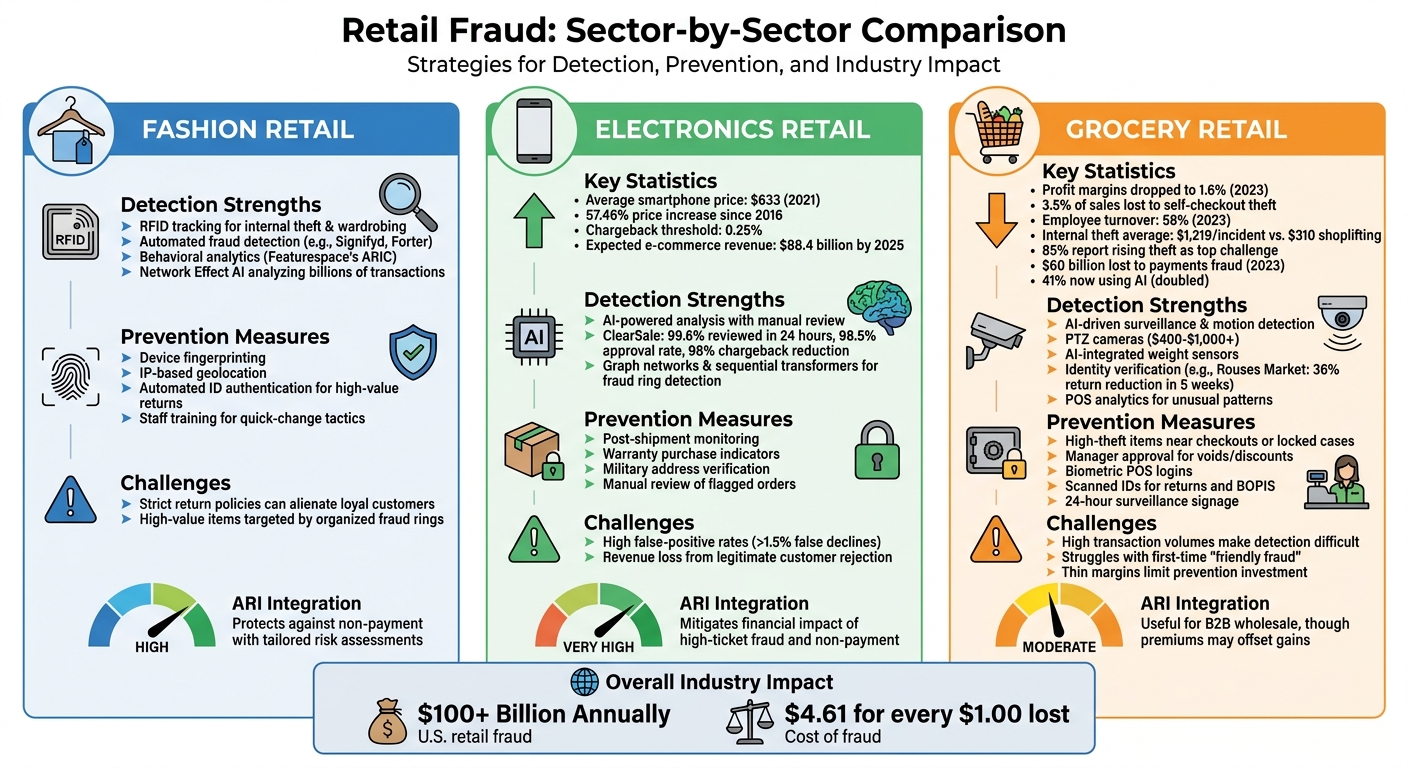
Different retail sectors face distinct challenges when it comes to fraud prevention, requiring customized strategies and tools to address their specific needs. Here’s a closer look at the strengths and limitations within major retail categories:
Fashion retail relies on tools like RFID tracking and biometric systems to combat issues such as wardrobing (returning used items) and internal theft. While these measures are effective, strict return policies can sometimes drive away loyal customers.
Electronics retail benefits from cutting-edge AI technologies like graph networks and sequential transformers, which are highly effective in identifying fraud rings and account takeovers. However, the downside is that these systems can generate a high number of false positives, particularly for expensive items, which might result in lost sales. As Accertify highlights:
"The best ecommerce fraud prevention platform for online retailers in 2026 is one that accurately approves good transactions – not just one that blocks bad ones".
Grocery retail uses AI-driven document verification and Mobile Driver’s Licenses (MDLs) to ensure compliance for age-restricted purchases. But the sector’s high transaction volumes and slim profit margins make it challenging to quickly address fraud without disrupting the checkout process. Any delays, especially in ID verification, could lead to abandoned purchases, which is a significant issue in this industry.
Across all these sectors, ARI plays a key role in securing B2B credit by offering tailored risk assessments and fraud solutions. Below is a summary of how each sector performs in detection, prevention, and ARI integration:
| Sector | Detection Strengths | Prevention Weaknesses | ARI Integration Performance |
|---|---|---|---|
| Fashion | RFID tracking effectively detects internal theft and wardrobing | Strict return policies can alienate loyal customers | High: Protects against non-payment with tailored risk assessments |
| Electronics | AI video analytics, graph networks, and sequential transformers excel at detecting fraud rings | High false-positive rates on expensive items can lead to revenue loss | Very High: Mitigates the financial impact of high-ticket fraud and non-payment |
| Grocery | AI document verification ensures compliance for age-restricted goods | Struggles to stop first-time "friendly fraud" amid high transaction volumes | Moderate: Useful for B2B wholesale, though premiums may offset gains due to thin margins |
Finding the right balance between fraud detection and customer experience is critical for effective fraud prevention in retail.
Conclusion
Preventing retail fraud requires tailored approaches depending on the sector. In fashion, tools like RFID tracking and advanced data analytics are essential for addressing internal theft. Electronics retailers depend heavily on AI-driven systems to detect schemes such as empty-box returns or account takeovers involving high-value items. Meanwhile, grocery retailers face challenges tied to the blending of physical and digital operations, such as gift card fraud and customer-assisted scams targeting high-volume products.
What ties these sectors together is the importance of maintaining lifecycle signal coherence – linking data from account creation to purchases and post-transaction behaviors to spot suspicious patterns. A combination of detection methods, including rules engines, machine learning, and graph networks, is key to addressing various fraud schemes. However, even with robust detection, financial protection remains vital.
Detection systems help mitigate risks, but they can’t eliminate them entirely. For U.S. merchants, the cost of fraud averages $4.61 for every $1.00 lost, showing how deeply fraud impacts profitability. This is where Accounts Receivable Insurance becomes crucial, offering financial protection that helps stabilize B2B retail operations.
To navigate these challenges, retailers must strike a balance between effective detection and financial safeguards. Those achieving sustainable growth treat fraud prevention as a strategic priority. By leveraging sector-specific solutions, adopting collaborative frameworks like the NRF Fraud Taxonomy, and securing their receivables with financial protection, retailers can safeguard their profits while delivering the seamless customer experiences that foster loyalty and revenue growth.
FAQs
What are the biggest fraud risks in my retail category?
Fraud risks in retail can vary depending on the specific sector, but there are a few common threats that most businesses face. These include payment fraud, account takeovers, return fraud, and organized retail crime. For instance, eCommerce businesses often deal with card-not-present (CNP) fraud, which can be particularly challenging. On the other hand, industries like fashion and electronics frequently encounter issues like theft and diversion schemes. To tackle these ever-changing threats, retailers need to adopt focused strategies and leverage modern tools to safeguard both their revenue and their customers’ trust.
How do I cut fraud without increasing false declines?
To tackle fraud effectively without mistakenly rejecting legitimate transactions, it’s crucial to use advanced, multi-layered detection methods. These strategies focus on accurately identifying fraudulent activity while ensuring genuine transactions go through smoothly.
AI-powered tools play a key role here, analyzing patterns and spotting anomalies to automate detection with minimal mistakes. By combining approaches – like rules-based systems and machine learning models – you can achieve better accuracy. Real-time decision-making ensures quick approvals for honest customers, while ongoing staff training and regularly updated detection models help stay ahead of new fraud tactics.
When does Accounts Receivable Insurance (ARI) make sense for retailers?
Accounts Receivable Insurance (ARI) offers retailers a way to protect themselves from financial risks such as non-payment, customer bankruptcy, or even political disruptions. This type of coverage is particularly helpful for businesses that operate across both domestic and international markets, as it helps minimize potential losses and ensures a more stable financial footing.