

Managing international trade claims doesn’t have to be a headache. A U.S.-based trade company handling over 400 claims annually transformed its outdated system into a cloud-based platform, cutting claim processing times from two years to mere hours. The switch eliminated manual inefficiencies, improved accuracy, and saved millions in costs. Key upgrades included automated workflows, real-time data integration, and compliance tools for global trade regulations.
Key Takeaways:
- Problem: Manual processes and outdated tools caused delays, missed deadlines, and inefficiencies.
- Solution: A cloud-based claims system integrated with Accounts Receivable Insurance (ARI) streamlined operations.
- Results: Claims processing improved by 90%, manual workload reduced by 50%, and costs dropped by 30-40%.
This case study highlights how modernizing systems can simplify claims management and improve financial outcomes in international trade.
Problems Before the Cloud System
Manual and Paper-Based Processes
Managing over 400 claims annually using Excel and Access created significant hurdles. The consultant in charge had to sift through endless rows of data, with no visual indicators to highlight urgent tasks. Each claim required monitoring key dates – file submissions, deliveries, reviews, and updates – but the manual system lacked the structure to handle this effectively.
Adding to the chaos, invoices, manifests, and emails were scattered across various locations. Staff often spent excessive time hunting for information to verify claim details or respond to customer inquiries. These inefficiencies not only slowed down operations but also highlighted broader issues with connectivity.
Disconnected Data Across Global Markets
The outdated Microsoft Access database ran on a local network, making remote collaboration nearly impossible – an obvious problem for global operations. Logistics providers in different countries couldn’t access claim details online, and expanding the user base meant manually adding people to the system, which severely restricted growth.
This lack of integration created barriers when dealing with claims tied to non-payment, bankruptcies, or political risks. For instance, if a foreign buyer defaulted or political unrest delayed shipments, there was no centralized way to cross-check claim details and supporting evidence. On top of that, the 25-year-old system posed serious security risks while maintenance costs continued to climb. The fragmented data flow also made compliance and risk management incredibly challenging, further emphasizing the need for a unified, cloud-based platform.
Compliance and Risk Assessment Difficulties
Navigating U.S. export regulations without real-time tools was a monumental task. Many companies missed out on substantial duty drawback refunds because manual systems couldn’t efficiently manage the process. Take the example of the 3D printing company, UltiMaker, in November 2025. Before switching to a cloud-based AI platform, they avoided pursuing refunds altogether because manually matching import-export data was simply too overwhelming.
"With typical providers, whoever is filing for you takes a cut of the refund even though you ended up doing 95% of the work", said James Franz, President of the Americas at UltiMaker.
Manual processes also made it hard to maintain audit-ready compliance. Errors in data entry for accruals and charge codes often led to financial discrepancies that could raise red flags during regulatory reviews. Once claims were submitted to U.S. Customs, companies had no way to track their status, leaving them unaware of potential refunds worth hundreds of thousands of dollars. These operational struggles made the need for change clear, paving the way for ARI’s cloud-based solution.
sbb-itb-2d170b0
How the Cloud-Based Claims System Was Implemented
Choosing and Customizing the System
The company adopted a cloud-based platform designed to eliminate manual inefficiencies. This system included automated feeds from government sources to keep HS codes, duty rates, and trade regulations updated for over 190 countries. It also featured a Trade Lane Analyzer, which allowed staff to assess import/export controls, country-of-origin rules, and required documentation. Other key functionalities included automated restricted party screening to verify suppliers, trading partners, and shipment locations against government watchlists, as well as export license validation to ensure proper approvals. These features addressed prior issues that had caused nearly 5% of global sales transactions to be canceled.
"Compliance becomes more strategic when you connect it directly to your supply chain processes. Once trade compliance is integrated, supply chain transactions are made cleaner and more compliant."
- Heidi Benko, Vice President of Product Solutions Strategy and Marketing at GT Nexus
This customized setup provided the groundwork for seamless integration with ARI’s claims management services.
Integration with ARI’s Services
The integration of ARI’s claims management services with the new cloud system created a unified platform. A phased rollout, completed in just nine months with Accenture, significantly outpaced the typical 12-month industry timeline. The system introduced straight-through processing for routine claims, automating 20% of the total claims volume without manual involvement. Additionally, digital First Notice of Loss (FNOL) channels were implemented, accounting for 40% of claims declarations. Automated workflows streamlined the process further, confirming 90% of coverage and intervention cases within four hours, with 40% of those confirmations issued instantly.
Data Migration and API Connections
After integration, technical migration and API connections ensured real-time data flow and adaptability. Historical claims data from the outdated Access database was successfully migrated, and over 100 APIs were established to link ARI’s global network of carriers, customs systems, and trading partners. These APIs facilitated real-time retrieval of duty rates, export license validation, and automatic population of trade data on invoices and documents. The migration process included rigorous validation steps, with trade content from government agencies continuously reviewed and updated by subject matter experts in over 100 countries. The cloud-based architecture allowed the company to provision new computing environments in minutes, enabling rapid scalability to handle fluctuating claim volumes.
"By having trade content integrated into an export management system, export departments would have visibility well in advance of a license requirement."
- Kevin Shoemaker, Vice President of Global Solutions at Integration Point
Results After Implementing the Cloud Claims System
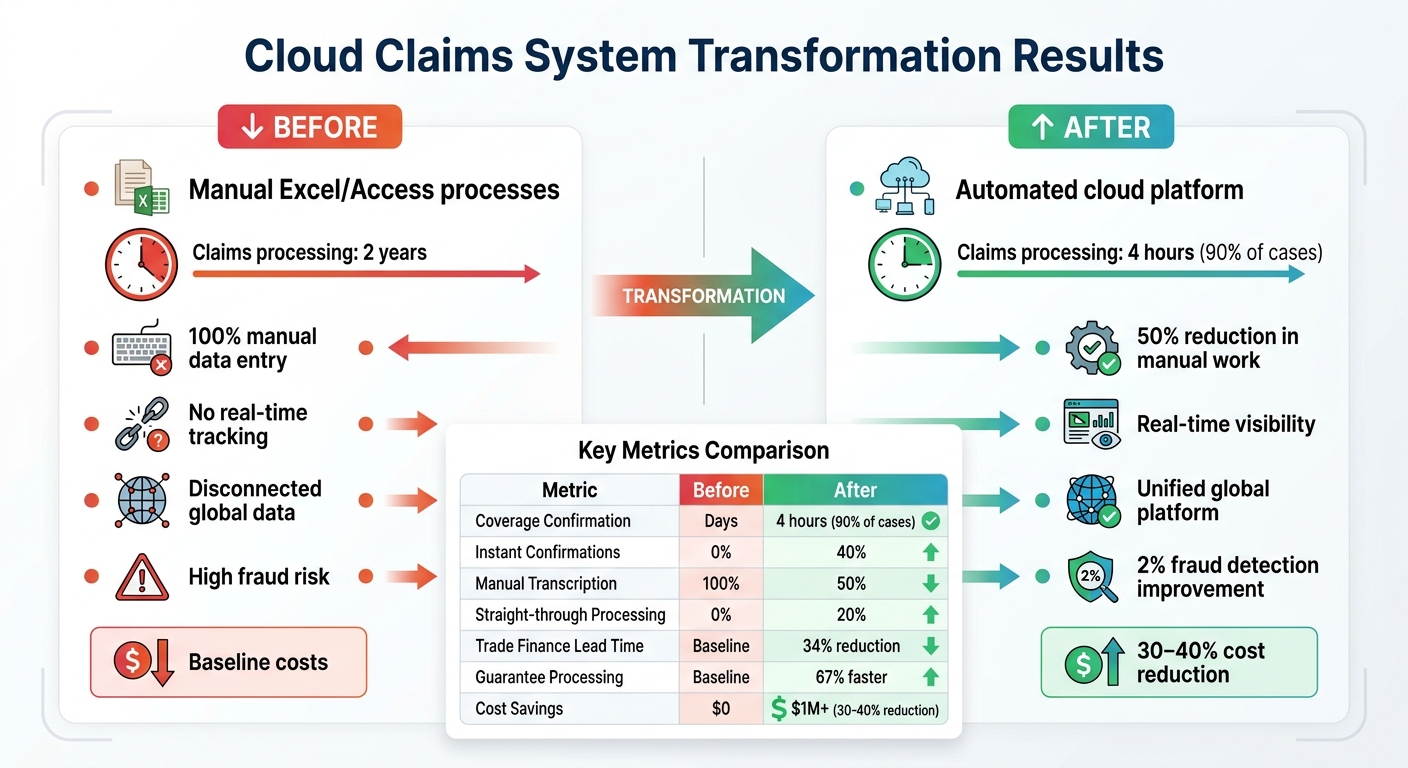
Cloud Claims System Results: Before vs After Implementation
Improvements in Operations
After rolling out the cloud system, the company experienced measurable gains that showcased the power of digital transformation. One of the standout changes was in international claims processing, where efficiency skyrocketed. Here’s the proof: 90% of coverage and insurer intervention cases were confirmed within just four hours, with 40% of those confirmed instantly. The system also streamlined operations by enabling straight-through processing for 20% of claims. This freed up staff to tackle more complex and high-value cases instead of spending time on routine data entry.
Fraud detection saw a modest but meaningful 2% improvement, while automated data extraction cut manual transcription tasks in half, reducing the workload by 50%.
"The production time of at least 50% was saved by using Astera as it took out manual work from the process."
- Susan Park, Operations Manager at Aclaimant
These operational upgrades not only saved time but also led to significant cost reductions and better overall financial performance.
Financial Benefits
The financial impact of the cloud system was equally impressive. Trade finance lead times dropped by 34%, and the speed of applying for bank guarantees jumped by 67%.
"We’ve achieved savings in the seven-figure range, reducing costs by about 30 to 40%. That’s a million dollars that we’ve saved so far, simply because of competitive quotes."
- Josef Huber, Team Lead of Group Treasury at Brückner Group
| Financial Metric | Before Implementation | After Implementation |
|---|---|---|
| Trade Finance Lead Time | Baseline | 34% reduction |
| Guarantee Processing Speed | Baseline | 67% faster |
| Manual Transcription Costs | Full manual entry | 50% reduction |
| Fraud Detection Rate | Baseline | 2% improvement |
| Recovery Rate | Baseline | 2% improvement |
These cost savings not only improved the bottom line but also created a ripple effect, enhancing customer and stakeholder satisfaction.
Better Customer and Stakeholder Experience
The adoption of digital channels completely transformed how customers and stakeholders engaged with the claims process. The centralized platform provided real-time visibility into critical details like coverage limits, deductibles, and claim progress. This transparency made the entire process smoother and more predictable for everyone involved.
Faster claim resolutions also strengthened relationships with trading partners and insurers.
"Their reliable systems let us focus on expanding our products and services and building our reputation as one of the most responsive property and casualty insurers in Canada."
- John Mitchell, President and CEO of Portage Mutual Insurance
Lessons Learned and Recommendations
Best Practices for Adopting Cloud Systems
A phased approach is essential for successful cloud migrations. Take AXA Belgium‘s September 2022 migration to Amazon Web Services as an example. By partnering with Accenture and following a structured roadmap, they completed their Guidewire ClaimCenter implementation in just nine months – three months ahead of schedule.
Start by creating a single source of truth for claim data. Consolidating all information into one environment ensures that everyone – from underwriters to trading partners – works with the same data, reducing inconsistencies. An API-first strategy is equally important. For instance, AXA Belgium’s API-first approach significantly cut registration and settlement times.
Automating high-volume tasks is another key step. Manual errors can cost $50–$150 each, and poor data quality costs businesses an average of $15 million annually. Clearly defining project roles and response protocols can also help manage data inconsistencies and missing information effectively.
For international trade, focus on pre-claim interventions using real-time monitoring tools. Cloud-based analytics can identify potential losses before claims are even filed. Additionally, collaborate with providers like Accounts Receivable Insurance to access export insurance policies tailored to complex B2B pricing and multi-stakeholder requirements. Lastly, ensure compliance with global standards like GDPR, ISO 27001, and PCI DSS to manage risks in international markets.
Planning for Growth and Future Needs
Planning for scalable growth ensures your cloud system stays adaptable to changing demands. Cloud platforms make it easy to scale up, letting you create new computing environments in minutes. Designing systems with APIs from the outset allows seamless integration with future tools and partners, avoiding costly rewrites.
"Cloud computing removes the infrastructure barrier that once separated well-funded companies from lean startups."
- Hanna Milovidova, Author, Ein-des-ein
Set up automatic scaling thresholds to manage unexpected traffic without manual effort. Regularly track cloud usage metrics and document data flows early, simplifying future integrations. Balancing global standards with local regulations is also crucial for adapting to specific market conditions while maintaining core capabilities.
In 2023, over 83% of companies relied on custom software to meet specific operational needs. Custom solutions can eliminate recurring licensing fees and unnecessary features, offering better long-term ROI for businesses with complex workflows, especially in international trade.
Advice for U.S.-Based Exporters
U.S.-based exporters face unique hurdles in international trade, including payment risks, currency fluctuations, and regulatory challenges. To address these, start with a pilot project to validate effectiveness and control costs. Using real-time monitoring and automation – like the strategies highlighted earlier – can help manage risks more efficiently.
When expanding globally, consider working with Accounts Receivable Insurance for customized coverage solutions. Their policies address risks such as buyer insolvency and political instability while providing real-time visibility into coverage limits, deductibles, and claim progress. This transparency builds trust with international partners.
Automating repetitive tasks like compliance reporting and data entry frees your export team to focus on strategic initiatives. Additionally, using middleware or an Integration Platform as a Service (iPaaS) prevents "spaghetti architecture", simplifying the process of adding new global partners.
"Asia is the world’s largest and fastest growing economic region, with more than 50% of global GDP and a growth rate through 2030 that will exceed 4% per year."
Cloud platforms also allow for rapid global deployment, giving U.S. exporters the agility to respond swiftly in fast-changing international markets. This ability to adapt quickly can be a game-changer in maintaining a competitive edge.
Conclusion
Switching to a cloud-based claims platform has transformed the way international trade risk is managed. Previously, businesses grappled with outdated systems and manual workflows that led to delays and increased financial exposure. These challenges created inefficiencies that slowed operations and amplified risks.
By adopting a structured, step-by-step approach to implementation, companies have seen tangible improvements. Centralizing data on unified platforms, using APIs for real-time connections, and automating repetitive tasks have significantly streamlined operations. These changes slashed manual data entry efforts, reducing time and resource waste by 50%.
The results are impressive. Businesses reported cost reductions of 30% to 40% in trade finance operations and processed bank guarantee applications 67% faster. Fraud detection capabilities improved sixfold, while 20% of claims now move through straight-through processing without human input. Moreover, 90% of coverage cases are resolved within four hours. These metrics highlight how digital transformation is revolutionizing global trade.
For U.S.-based exporters, Accounts Receivable Insurance offers essential protection when navigating international markets. Their tailored policies safeguard against risks like buyer insolvency, political instability, and payment defaults. These policies integrate seamlessly with modern cloud platforms, providing real-time insights into coverage limits, deductibles, and claim statuses – ensuring transparency and strengthening trust with global partners.
"We’ve achieved savings in the seven-figure range, reducing costs by about 30 to 40%. That’s a million dollars that we’ve saved so far." – Josef Huber, Team Lead of Group Treasury at Brückner Group
Cloud-based claims platforms are paving the way for scalable, transparent systems that protect revenue while fostering trust in international trade.
FAQs
What should I automate first in a trade claims process?
Start by focusing on automating the claims registration and initial verification processes. These stages typically require extensive manual data entry and checks, which can be simplified with automated systems. Streamlining these steps not only saves time but also minimizes errors, making the entire process faster and more efficient.
How do APIs speed up international claims handling?
APIs speed up the handling of international claims by streamlining workflows, facilitating real-time data exchange, and integrating systems effortlessly. These capabilities help cut down processing times and improve efficiency across the board.
What compliance features should a cloud claims system include?
A cloud-based claims system must prioritize compliance by integrating tools that adhere to international trade regulations, oversee export and import activities, and enforce restrictions on dealings with embargoed countries. Additionally, it should ensure alignment with global trade policies. These capabilities enable businesses to operate within legal boundaries while navigating the complexities of international markets.