
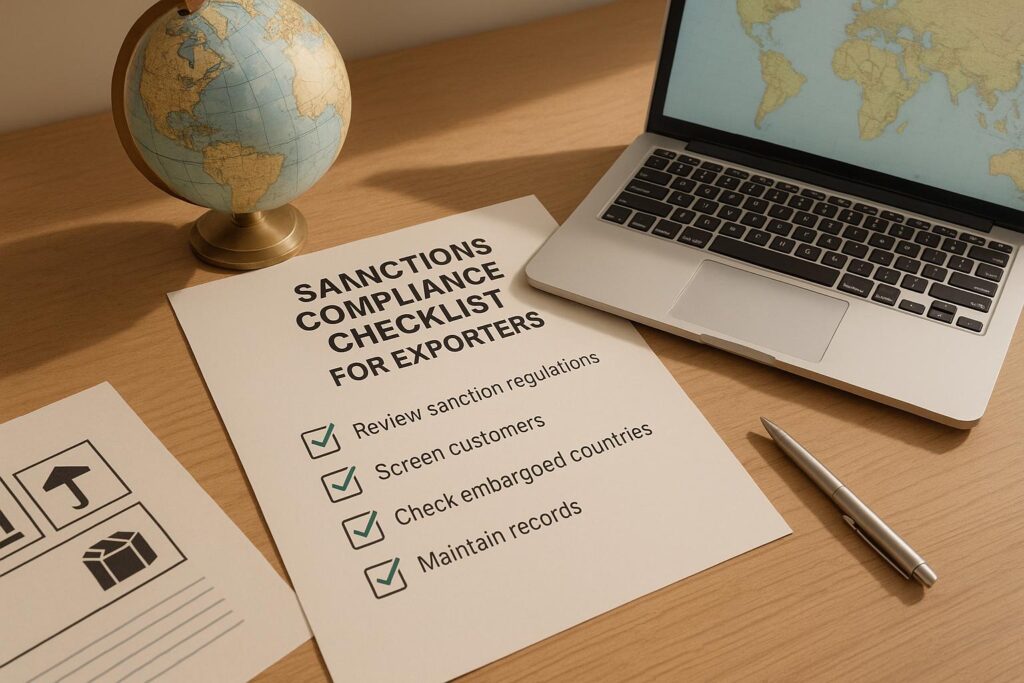
Exporting goods comes with serious risks if you’re not following U.S. sanctions laws. Mistakes – like shipping to a sanctioned party or restricted country – can lead to heavy fines, export bans, and damage to your reputation.
Here’s what you need to know to stay compliant:
- Screen Everyone: Check customers, owners, banks, and intermediaries against updated sanctions lists.
- Know the Rules: Understand product classifications (EAR/ITAR), country restrictions, and sector-specific rules.
- Document Everything: Keep records of screenings, decisions, and compliance steps for at least five years.
- Train Your Team: Make sure sales, logistics, and finance teams know how to spot red flags.
- Use Tools: Automate screening and monitoring to catch changes in sanctions status.
Following these steps can help you avoid penalties and keep your business running smoothly.
Export Compliance Essentials Webinar [2025]
Governance, Policies, and Risk Assessment
Establishing strong compliance starts with clear governance. This means defining roles, documenting policies, and implementing a systematic approach to assess risks. Without these foundational elements, even the most advanced screening tools and procedures can falter under regulatory or audit scrutiny.
Assigning Compliance Responsibilities
The first step is to appoint a dedicated compliance leader, such as a Chief Compliance Officer or Export/Trade Compliance Officer. This individual should be tasked with designing and enforcing controls, monitoring sanctions lists, and conducting detailed risk reviews. To avoid conflicts of interest, they must operate independently from sales targets and have direct access to senior leadership or the board.
Support from the top is critical. Document board-level or senior management oversight through resolutions or charters that highlight their commitment to a risk-based sanctions compliance program. Form a cross-functional compliance committee that includes representatives from compliance, legal, sales, logistics, finance, and IT. This group should regularly review sanctions updates, risk assessments, and any remediation plans.
Front-line teams play a crucial role as well. They must gather detailed customer and ownership data, verify export classifications, review shipping routes, and screen banks and payment terms. To keep everyone aligned, create a responsibility matrix (like a RACI chart) that clearly defines who is responsible, accountable, consulted, and informed for key tasks such as onboarding counterparties, screening, escalation, blocking shipments, and reporting potential violations. Regular training and annual attestations ensure that staff understand and embrace their roles. Separating commercial and control functions further reduces the risk of conflicts that could undermine compliance. These role assignments lay the groundwork for the detailed policies discussed in the next section.
Writing and Updating Compliance Policies
Start your compliance policies with a clear commitment statement referencing relevant U.S. regulations, such as OFAC sanctions and BIS Export Administration Regulations, as well as any other applicable jurisdictions. Your core policy should clearly outline prohibited activities – like engaging with Specially Designated Nationals (SDNs), exporting to embargoed territories, or handling unlicensed controlled items – and detail mandatory steps for screening customers, beneficial owners, banks, and vessels.
For high-risk sectors and regions, include tailored annexes. For instance, industries like energy, defense, technology, or dual-use goods may require additional approvals or enhanced due diligence. Similarly, outline specific procedures for comprehensively sanctioned or high-risk jurisdictions. Incorporate red-flag indicators – such as unusual routing, refusal to disclose ownership details, or the involvement of suspicious intermediaries – and ensure there are clear escalation protocols, including "stop-ship" procedures, for unresolved red flags.
Your policies should also address documentation standards, record retention, training requirements, internal reporting processes, and consequences for non-compliance. Make it clear that violations will be taken seriously, regardless of their impact on sales. Conduct formal reviews of your policies at least once a year to ensure they align with the latest OFAC and BIS regulations and reflect any changes in your business activities. Updates should also occur whenever there are regulatory changes, such as new OFAC programs, updates to the SDN or Sectoral Sanctions Identification Lists, or significant BIS rule adjustments.
Business changes, such as entering new markets, introducing new product lines, acquiring new customers, or shifting to a distributor or online model, should trigger off-cycle policy reviews. Maintain a documented change-control process that includes version control, senior management or compliance committee approval, communication to staff, and updates to related procedures, forms, and IT systems. With these policies in place, a robust risk assessment process ensures they are applied effectively.
Conducting Regular Risk Assessments
A risk-based approach is essential for identifying, evaluating, and scoring potential vulnerabilities. Your risk assessment should take into account geography, product type, industry sector, and customer profile, providing a comprehensive understanding of where your risks lie.
A geographic risk assessment involves categorizing countries and regions based on factors like U.S. embargoes, targeted programs, exposure to secondary sanctions, corruption indices, and proximity to sanctioned territories. Product and technology risk assessments should determine whether items fall under the Export Administration Regulations (EAR), identify their Export Control Classification Numbers (ECCNs), assess potential dual-use applications, and evaluate their sensitivity for military or surveillance use.
Sector-specific assessments should focus on industries frequently targeted by sanctions, such as energy, defense, aviation, maritime, and high-tech sectors. Similarly, customer and counterparty risk assessments must consider ownership and control structures, links to sanctioned jurisdictions, the use of intermediaries, and any adverse media or enforcement history.
The results of these assessments should be documented in a risk register that assigns scores (low, medium, or high) and maps risks to corresponding control measures, such as enhanced screening, additional approvals, or due diligence. Review this register annually or whenever there are significant regulatory or business changes. High-risk countries, sectors, and customer types should be integrated into your screening systems with rules that reflect their risk level – such as stricter matching thresholds, mandatory enhanced due diligence, or senior-level approval for onboarding or shipping.
Prioritize re-screening based on risk and document all decisions, especially overrides, approvals of borderline cases, and blocked or rejected transactions. Clear documentation provides essential support during audits.
To mitigate financial losses from non-paying or sanctioned parties, consider Accounts Receivable Insurance. This specialized insurance protects against non-payment due to bankruptcy, slow payment, or political risks, including sanctions or trade restrictions that may hinder payment. It allows you to manage credit terms confidently while maintaining strict compliance standards. These risk assessments provide the foundation for the screening and due diligence procedures discussed in the next section.
Screening Counterparties and Verifying Ownership
When it comes to export transactions, screening every party involved is not just a recommendation – it’s an absolute necessity. This process helps ensure compliance with regulations and prevents violations. It’s not enough to check your direct customer; you must also verify end users, consignees, freight forwarders, brokers, and even the banks handling payments. Each of these parties needs to be compared against U.S. and international sanctions lists before moving forward with a transaction. This step forms the backbone of the more in-depth due diligence discussed later.
Collecting and Screening Counterparty Information
The first step in this process is gathering complete and accurate information about every counterparty. This includes legal names, addresses, countries of operation, registration or tax identification numbers, ownership details, and contact information. For individuals, you’ll also need their date and place of birth, as well as their nationality, to distinguish them from others with similar names. For businesses, obtain incorporation documents, corporate structure charts, and details about directors and senior managers to assist in ownership analysis.
Using standardized onboarding questionnaires can streamline this process. These forms should request essential information upfront, supported by documents like registration certificates, shareholder registers, and end-use declarations. Always validate the data you receive through independent sources, such as commercial registries, government databases, or trusted business intelligence tools. Be alert to inconsistencies, such as mismatched names or addresses, or a counterparty’s unwillingness to disclose ownership details – these are red flags that may require deeper investigation, management review, or even rejecting the transaction.
Screen all parties against U.S. sanctions lists as outlined in your risk assessment. Many businesses also check non-U.S. lists, such as those from the EU or UK, especially if their operations span multiple jurisdictions. Since these lists are updated frequently, make sure your screening tools refresh data in real time or at least daily. Automated platforms can simplify this process by consolidating multiple sanctions lists, using fuzzy name matching to identify aliases, and maintaining an audit trail of screening activities. To minimize false positives, configure risk-based thresholds and incorporate additional identifiers like dates of birth or company IDs. Maintain “white lists” for low-risk, recurring customers but rescreen them periodically when lists are updated.
Manual reviews remain critical for potential matches. Compliance teams must carefully compare counterparty data with sanctions lists and document why a match is determined to be valid or not. Regularly testing your screening system – by running it against known Specially Designated Nationals (SDNs), for example – can help ensure its accuracy.
Document every step of your screening process, from the information you collect to the checks you perform and the decisions you make. This documentation is essential for demonstrating a reasonable, risk-based approach during audits or investigations. Experts recommend establishing a written sanctions screening policy that outlines roles, tools, thresholds, escalation procedures, and record retention requirements. Keep detailed logs of each screening event, including timestamps, the sources checked, any hits generated, and how they were resolved, along with supporting documents like ownership charts.
Identifying Beneficial Owners and the 50 Percent Rule
The Office of Foreign Assets Control (OFAC) enforces the 50 Percent Rule, which considers an entity blocked if one or more sanctioned individuals or entities collectively own at least 50% of it – even if the entity isn’t explicitly listed on the SDN List. This means you need to go beyond the surface and trace ownership through multiple layers to identify any sanctioned individuals or entities with significant control. Simply screening your direct customer isn’t enough; you must uncover who ultimately owns and controls them. This step is key to maintaining compliance and managing risk effectively.
Require counterparties to disclose both direct and indirect ownership details, including percentage stakes, and back up their claims with evidence like shareholder registers or incorporation documents. Map out each ownership tier and calculate the total ownership percentages of any sanctioned individuals or entities. Update this analysis when new information becomes available or sanctions lists are revised. If ownership structures involve opaque jurisdictions or trusts, conduct enhanced due diligence using third-party intelligence or consider declining the relationship if ownership cannot be verified.
For example, if cumulative SDN ownership exceeds 50%, you must halt the transaction until you secure the necessary authorization.
Ownership isn’t just about equity percentages. You should also examine governance factors like board representation, voting agreements, management contracts, and veto rights that could give sanctioned parties effective control, even with a minority stake. Regulators are increasingly scrutinizing complex structures designed to hide control, so treat these scenarios as high-risk.
Moody’s advises exporters to "identify all beneficial owners of your customers, counterparties and suppliers" and to include "complex or opaque ownership structures, including offshore holding companies, intermediary companies, and trusts" in their assessments.
Once ownership is confirmed, remain vigilant by regularly re-screening counterparties to account for any changes.
When to Re-Screen Counterparties
Screening isn’t a one-and-done task – it’s an ongoing process to address evolving risks. Counterparties should be re-screened at key moments, such as during onboarding, before shipments or major transactions, when there are significant changes (like new ownership or management), or when external events occur (like new sanctions announcements or updated end-use information). Changes in payment terms or banks should also prompt re-screening.
Set risk-based intervals for re-screening. Higher-risk geographies, sensitive industries, and large-value transactions often require more frequent checks.
Before accepting purchase orders, issuing invoices, or processing payments, run sanctions checks on all banks, payment intermediaries, and payors involved in the transaction. If payment terms change, conduct enhanced due diligence to rule out potential sanctions violations or evasion schemes. To manage financial and political risks, some exporters use Accounts Receivable Insurance. While this insurance can flag high-risk buyers or regions, it doesn’t replace the need for thorough sanctions screening.
Your procedures should clearly define when to re-screen: for new parties, at regular intervals, when authorities update sanctions lists, when ownership or structure changes, or when contracts or credit terms are amended. Train your teams to recognize red flags, such as unusual shipping routes or intermediaries, and to report any reluctance to provide ownership details. Maintain written procedures that outline roles, required data fields, screening frequency, and escalation paths. Log every screening hit, investigation, and decision, including the rationale for clearing false positives or obtaining licenses. Regular audits and staff training on sanctions updates can further strengthen compliance efforts.
Regulatory bodies like the DOJ, OFAC, and BIS often take into account whether a company has a documented, proactive, and well-managed screening and due diligence framework when evaluating enforcement cases.
Product, Destination, and Sector Restrictions
This step builds on the earlier stages of screening and due diligence by ensuring that every transaction complies with U.S. regulations across three critical dimensions: the product, its destination, and the sector involved. Even if your counterparty checks out, errors in product classification, destination, or sector alignment can lead to serious compliance violations.
The U.S. Department of Commerce Bureau of Industry and Security (BIS) enforces export controls through the Export Administration Regulations (EAR), which classify items under the Commerce Control List (CCL). Defense-related items, on the other hand, fall under the International Traffic in Arms Regulations (ITAR) and are listed on the United States Munitions List (USML). To stay compliant, you need to determine which system governs your products, classify them accurately, and cross-check this classification against the destination, the end-user’s industry, and any applicable sectoral sanctions. Proper alignment across these factors can significantly reduce compliance risks.
Classifying Items Under U.S. Export Controls
The first step is to determine whether your item falls under EAR (commercial/dual-use) or ITAR (defense-related) regulations. This distinction is crucial since licensing requirements, prohibited destinations, and penalties differ between the two.
For EAR-governed items, assign the correct Export Control Classification Number (ECCN) from the Commerce Control List. Factors like performance thresholds, encryption levels, material composition, and processing capabilities play a role here. Technologies such as advanced semiconductors, lasers, sensors, and avionics often have specific ECCNs because of their potential dual-use applications in both civilian and military contexts. If you’re unsure, you can request a Commodity Classification Automated Tracking System (CCATS) determination from BIS or consult trade specialists for guidance.
Items not listed on the CCL are typically classified as EAR99, meaning they fall under EAR but generally face fewer restrictions. However, even EAR99 items may require a license depending on the destination, end user, or intended use. For example, basic testing equipment classified as EAR99 might need authorization if shipped to heavily sanctioned countries like Iran.
For defense-related items, consult the USML to determine the applicable category and subcategory. The USML includes items specifically designed or modified for military use, such as weapons systems, military electronics, and components for defense platforms. Certain items designated as "significant military equipment" under ITAR come with additional reporting and licensing requirements.
Map each ECCN or USML category in your product portfolio to high-risk sectors. Items like advanced semiconductors, aerospace components, UAVs, and oil and gas equipment often face heightened scrutiny when exported to destinations such as Russia or China. Similarly, USML categories related to missiles, UAVs, and military electronics carry increased risks when dealing with countries like Iran or Russia. To manage these risks, create internal checklists or automated system rules to flag high-risk product codes.
When high-risk ECCNs or USML categories are flagged, implement enhanced due diligence measures. This could include conducting in-depth ownership checks and obtaining detailed end-use statements. In some cases, consulting sanctions counsel may be necessary to confirm that your product classification, combined with its destination and end-user analysis, complies with all licensing requirements and restrictions.
Matching Sectoral Sanctions to Industries
Once your product classifications are established, tie them to the relevant sectoral sanctions. Unlike comprehensive country sanctions, sectoral sanctions target specific industries, restricting certain activities, technologies, or services within those sectors. These measures aim to exert economic pressure on strategic industries while allowing other types of trade to continue. Understanding not just where your goods are going but also the industry your customer operates in is critical.
U.S. sectoral sanctions often focus on industries like energy, defense, and technology. For instance, sanctions targeting parts of Russia’s financial, energy, and defense sectors limit new debt and equity financing, the provision of certain services, and the export of specific technologies. In the energy sector, restrictions may cover activities like upstream oil exploration, deepwater drilling, Arctic projects, or shale development – even if the exported technology isn’t globally banned. If your customer is involved in these areas, you’ll need to determine whether your product or service falls under the restrictions.
The defense sector is another key focus area. Sanctions increasingly target entities linked to missile or UAV development. Even dual-use components such as navigation systems, specialized materials, or avionics – typically classified as EAR99 – can be restricted if they’re part of these supply chains. Non-financial companies, including manufacturers, exporters, energy firms, and logistics providers, are under growing pressure to meet global sanctions compliance standards.
To manage these complexities, maintain an internal matrix that links your product lines and customer industries to specific sectoral sanctions provisions. High-risk combinations, such as energy equipment destined for Russia or UAV components headed to Iran, should automatically trigger legal reviews or blocking protocols.
Sectoral sanctions often extend beyond physical goods to include related services, technical support, and financing tied to restricted sectors. This could involve activities like providing installation, maintenance, or training services for sanctioned energy or defense projects; offering software updates or cloud-based support for controlled technology; or facilitating logistics and shipping for sanctioned goods. For example, sanctions targeting Iranian oil and Russian energy emphasize "facilitation" and "deceptive shipping practices", making services like voyage planning or document preparation for shadow fleet tankers sanctionable – even if no U.S.-origin goods are involved.
Your compliance checklist should explicitly address whether your company is providing technical data, remote support, or sector-specific services to high-risk industries. If so, determine whether these activities are allowed, restricted, or prohibited under the relevant sanctions, and thoroughly document your analysis in the transaction file.
Country-Specific Embargoes and Restrictions
In addition to product and sector checks, it’s essential to verify that the destination country adheres to U.S. embargoes. Comprehensive embargoes, such as those against Cuba and Iran, prohibit nearly all exports, services, and dealings by U.S. persons unless a specific exemption or license applies. For transactions involving comprehensively sanctioned jurisdictions, assume the activity is prohibited and work backward to identify any possible exceptions. Check whether the counterparty is located in, organized under the laws of, or owned or controlled by entities from these countries. Even EAR99 items typically require authorization for such destinations.
Partial or targeted sanctions focus on specific regions, sectors, end users, or end uses within a country. For example, sanctions on Russia combine regional embargoes (e.g., Crimea, Donetsk, and Luhansk), sectoral restrictions (energy, finance, defense), and extensive listings on the Specially Designated Nationals (SDN) and Entity Lists. Exporting to Russia requires a detailed review to ensure compliance with all applicable measures, including those tied to specific regions, sectors, or parties.
Other regions, like parts of Ukraine and Belarus, also fall under partial sanctions and require a nuanced evaluation. Incorporate these distinctions into your screening processes. Comprehensive embargoes should trigger an automatic "prohibited unless specifically licensed" rule, while partial sanctions require detailed assessments and documentation.
The OFAC Specially Designated Nationals and Blocked Persons List (SDN) is frequently updated, making real-time compliance monitoring essential. Subscribe to reliable data sources for near real-time updates of sanctions lists and configure your systems to refresh regularly. When updates occur, re-screen all active transactions and counterparties to ensure continued compliance.
End use and end-user type are critical in evaluating product, destination, and sector restrictions. The same product can be allowed or prohibited depending on its intended use and the party using it. U.S. policy increasingly targets military, intelligence, and high-risk security services in countries like Russia, Iran, and China. As such, exports of dual-use items that could contribute to military or missile/UAV programs are subject to heightened scrutiny. Require detailed end-use statements from your customers, including the final product’s description, its intended application, and operational context, to ensure compliance with export control requirements.
sbb-itb-2d170b0
Transaction and Contract Due Diligence
Poorly written contracts or risky payment arrangements can leave your company vulnerable to sanctions violations. To counter this, compliance safeguards need to be woven directly into your commercial agreements and transaction workflows. This step ensures that the screening and risk assessment measures discussed earlier are carried forward into your contracts and payment structures.
Contracts act as your first line of defense. They set clear expectations, distribute risks appropriately, and provide legal options if a counterparty’s actions jeopardize compliance. Payment terms and relationships with banks add another layer of sanctions risk, especially in transactions involving complex routes, intermediaries, or jurisdictions known for evasion activities. Credit terms should be carefully aligned with sanctions exposure, and exporters should consider financial protections to address non-payment risks tied to sanctions-related events.
Adding Sanctions Clauses to Contracts
Every export contract should include four key elements addressing sanctions compliance:
- Representations and Warranties: These require a written certification confirming that no sanctioned party or 50% sanctioned ownership exists within the counterparty, their owners, or their affiliates.
- Covenants and Ongoing Compliance Obligations: Counterparties must agree to comply with all applicable U.S. sanctions and export controls throughout the contract. They should notify you immediately of any changes in sanctions status and allow for periodic updates on ownership, end use, or affiliations.
- Restrictions on Re-Exports, Resales, and Diversion: Contracts must prohibit routing or reselling goods to embargoed countries, sanctioned entities, or for prohibited uses like military applications or missile development. These restrictions should also apply to any sub-buyers, distributors, or intermediaries.
- Remedies and Termination Rights: Include the right to suspend performance, refuse shipment, or terminate the contract without penalty if fulfilling it would violate sanctions. Allocate costs to the counterparty if their misrepresentation or change in status leads to sanctions risks. For instance, if a customer is added to the SDN List after goods are manufactured but before shipment, your contract should allow you to halt delivery and recover costs.
Draft these clauses to reference "all applicable U.S. sanctions and export control laws and regulations" rather than specific programs, ensuring the language remains valid as sanctions evolve. Align your clauses with DOJ and OFAC expectations, and have them reviewed by legal counsel, particularly for high-risk sectors or destinations.
To streamline this process, use standard sanctions templates for agreements like master sales contracts, purchase orders, distributor agreements, and finance documents. Allow deviations only with legal and compliance approval. Configure your systems (e.g., ERP or CRM platforms) to flag or block deals missing approved sanctions clauses or involving high-risk counterparties or geographies. Pre-execution checklists should confirm restricted party screenings, licensing requirements, and compliance sign-offs for higher-risk transactions.
Once contracts are finalized, ensure operations and logistics teams understand how to act on the sanctions terms. For example, if a counterparty’s screening status changes, shipments should be paused for review. Regular training, internal audits, and clear escalation procedures for red flags can help ensure these clauses are enforced effectively.
Checking Payment Terms and Banks
Contracts alone are not enough. Payment terms must also be scrutinized to address sanctions risks. Your agreements should include sanctions compliance conditions, requiring payments to be processed only through banks and channels that are not subject to blocking or sectoral sanctions. Payments should not involve sanctioned parties or entities 50% owned by sanctioned individuals. Contracts should also allow you to reject or reroute payments if the designated bank becomes sanctioned and to suspend performance until a compliant alternative is arranged.
Screen all banks and their parent organizations against sanctions lists, and account for sectoral or country-specific restrictions that could affect financial services. For instance, Russia’s financial sector faces substantial restrictions impacting certain banks and their subsidiaries. Transactions involving indirect payments, unrelated entities, or complex banking chains often require additional documentation and scrutiny.
For high-risk industries like energy logistics or defense, work with reputable international banks known for strong compliance programs. Avoid currencies tied to sanctions, such as specific Russian ruble transactions, and steer clear of offshore payment centers and financial institutions located in high-risk jurisdictions.
USD payments, which typically clear through U.S. banks, fall under OFAC jurisdiction and must be carefully screened. For example, a misrouted letter of credit could trigger a sanctions violation.
Establish written procedures to review payment terms for high-risk transactions. These should include compliance checks for currency, payment methods (e.g., wire transfers, letters of credit), and routing. Document all details, including the payer, intermediary banks, and final beneficiary banks, and flag unusual payment routes for further review. Letters of credit should pass sanctions screening, and their terms should align with contractual sanctions language, including the right to refuse payment or shipment if risks arise. Keep detailed records of all reviews, including dates, reviewers, and outcomes, to demonstrate consistent compliance efforts.
Managing Credit Terms and Payment Risks
Extending credit to counterparties in high-risk jurisdictions or sectors can increase the likelihood of non-payment due to sanctions-related disruptions, such as asset freezes, banking restrictions, or sudden regulatory changes. To mitigate these risks, exporters must adjust credit terms to account for sanctions exposure.
Conduct a sanctions-focused credit risk assessment for each customer, considering their jurisdiction, sector, ownership structure, and payment history. For higher-risk customers, consider requiring advance payment, letters of credit from vetted banks, or shorter payment terms to limit exposure. Document the reasoning behind all credit decisions in your compliance files.
To further protect against non-payment risks, Accounts Receivable Insurance offers tailored solutions for managing trade credit and receivables risks. This type of coverage can shield against non-payment caused by bankruptcy, slow payment, or political issues like sanctions or trade restrictions, giving exporters the confidence to manage credit terms while staying compliant.
Integrate credit and sanctions reviews by requiring compliance approval before extending or renewing credit lines for customers in high-risk areas. Monitor outstanding receivables for any changes in the customer’s sanctions status, and establish clear escalation procedures. If a customer becomes sanctioned while payment is pending, consult legal counsel immediately to determine whether the payment can be accepted or must be blocked.
Monitoring, Controls, and Recordkeeping
Ensuring compliance with sanctions is not a one-time task – it requires constant vigilance. Once you’ve completed screening and due diligence, the next step is to establish systems that maintain compliance and demonstrate your efforts. These safeguards help identify new risks and ensure adherence to regulations.
This section covers how to integrate monitoring into your daily operations, the records you need to keep, and how to address compliance issues when they arise. These practices not only create a reliable audit trail but also provide evidence of due diligence in case regulators scrutinize your transactions.
Using Automated Screening Tools
Relying solely on manual sanctions checks is no longer practical. Sanctions lists are updated frequently, and a customer who was compliant yesterday could be flagged today. Automated tools are essential for embedding sanctions checks throughout your trade lifecycle – from onboarding customers and vendors to shipment releases, invoicing, and collections.
System integration is key. Your screening tools should work seamlessly with systems like ERP, CRM, shipping, and accounts receivable. For example, screening should occur when a prospect is entered into the CRM, before approving an account or extending credit. At the shipping stage, all counterparties – buyers, consignees, end-users, and freight forwarders – should be screened before accepting orders and again before issuing export documents or releasing goods. Controls that block shipments until all hits are cleared and necessary licenses are verified help prevent violations. Similarly, accounts receivable processes should include screening banks, intermediaries, and guarantors, as well as re-screening customers before approving extended payment terms or rescheduling invoices.
Automated tools should update sanction lists in near real-time and handle complexities like fuzzy matching, aliases, and spelling variations. This minimizes missed matches and reduces false positives. Risk-based thresholds can help balance thoroughness with operational efficiency. All alerts and decisions should be logged with time stamps and user IDs to support audits.
Continuous list monitoring is another critical feature. If a party is newly designated on a sanctions list, the system should automatically flag related customers or open invoices. This allows you to halt shipments and place receivables on hold immediately. Automated alerts can also highlight overdue payments from high-risk regions, prompting further review for potential sanctions violations or political risks.
Regular validation and independent testing of your tool’s configuration are essential to demonstrate effectiveness to regulators. This includes testing samples and cross-checking against historical data to ensure the system would have identified past violations. Frequent audits, testing, and management reporting keep monitoring efforts aligned with evolving regulations.
Record Retention Requirements
Detailed recordkeeping is a cornerstone of export compliance. U.S. export control guidelines require retention of documents such as invoices, purchase orders, shipping records, export classifications, licensing records, and screening logs. These records substantiate compliance efforts and create a clear audit trail.
Under the Export Administration Regulations (EAR), most export-related records must be kept for at least five years from the date of export, reexport, or transaction termination. OFAC also expects thorough records, including policies, procedures, and screening logs. Many companies align with the five-year standard but may extend retention to seven years to meet additional regulatory or contractual requirements. Electronic systems should back up and secure records against loss or tampering.
What to retain: Centralized, searchable records should include all screening data (e.g., names, addresses, identifiers), list versions, match details, analyst notes, and decisions (cleared or true hit). Logs should document time stamps, user actions, and any overrides. Records must show that sanctions lists were updated promptly and that periodic re-screening was conducted.
For monitoring alerts – such as blocked payments or unusual routing – retain case files that document investigation steps, legal advice, and decision-making rationale. A governed document management system with access controls, audit logs, and retention schedules helps meet compliance expectations under BIS and OFAC frameworks.
Training, policy, and governance records are equally important. Keep a library of current and historical sanctions policies, procedures, risk assessments, and management reports. Training records should track course content, attendance, completion dates, and targeted audiences to show that employees received role-specific training. Documentation of senior management’s communication on the importance of sanctions compliance can also influence regulatory evaluations. Organizing these materials by year and business unit – and linking them to audits and corrective actions – demonstrates continuous improvement and streamlines regulatory reviews.
Responding to Compliance Issues
When potential violations or blocked payments arise, a swift and well-documented response is critical. Your response plan should align with risk assessments and credit reviews, with clear steps to contain, investigate, and resolve issues.
Immediate actions include placing transaction holds, blocking payments, and conducting an initial review by a trained analyst. Escalation criteria – such as confirmed list matches or high-risk jurisdictions – should trigger further actions. Document every step, preserve related records, and consult applicable OFAC and BIS guidance. Clearly define reporting channels and protect employees through non-retaliation policies. For blocked payments, work with your banks to meet OFAC reporting requirements and update customer risk ratings and credit terms.
Investigation and remediation follow containment. Once an issue is identified, halt affected transactions, secure all relevant data, and assemble an internal team (e.g., compliance, legal, finance). Investigations should gather transaction records, screening logs, system configurations, and employee interviews to identify root causes. Based on findings, implement corrective actions like updating procedures, enhancing controls, retraining staff, or upgrading systems. Document these changes thoroughly, as regulators consider timely remediation and strong compliance programs as mitigating factors.
If a potential violation involves OFAC or EAR, consult legal counsel to evaluate the benefits of a voluntary self-disclosure. Prompt, transparent disclosures can significantly reduce penalties. Regular training and simulation exercises can prepare employees to handle escalation processes under pressure.
Supporting financial risk management: Trade credit and accounts receivable insurance providers, such as Accounts Receivable Insurance, can help manage broader financial risks like non-payment, bankruptcy, and political instability. Their monitoring and claims data can flag counterparties with elevated sanctions risks, prompting additional due diligence or re-screening. These structured records align well with comprehensive sanctions monitoring efforts.
Conclusion
Sanctions compliance requires constant attention to protect your business from legal, financial, and reputational risks. Both U.S. and global enforcement efforts have intensified, with regulators now expecting businesses to adopt proactive, risk-based compliance programs. These programs should include governance, risk assessments, screening, employee training, monitoring, and corrective actions. The stakes are high – non-compliance can lead to severe penalties, export bans, loss of banking relationships, and long-term reputational harm.
Take the case of Luminultra Technologies as a cautionary example. The company was fined $685,051 by the Bureau of Industry and Security for knowingly exporting PhotonMaster luminometers and test kits to Iran. Although these items were classified as EAR99, they still required authorization under § 746.7(e) of the EAR. Internal emails confirmed the violations, which significantly heightened enforcement risks. As part of the settlement, Luminultra must complete an export compliance audit by March 30, 2026, conduct annual audits for three years, provide compliance training for all employees, and face a three-year suspended denial of export privileges. This case highlights that even EAR99 items can require licenses, and internal recognition of violations amplifies enforcement risks.
Main Points for Exporters
Developing a strong sanctions compliance program means going beyond merely "checking boxes." Active vigilance and integration into daily operations are essential. Here are the core elements to prioritize:
- Governance and Accountability: Establish a dedicated compliance team, formalize policies, and assign clear roles for decision-making and escalation. Conduct regular risk assessments to identify high-risk areas like jurisdictions, sectors, and counterparties.
- Screening and Verification: Use automated tools to continuously screen against updated sanctions lists. These tools should integrate with your ERP, CRM, and other systems. Ensure you identify beneficial owners, apply the 50 percent rule, and re-screen when circumstances change.
- Product and Sector Controls: Properly classify items under U.S. export controls, monitor sector-specific sanctions, and stay updated on country-specific embargoes. As demonstrated by the Luminultra case, even items classified as EAR99 may require licenses based on their destination or use.
- Transaction Due Diligence: Incorporate sanctions clauses into agreements, verify payment terms, and carefully manage credit terms – especially when operating in politically unstable markets.
- Monitoring and Recordkeeping: Keep detailed records for at least five years, as required by the Export Administration Regulations (EAR) and the Office of Foreign Assets Control (OFAC). Regularly test your screening systems, conduct internal audits, and train employees to recognize sanctions risks. Address violations by investigating root causes, implementing corrective measures, and documenting the process thoroughly.
Over the past decade, the Office of Foreign Assets Control (OFAC) has issued billions of dollars in civil penalties, with some enforcement actions reaching hundreds of millions for large organizations. Non-financial companies, including manufacturers and logistics providers, are increasingly being held accountable for compliance with global sanctions. The bottom line is clear: sanctions compliance is mandatory, and the cost of failure is too steep to overlook.
Using ARI to Reduce Risk
While operational measures are essential, financial safeguards can provide an additional layer of protection. Even the most robust compliance program cannot eliminate all financial risks. This is where trade credit and accounts receivable insurance (ARI) come in, offering a safety net for risks such as non-payment due to sanctions-related disruptions, buyer insolvency, or political instability.
Accounts Receivable Insurance provides tailored solutions to protect exporters from losses when foreign buyers fail to pay. Whether due to sudden embargoes, currency restrictions, or political conflict, ARI helps mitigate these risks. Their services include customized insurance policies, risk assessments, claims management, and access to a global network of credit insurance carriers. By combining operational compliance with financial risk management, you can strengthen your trade strategy and maintain confidence in international markets.
FAQs
What steps should exporters follow to comply with U.S. sanctions laws?
To align with U.S. sanctions laws, exporters should take several proactive steps to stay compliant and protect their operations:
- Understand the rules: Dive into the specific sanctions and trade restrictions that apply to your industry and target markets. A great starting point is the U.S. Department of the Treasury’s Office of Foreign Assets Control (OFAC) guidelines.
- Screen everyone involved: Carefully vet customers, suppliers, and third parties to ensure they’re not on any restricted or prohibited lists. This due diligence can save you from costly violations down the line.
- Keep detailed records: Document everything – transactions, contracts, and compliance checks. Having a clear paper trail demonstrates your commitment to following the rules.
- Set up internal safeguards: Develop strong compliance policies, train your team on sanctions requirements, and monitor transactions to spot potential red flags early.
To further protect against financial risks like non-payment or political instability, consider trade credit insurance. This option can provide an extra layer of security for businesses navigating both domestic and international markets.
How can automated screening tools improve sanctions compliance for exporters?
Automated screening tools play a key role in improving the efficiency of sanctions compliance programs. These tools use advanced algorithms to quickly match customer and transaction data against the latest sanctions lists, ensuring businesses stay aligned with trade regulations in real-time.
By minimizing manual errors and speeding up the screening process, these tools help reduce risks like fines, penalties, or damage to a company’s reputation. Many of these solutions also offer flexible features that can be tailored to meet the unique needs of a business, making compliance smoother and more dependable for both local and global trade operations.
What key sanctions compliance clauses should exporters include in their contracts?
Exporters need to make sure their contracts include clear sanctions compliance clauses to reduce the risk of legal or financial troubles. These clauses should clearly state that all parties involved must follow the relevant sanctions laws and regulations, such as those enforced by the U.S. Department of the Treasury’s Office of Foreign Assets Control (OFAC).
Contracts should also detail the actions to take if a party violates sanctions, like allowing for the termination of the agreement or the suspension of obligations. Adding a requirement for regular due diligence and screening of counterparties can provide an extra layer of protection against compliance risks. Well-crafted clauses not only protect your business operations but also show your dedication to following regulations.