

Political stability directly impacts trade credit by influencing trust and payment reliability in business transactions. Stable governments and consistent policies create an environment where businesses feel confident offering deferred payment terms. In contrast, political instability – such as civil unrest, sudden sanctions, or government policy changes – can disrupt supply chains, halt payments, and increase the risk of defaults.
Key Takeaways:
- Stable Environments: Encourage smoother payment processes and stronger credit relationships.
- Political Risks: Instability can lead to unpaid invoices, asset losses, and supply chain disruptions.
- Mitigation Strategies:
- Use political risk indices (e.g., Coface ratings) to assess country conditions.
- Diversify trade credit exposure across regions.
- Secure trade credit insurance to protect receivables.
- Monitor political developments regularly and adjust credit terms as needed.
By understanding and addressing political risks, businesses can safeguard cash flow and maintain stability, even in uncertain regions.
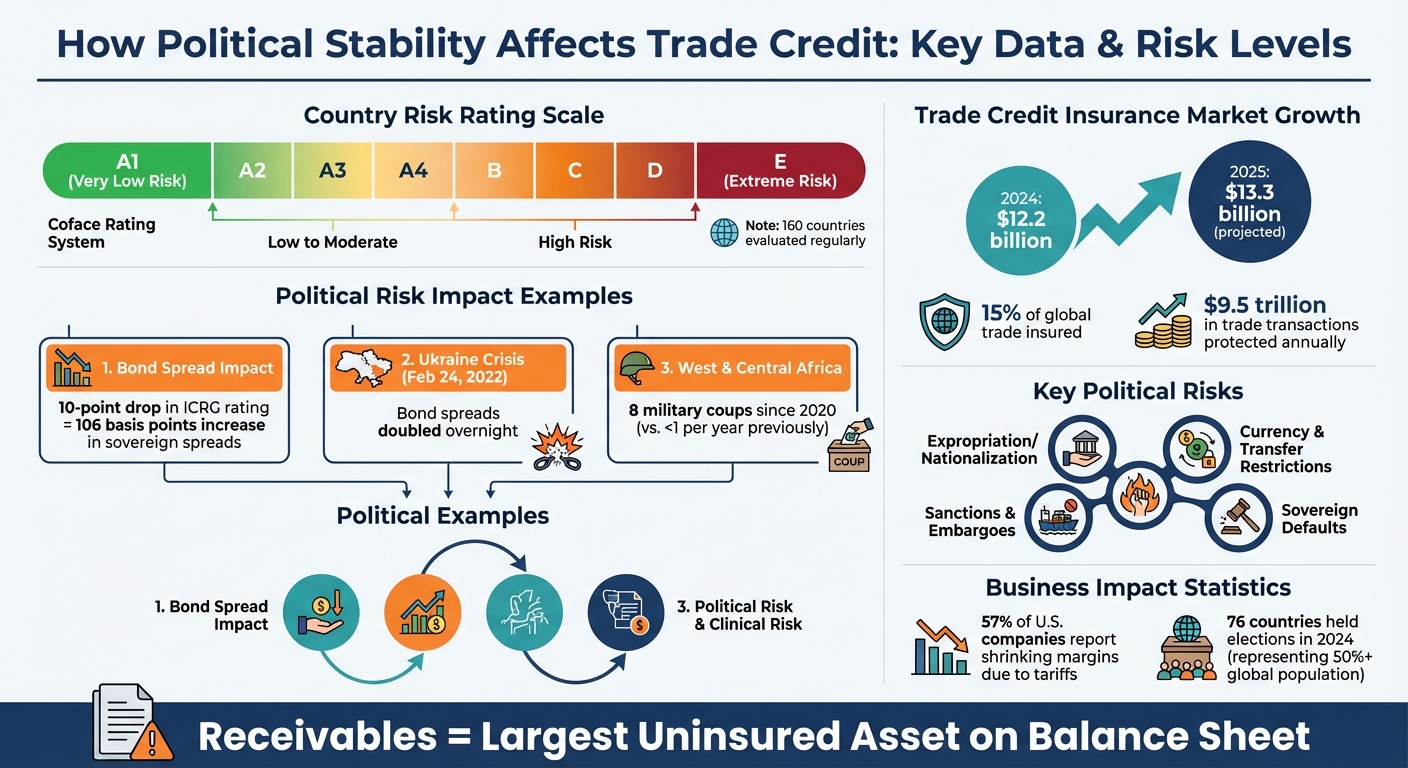
Political Risk Impact on Trade Credit: Key Statistics and Risk Levels
Main Risks to Trade Credit in Politically Unstable Regions
Government Actions and Policy Changes
In politically unstable regions, government actions can severely disrupt trade credit and undermine trust between business partners. For example, new political regimes might resort to expropriation or nationalization, seizing foreign investments or entire industries without offering fair compensation. This leaves businesses facing complete asset losses. Another major concern is the imposition of currency and transfer restrictions, where governments block fund transfers across borders or enforce rigid exchange rate controls. These measures can make it nearly impossible for buyers to meet their payment obligations.
Additionally, sudden fiscal changes, such as rising government debt or unexpected tax increases, heighten the risk of sovereign defaults and corporate bankruptcies. To help companies navigate these risks, agencies like Coface provide country risk ratings, ranging from A1 (Very Low) to E (Extreme), offering a clear picture of potential threats. Beyond these policy shifts, direct conflict within a region creates further instability, making credit repayments even more uncertain.
Political Violence and Civil Unrest
Political violence and unrest directly impact a buyer’s ability to fulfill credit obligations. Events like wars, civil unrest, or terrorist attacks can cause immediate disruptions. For instance, physical destruction of assets halts production, while forced closures during violent periods cut off revenue streams, leaving businesses unable to repay debts. A stark example occurred during the 2017 protests in Ethiopia, where businesses perceived as politically affiliated became specific targets for destruction. Such incidents often lead to prolonged defaults or even insolvency.
The ongoing Ukraine conflict (2024–2025) highlights how sustained geopolitical tensions can put insured assets at risk, creating ripple effects that destabilize trade credit on a global scale. Furthermore, sanctions and currency restrictions introduced in response to conflicts exacerbate these challenges, adding new layers of risk for businesses engaged in cross-border trade.
Sanctions, Embargoes, and Currency Restrictions
Sudden trade barriers, such as sanctions or embargoes, can bring cross-border transactions to an abrupt halt. As Coface explains, "Embargoes and sanctions can be implemented very quickly and without prior notification, literally stopping businesses in their tracks". These measures can instantly render previously profitable contracts unviable.
Currency restrictions are another major threat. Governments may limit or block access to foreign currency, undermining a country’s ability – or willingness – to meet its foreign debt obligations. This often results in unpaid invoices and mounting bad debts. Additionally, global tariffs and trade barriers complicate supply chains, requiring businesses to adopt flexible and informed trade credit strategies. Coface’s 160 regularly updated country evaluations serve as a critical tool for tracking these rapidly shifting risks.
sbb-itb-2d170b0
Cover Talk: Credit and political risk insurance
Assessing Political Stability Before Extending Trade Credit
Navigating credit risk in politically unstable regions requires a balanced approach – one that combines thorough initial evaluations with continuous monitoring.
Using Political Risk Indices and Reports
Before offering trade credit, businesses need dependable tools to measure political stability. For instance, Coface rates 160 countries on a scale from A1 (Very Low) to E (Extreme), with frequent updates reflecting shifting conditions. Similarly, Allianz Trade’s quarterly Country Risk Atlas integrates data on the economy, politics, and business environments. These indices help distinguish between a country’s economic capability to pay and its political willingness to honor obligations, offering critical insights for credit decisions.
"While the global economic outlook has improved… many low-income countries still present less conducive business conditions, while high-income economies are facing prolonged political uncertainty."
- Aylin Somersan Coqui, CEO, Allianz Trade
Real-time indicators like bond spreads also shed light on geopolitical risks. For example, a 10‐point drop in a country’s International Country Risk Guide (ICRG) rating typically raises sovereign spreads by 106 basis points on average. A stark example occurred on February 24, 2022, when Ukraine’s bond spreads doubled overnight as the Russian invasion began, signaling a sharp decline in its payment capacity. While macro-level data is essential, evaluating individual trading partners adds another layer of protection.
Conducting Due Diligence on Trading Partners
Political risks often vary significantly within the same country. Two businesses operating in the same region might face entirely different challenges depending on their industry, products, or political affiliations.
When assessing trading partners, it’s crucial to evaluate their exposure to government intervention, particularly in sensitive sectors like natural resources or telecommunications. Risks such as expropriation or civil unrest should also be considered. Trade credit insurance providers can assist by conducting in-depth research into a partner’s political vulnerabilities before agreements are finalized.
Monitoring Current Political Developments
Even after completing due diligence, staying informed about ongoing political changes is vital. Political landscapes can shift rapidly, and regular updates are essential for proactive risk management. For instance, elections scheduled in 2024 across 76 countries – which collectively represent over half the global population – pose potential risks of policy shifts and protectionist measures. Additionally, since 2020, West and Central Africa have experienced eight military coups, a stark rise compared to the previous decade’s average of less than one per year.
"With political risk, in particular, it’s vital that these details are updated regularly, as situations change rapidly and occurrences in one country can easily cause a knock-on effect to the wider region."
- Chak Leo, Regional VP Communication Asia Pacific, Coface
Effective monitoring involves tracking multiple indicators simultaneously. Keep an eye on bond spreads for sudden changes, follow updates on territorial disputes and trade conflicts, and watch for signs of social unrest, like rising unemployment or growing income inequality. AI-driven tools can also help businesses adapt quickly to evolving sanctions and tariffs. Adjusting credit terms as conditions change – whether by offering more flexible terms to maintain partnerships during uncertain times or tightening restrictions when risks grow – adds another layer of resilience to risk management strategies.
Reducing Political Risks to Protect Trade Credit
After identifying political risks, the next logical step is to put strategies in place to minimize their impact on your receivables. A well-rounded approach that combines diversification, insurance, and proactive management can provide a solid safety net.
Diversifying Trade Credit Portfolios
Spreading your credit exposure across different regions and trading partners helps reduce the risk of any single political event disrupting your cash flow. Start by mapping out both your direct and indirect suppliers to identify areas of concentrated risk. For example, if a large portion of your receivables is tied to a politically unstable region, events like sudden policy changes or a coup could severely affect your finances. By distributing your exposure geographically, you can lessen this kind of vulnerability. Many businesses are also adjusting their supply chains to focus on countries with fewer tariff risks and more stable political climates. Diversification works hand-in-hand with insurance to shield against political disruptions.
Using Trade Credit Insurance
While diversification spreads out your risk, trade credit insurance directly protects your receivables. Products like Accounts Receivable Insurance (ARI) offer tailored coverage against risks such as government expropriation, currency inconvertibility, political violence, and breaches of contract by foreign governments. This coverage can be a financial lifesaver when sudden sanctions or embargoes disrupt trade, even for contracts signed before these restrictions were in place.
The trade credit insurance market is expanding, with projections showing it will grow to $13.3 billion in 2025, up from $12.2 billion in 2024. Currently, about 15% of global trade is insured, safeguarding an estimated $9.5 trillion in trade transactions annually. With volatile tariffs impacting profits, more businesses are turning to trade credit insurance – 57% of surveyed U.S. companies reported shrinking gross margins due to these challenges.
"Typically, receivables – the lifeblood of a company fueling cash flow – are the largest uninsured asset on the balance sheet. Having the insurance greases the wheels of global trade."
- Marc Wagman, Managing Director of Credit and Political Risk, Gallagher
In addition to covering losses, insured receivables are often considered lower-risk collateral by banks, making it easier to secure trade financing. ARI also assists with pre-contract risk assessments, giving businesses the tools to make smarter credit decisions in unpredictable regions. For specific high-stakes deals, businesses can request tailored credit opinions to evaluate the risk of non-payment for individual customers.
Applying Risk Management Practices
Building on your earlier due diligence, it’s essential to adopt adaptable risk management practices. Keep your credit management systems updated and negotiate clear payment terms to reduce liquidity risks. Take advantage of AI-powered tools and tariff simulators to access real-time data, conduct stress tests, and reassess exposures as trade policies evolve. These tools allow businesses to move beyond outdated risk models and respond quickly to market changes.
Prepare contingency plans that outline specific actions for worsening political conditions. This could include tightening credit terms, requiring letters of credit, or halting shipments to high-risk areas. Pre-claim interventions – working with your insurance provider to address payment delays before they escalate – can help maintain customer relationships while safeguarding cash flow. Regularly reviewing your insurance policies ensures that coverage keeps pace with geopolitical shifts and rising insolvency risks. For instance, during the COVID-19 pandemic, government-backed reinsurance programs helped maintain credit limits and kept supply chains running smoothly.
Conclusion: Protecting Trade Credit During Political Uncertainty
Political instability can pose serious financial risks to your receivables. Sudden government changes, civil unrest, or unexpected sanctions can disrupt customer payments in an instant. Businesses that survive and thrive during such upheavals are those that proactively assess political risks before extending credit, rather than reacting after the damage is done.
These challenges highlight that political risk varies greatly by firm and can dramatically shift credit dynamics. Extending credit without safeguards in place can become a high-stakes gamble – one that most businesses cannot afford to take.
This is where Accounts Receivable Insurance becomes a game-changer. It turns unsecured receivables into a protected asset, reinforcing your overall risk management strategy. With the global trade credit insurance market expected to hit $13.3 billion by 2025, more companies are realizing that insurance isn’t just about protection – it’s a strategic advantage. As Mike Seff from Intact Insurance Specialty Solutions aptly states:
"Trade credit management helps you avoid the trap of false confidence in business-as-usual practices".
To navigate political uncertainty effectively, businesses need a multi-pronged approach: evaluate political risks using the latest indices, diversify across regions and partners, and secure tailored insurance coverage to address specific vulnerabilities. Strengthen credit controls, train your team to spot early red flags like currency issues or payment delays, and use modern analytical tools to monitor evolving conditions. Political uncertainty may be unavoidable, but with the right preparation, you can protect your cash flow and maintain stability even in volatile times.
FAQs
What are the earliest red flags that political risk could delay customer payments?
Political risks that can affect customer payments often show up in the form of political instability, government interventions, civil unrest, war, terrorism, or economic challenges like currency restrictions and trade embargoes. These situations can significantly disrupt a country’s financial systems, making it difficult for businesses to collect payments on schedule.
How do I decide when to tighten credit terms versus keep them flexible in a volatile country?
When determining payment terms, it’s important to evaluate the political risk and how it might affect payment reliability. In stable regions, offering more relaxed terms is generally safer. However, in areas experiencing political unrest or government interference, stricter terms can help minimize the risk of non-payment.
Stay informed about political developments and consider protective measures, such as trade credit insurance, to safeguard your cash flow. Striking the right balance between pursuing growth opportunities and managing risks is key, so be ready to adjust terms as circumstances evolve.
What political risks can Accounts Receivable Insurance (ARI) cover for international receivables?
Accounts Receivable Insurance (ARI) offers businesses a safety net against political risks that might prevent international buyers from making payments. These risks can range from government actions and expropriation to civil unrest, war, or even terrorist incidents. By addressing these uncertainties, ARI helps businesses protect their trade credit and maintain financial stability, even in unpredictable or unstable regions.