

Mediation clauses are a key feature in export contracts, providing a structured way to resolve disputes before escalating to arbitration or litigation. They require parties to attempt mediation – a process involving a neutral third party to facilitate discussions – before pursuing legal action. This helps save time, reduce costs, and preserve business relationships.
Key Takeaways:
- Mediation is faster and more affordable than arbitration or litigation. It often resolves disputes within months and costs significantly less.
- Confidentiality is a major benefit, as mediation keeps sensitive business information private.
- Enforceability of mediated agreements is supported by the Singapore Convention, making them easier to uphold internationally.
- Mediation is particularly useful for resolving disputes over delivery terms, payment issues, or contract misunderstandings in international trade.
For exporters, combining mediation clauses with tools like Accounts Receivable Insurance protects against non-payment risks while disputes are being resolved. This dual approach ensures smoother operations and financial security.
Alternative Dispute Resolution For In-House Counsel Writing, Litigating And Resolving Disputes
sbb-itb-2d170b0
1. Mediation
Mediation is often the first step in a multi-layered dispute resolution process, offering a low-cost and quick way to resolve export disputes. It brings together exporters and importers with a neutral facilitator, or mediator, who helps both sides communicate more effectively, clear up misunderstandings, and work toward personalized solutions. Unlike arbitration or litigation, mediation doesn’t impose decisions but encourages collaboration. As the International Trade Council puts it:
"Mediation is a more collaborative and informal process compared to arbitration. A neutral third party, known as the mediator, works with the disputing parties to facilitate communication, clarify misunderstandings, and help them reach a mutually acceptable resolution."
This approach not only resolves disputes but also helps preserve valuable business relationships by focusing on solutions rather than assigning blame.
Cost
One of mediation’s biggest advantages is its affordability. The costs are typically limited to sharing the mediator’s fees and administrative charges, while each party handles its own legal expenses. This makes it an economical choice compared to other resolution methods.
Time
Mediation is also the quickest way to resolve disputes. On average, it takes about four months from filing to resolution, and the actual mediation sessions usually last just one or two days. This efficiency is a stark contrast to litigation, which can stretch on for years due to court delays.
Enforceability
If mediation succeeds, the result is a signed and binding settlement agreement. Thanks to the Singapore Convention on International Settlement Agreements Resulting from Mediation – endorsed by over 50 countries – these agreements can be enforced internationally without the need for additional legal action. Similarly, a 2008 EU Directive ensures that mediated settlements can be recognized as court orders throughout EU Member States.
Confidentiality
Mediation takes place in private, with all discussions, documents, and settlement offers kept confidential. These details are generally inadmissible in any future legal proceedings. This level of privacy safeguards sensitive business information and protects the reputations of both exporters and importers.
These benefits make mediation a highly effective tool for addressing the unique challenges of international trade disputes.
Suitability for Export Disputes
Mediation is particularly well-suited for resolving international trade conflicts. It provides a neutral space that avoids the "home court" advantage, allowing parties to craft solutions that address specific legal and cultural needs. For example, disputes over delivery schedules, payment terms, or other contract details can be resolved with tailored adjustments. Mediation also boasts high success rates, with most disputes settled during the process.
For exporters dealing with payment issues, Accounts Receivable Insurance (https://accountsreceivableinsurance.net) offers an extra layer of protection against non-payment while mediation efforts are underway.
2. Arbitration
When mediation doesn’t resolve a dispute, arbitration steps in as the next structured option. Unlike mediation, which focuses on collaboration, arbitration is more formal and results in a binding decision. It involves a neutral third party – known as the arbitrator – who listens to both sides and makes a final ruling. As international lawyer Daniel Harris warns:
"A bad dispute resolution clause is worse than no clause at all."
For exporters, understanding how arbitration works is essential.
Cost
Arbitration comes with its own set of costs, including fees for the arbitrator’s time and administrative charges from the arbitral institution. These costs differ from those in public court litigation. However, arbitration can save money in other ways. For instance, it often limits the scope of document discovery, avoiding the exhaustive and expensive process common in U.S. litigation, where everything from WhatsApp chats to voicemails might need to be disclosed. While cost and delays are often cited as drawbacks of arbitration, the streamlined discovery process and limited opportunities for appeal can help keep overall expenses lower than traditional litigation.
Time
Arbitration offers a middle ground in terms of timelines – it’s faster than litigation but slower than mediation. The time required varies depending on the institution. For example, cases at the Singapore International Arbitration Centre (SIAC) take a median of 11.7 months, while those at the International Chamber of Commerce (ICC) average 22 months. By comparison, U.S. federal courts take an average of 29.8 months just to reach trial. Interestingly, 72% of arbitrations at the International Centre for Dispute Resolution are resolved before an award is issued, often because parties turn to mediation during the process. These time efficiencies, combined with arbitration’s enforceability, make it an attractive option.
Enforceability
One of arbitration’s strongest advantages is the global enforceability of its awards. Thanks to the 1958 New York Convention, signed by 172 countries, arbitral awards issued in one country can be recognized and enforced in others, such as Brazil, Germany, or the United States, without the need for new litigation. In contrast, court judgments often lack such reciprocal enforcement agreements. Arbitration awards are final and binding, with very limited grounds for appeal. While this ensures a definitive resolution, it also means higher stakes if the decision doesn’t favor one party.
Confidentiality
Arbitration proceedings are private and confidential, unlike court cases, which are typically public. This confidentiality protects sensitive business information, trade secrets, and company reputations from public exposure. For businesses, this privacy is a key advantage when dealing with disputes.
Suitability for Export Disputes
Arbitration is particularly well-suited for resolving international trade disputes. It removes the "home court advantage" by offering a neutral forum, ensuring neither party benefits from local bias. Exporters can also select arbitrators with expertise in their specific industry, rather than relying on generalist judges. Additionally, arbitration provides flexibility: parties can agree on the location, governing law, and even the language of the proceedings. For exporters concerned about cash flow during the arbitration process – which can take 12 to 18 months – Accounts Receivable Insurance (https://accountsreceivableinsurance.net) can provide financial protection against non-payment.
3. Litigation
Litigation, often seen as the traditional way to resolve disputes, involves taking a case to court where a judge or jury delivers the final decision. While it might seem like the default option, litigation presents significant hurdles, especially for export contracts. Issues like international enforcement and high costs make it less appealing compared to other resolution methods.
Cost
Although court filing fees may seem minimal, the overall expenses of litigation can escalate quickly. Lengthy discovery phases, extended procedures, and potential appeals can drive up costs significantly. For instance, in Los Angeles, contract litigation often costs between $12,000 and $15,000, with more complex cases exceeding $50,000. Attorneys in California typically charge anywhere from $150 to $800 per hour, whereas mediation for similar disputes usually costs around $4,000 to $5,000. The discovery process, which involves gathering documents, emails, and other evidence, is much more exhaustive – and expensive – than what arbitration requires.
Time
Litigation timelines can vary widely, but they’re rarely short. In 2019, the median time from filing to resolution in U.S. federal courts was 9.9 months. For cases that went to trial, the median time stretched to 27.7 months. In high-volume commercial courts, it’s even worse: 35 months in the Southern District of New York, 40.6 months in Delaware, and 38.5 months in Washington, D.C.. Appeals can further prolong the process, sometimes adding years to the timeline.
Enforceability
International enforcement of court judgments is another major hurdle. Foreign courts are generally not obligated to recognize or enforce U.S. judgments unless a reciprocal enforcement agreement exists. As international lawyer Daniel Harris puts it:
"Court judgments can be difficult to enforce internationally unless there is a reciprocal enforcement agreement between the countries involved."
The Hague Convention on the Recognition and Enforcement of Foreign Judgments in Civil or Commercial Matters, set to take effect on July 1, 2025, may improve enforceability in some jurisdictions. However, arbitration still tends to offer fewer challenges in this area.
Confidentiality
One of the biggest drawbacks of litigation is its lack of confidentiality. Court proceedings are public, which means sensitive commercial information, trade secrets, or even reputational risks could be exposed. For businesses, this transparency can be damaging, especially in competitive industries.
Suitability for Export Disputes
Considering the high costs, lengthy timelines, and enforcement challenges, litigation is often the least practical option for resolving international export disputes. The "home court advantage" can create bias when one party litigates in their local jurisdiction. In some cases, parties may deliberately choose litigation to make the process as costly and drawn-out as possible, effectively discouraging the other side from pursuing claims.
That said, there are exceptions. For example, in intellectual property disputes in countries like China, local courts may provide more effective enforcement. For exporters dealing with prolonged litigation, Accounts Receivable Insurance (https://accountsreceivableinsurance.net) can help maintain cash flow by protecting against non-payment during court proceedings.
Advantages and Disadvantages
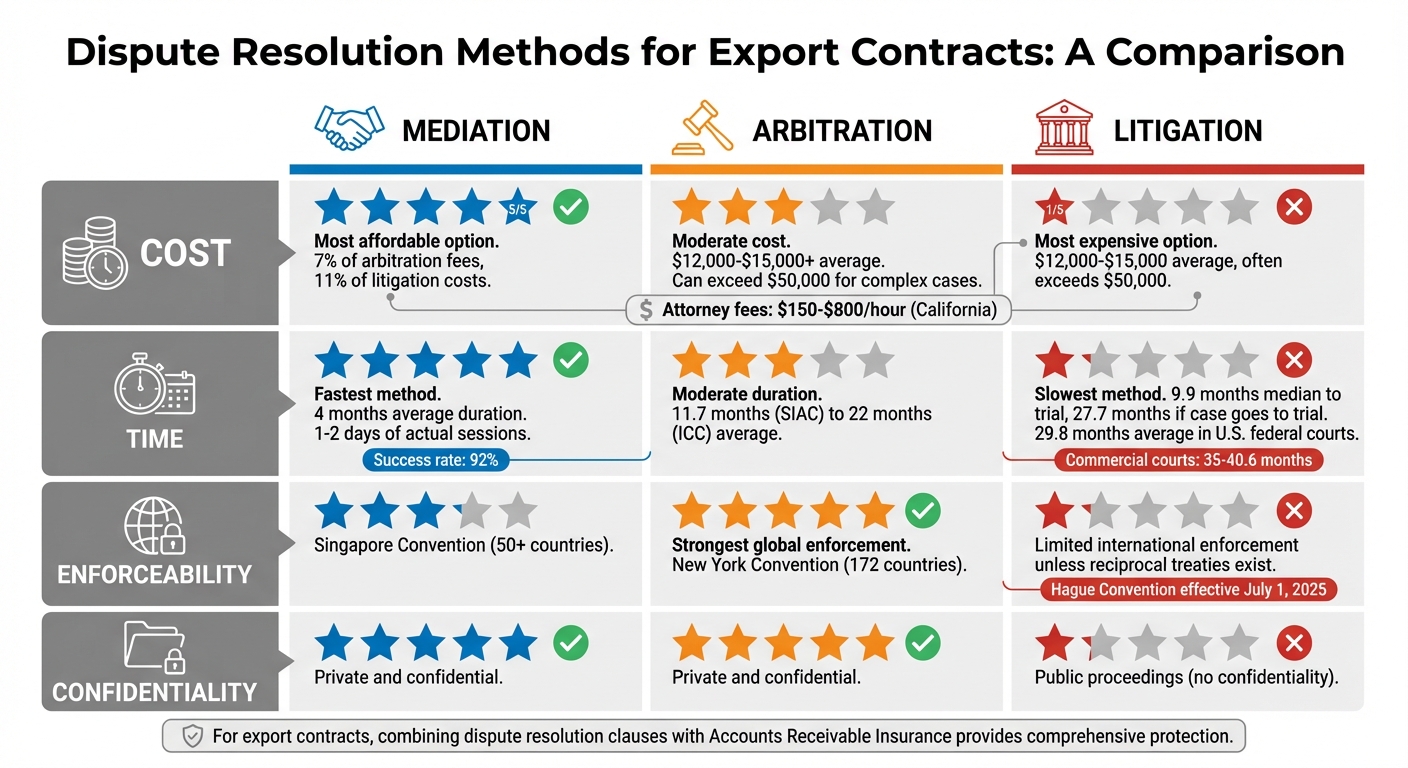
Mediation vs Arbitration vs Litigation: Cost, Time, and Enforceability Comparison
When weighing mediation, arbitration, and litigation, it’s essential to consider factors like cost, time, enforceability, and confidentiality. Each method offers unique benefits and challenges, making the choice highly dependent on the specific circumstances of the dispute.
Cost is a major differentiator. Mediation is often the most affordable option, averaging just 7% of arbitration fees and 11% of litigation costs, according to studies. Arbitration, while more expensive than mediation, can still reduce overall legal expenses due to quicker resolutions. Litigation, on the other hand, tends to be the most expensive due to extended timelines and higher legal fees.
Time efficiency is another critical factor. Mediation is the fastest, with 92% of commercial mediations resulting in agreements. Arbitration typically takes between 11.7 and 22 months for international disputes, while U.S. federal court cases average 29.8 months to reach a resolution, excluding appeals. As Hughes Hubbard & Reed LLP explains:
"International arbitration tends to be much faster than litigation for proceedings that run their course".
However, while mediation and arbitration are quicker, the enforceability of their outcomes is a key consideration.
Enforceability varies significantly. Arbitration awards are globally recognized and enforceable in 172 countries under the New York Convention. In contrast, court judgments often face enforcement challenges unless reciprocal treaties are in place. The Hague Convention, set to take effect on July 1, 2025, may improve this for cross-border court judgments. Mediation outcomes, while not automatically enforceable, can be formalized into settlement agreements. The Singapore Convention simplifies enforcement across more than 50 jurisdictions.
Confidentiality is another area where the methods differ. Litigation is a public process, often exposing sensitive information. Mediation and arbitration, however, are private and maintain confidentiality.
These differences highlight the importance of choosing the right dispute resolution method based on specific needs. For businesses concerned about cash flow during prolonged disputes, Accounts Receivable Insurance (https://accountsreceivableinsurance.net) can provide essential protection against non-payment risks.
Conclusion
Mediation clauses provide an effective way to resolve export contract disputes without straining relationships or incurring excessive costs. As highlighted by Miller Thomson:
"Dispute resolution clauses are far more than boilerplate; they are essential risk-management tools that can significantly impact commercial disputes".
To maximize their benefits, draft these clauses with precision. Include details like the administering institution, clear timelines (such as 45–60 days), the language to be used, and the venue. Make mediation a required step before moving to binding arbitration. This structured approach ensures a balance between efficient dispute resolution and financial safeguards.
That said, mediation clauses alone cannot protect businesses from the financial fallout of non-payment or insolvency. Pairing them with Accounts Receivable Insurance helps mitigate risks like non-payment, insolvency, and political instability in both domestic and international markets. By combining these tools, businesses can build a well-rounded risk management strategy that addresses both dispute resolution and financial security in export contracts.
FAQs
What should a mediation clause include?
A mediation clause should clearly outline several key elements to avoid confusion and ensure a smoother resolution process. These include the specific types of disputes it applies to, the rules and procedures to follow during mediation, and how the mediator will be selected. Additionally, it should specify the venue and language for the mediation, include terms regarding confidentiality, and detail enforcement procedures. Addressing these points provides structure and clarity for all parties involved.
When should an export dispute skip mediation?
Export disputes can skip mediation when a contract or legal provision explicitly permits immediate litigation or arbitration. This is particularly relevant in situations involving urgent or irreparable harm. Similarly, cases like the misuse of confidential information may warrant direct court action, even if a mediation clause is in place.
How do I enforce a mediated settlement internationally?
To ensure a mediated settlement is enforceable across borders, one option is to transform it into an arbitral award. This approach allows the settlement to be recognized under international agreements like the New York Convention. Another route involves leveraging new frameworks, such as UNCITRAL’s initiatives aimed at simplifying enforcement processes. Including clear dispute resolution clauses that reference international rules, such as those from ICC or UNCITRAL, can also strengthen enforceability. While litigation and arbitration remain widely used methods, they often come with substantial costs and lengthy timelines.