

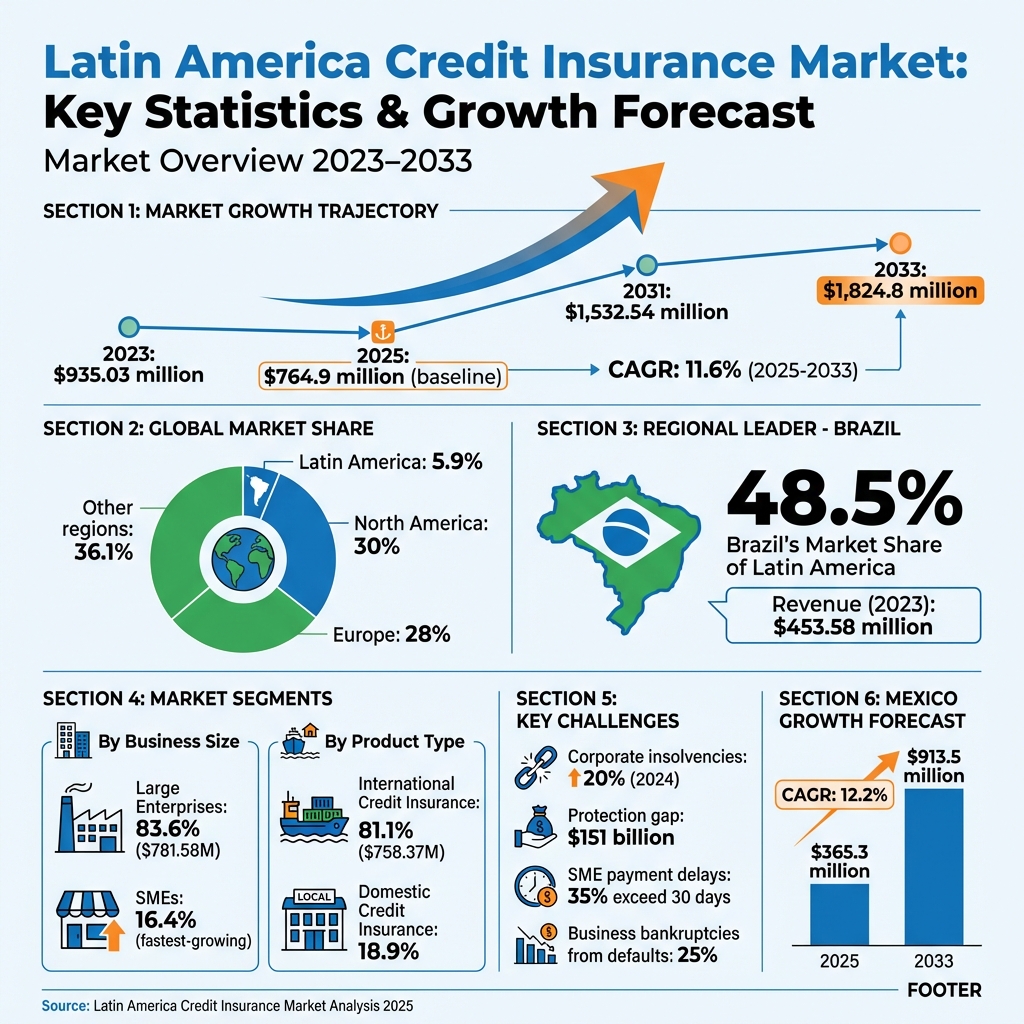
The Latin America credit insurance market is growing fast, with revenues projected to rise from $764.9 million in 2025 to $1,824.8 million by 2033, reflecting an annual growth rate of 11.6%. Businesses in the region are increasingly turning to credit insurance to manage risks like late payments, insolvencies, and political instability. Key highlights include:
- Market Trends: Brazil leads with a 48.5% market share (2023), while SMEs are the fastest-growing segment.
- Key Challenges: High insolvency rates (up 20% in 2024) and economic uncertainty are driving demand for credit insurance.
- Growth Drivers: Extended payment terms, AI-powered underwriting, and nearshoring are reshaping the market.
- Opportunities: A $151 billion protection gap signals untapped potential, especially in export credit insurance and SME-focused policies.
Credit insurance is becoming a critical tool for businesses to secure cash flow and navigate an unpredictable economic landscape. Read on to explore market dynamics, growth drivers, and country-specific insights.
Latin America Credit Insurance Market Growth 2025-2033: Key Statistics and Regional Breakdown
Current Market Size and Structure
Market Size and Regional Share
In 2023, the South & Central America trade credit insurance market reached a value of $935.03 million. Despite this growth, Latin America accounted for just 5.9% of the global market, a modest figure compared to North America’s 30% and Europe’s 28% shares. Premiums in the region have risen significantly over time, climbing from $152 million in 2007 to approximately $415 million by Q3 2021. However, there remains a $151 billion protection gap in insurance coverage across Latin America as of 2023, highlighting a large area of untapped opportunity.
Market Breakdown by Segment
Large enterprises dominate the market, contributing 83.6% of total revenue (equivalent to $781.58 million) in 2023. Meanwhile, small and medium enterprises (SMEs), though accounting for just 16.4%, represent the fastest-growing segment. On the product side, international credit insurance holds the lion’s share, making up 81.1% of the market ($758.37 million), while domestic credit insurance trails at 18.9%. To serve these market segments, insurers rely on a mix of direct sales, specialized brokers, and bancassurance partnerships.
Country-Level Performance
Brazil leads the regional market, commanding 48.5% of total revenues ($453.58 million) in 2023. The country is also set to experience the fastest growth rate through 2033. A key factor driving this growth is Brazil’s "Open Insurance" framework, which promotes data sharing among insurers, fostering competition and enabling more tailored insurance products.
Mexico, another key player, faces challenges. Following a 2025 VAT reform that eliminated tax credits for fulfilling insurance contracts, Fitch Ratings downgraded Mexico’s outlook for 2026 to "deteriorating", citing pressure on insurers’ technical results. Elsewhere in the region, countries like Colombia, Chile, and Peru maintain more stable conditions. These markets benefit from initiatives such as pension reforms and the growing role of bancassurance. Together, these dynamics paint a complex picture of the region’s insurance landscape, setting the stage for future growth and challenges.
Growth Forecasts and Key Drivers
Projected Growth Rates
The credit insurance market in Latin America is on a strong upward trajectory, with projections showing an increase from $935.03 million in 2023 to $1,532.54 million by 2031 – a compound annual growth rate (CAGR) of 6.4%. By 2033, the market is expected to reach $1,824.8 million, reflecting an even higher CAGR of 11.6%. Among the region’s players, Brazil continues to lead with the highest growth potential. These numbers highlight the dynamic expansion underway in this sector.
Factors Driving Market Growth
Several key factors are fueling this growth, many of which stem from current economic and geopolitical shifts. Corporate insolvencies have surged by 20% as of late 2024, reflecting the strain of macroeconomic pressures like elevated inflation rates and Chile’s benchmark interest rate of 9.75%. These conditions are pushing businesses to seek stronger cash flow protection. At the same time, geopolitical challenges, including notable U.S. tariffs on key exports, are increasing the demand for strategies that diversify credit risks.
Technological advancements are also reshaping the landscape. Innovations such as digital payment platforms and AI-powered underwriting tools – frequently highlighted at industry events – are streamlining operations and enhancing efficiency.
"In the coming years, insurance premium gains will continue to outpace economic growth in Latin America, as seen over the past two decades." – Caroline De Souza Rodrigues Cabral, Senior Economist, Swiss Re Institute
Challenges to Growth
While the market shows impressive potential, obstacles remain. Political instability and economic unpredictability create ongoing challenges for insurers and businesses alike. Structural issues, including outdated infrastructure, low productivity, and fiscal imbalances, further complicate growth. Another significant hurdle is the limited awareness of credit insurance benefits among small and medium enterprises, which restricts broader market participation. Additional concerns include currency depreciation, foreign exchange volatility, rising cybersecurity risks, and the financial strain of large claim payouts during economic downturns.
These challenges underscore the need for adaptability and innovation as the market continues to evolve.
Business Opportunities and Market Implications
Opportunities by Business Size
The Latin American credit insurance market presents distinct opportunities for businesses of all sizes. Large enterprises are projected to dominate, contributing 66.75% of market revenue by 2025. However, SMEs are the fastest-growing segment, as more small and medium-sized businesses recognize the importance of safeguarding against payment defaults. This is especially critical considering that 35% of SMEs face payment delays exceeding 30 days, and 25% of business bankruptcies are directly linked to payment defaults.
For SMEs, credit insurance provides more than just protection from unpaid invoices. It also enhances their ability to secure financing and gain insights into buyer creditworthiness. Insured receivables make these businesses more appealing to financial institutions, often leading to easier access to loans and better credit terms. A great example of this is Tinubu Square SA’s use of AI-driven underwriting in October 2024, which optimized credit decisions for SMEs.
Large corporations, on the other hand, benefit from tailored credit solutions designed for their complex supply chains. In March 2024, Allianz Trade introduced "Allianz Trade pay", a B2B e-commerce payment solution that integrates fraud detection, digital buyer onboarding, trade credit insurance, and instant financing. This solution is specifically aimed at addressing modern supply chain challenges. These developments underscore how businesses of all sizes are finding new ways to navigate and thrive in this evolving market.
High-Growth Regions and Products
Brazil and Mexico are leading the way as key markets in the region. Brazil accounted for a commanding 48.5% share of the South & Central America trade credit insurance market in 2023, while Mexico’s market is expected to grow significantly – from $365.3 million in 2025 to $913.5 million by 2033, reflecting a strong CAGR of 12.2%. Brazil’s adoption of "Open Insurance" policies, which promote better data sharing and customized product offerings, further strengthens its position as a dynamic market.
Export credit insurance is another area of rapid growth, providing coverage for up to 90% of invoice value in cases of buyer default. The agriculture sector, in particular, is projected to grow at a CAGR of 7.5% through 2031, driven by its increasing exposure to global trade risks. Additionally, the trend of nearshoring – relocating production closer to key markets – is fueling demand for coverage of intermediate goods, as supply chain complexities continue to rise.
With a regional protection gap valued at $151 billion in premium equivalent terms as of 2023, there is significant room for insurers to create more accessible and affordable products.
"Latin America’s insurance market is a fertile territory for accelerated growth and business model innovations. It is already the fastest-growing regional insurance market globally." – McKinsey & Company
The Role of Insurance Brokers
In this dynamic environment, insurance brokers play a vital role in helping businesses navigate risks and seize opportunities. While many consumers in Latin America begin their insurance search online, the majority still rely on brokers for completing purchases. This highlights the importance of blending digital tools with personalized, expert guidance.
Specialized providers such as Accounts Receivable Insurance are instrumental in helping businesses manage complex risks. These intermediaries assist in addressing challenges tied to economic and political instability, offering specialized coverage for scenarios like strikes, riots, civil commotion (SRCC), and sabotage and terrorism (S&T). Such protections are becoming increasingly relevant in a region marked by social uncertainties.
"The reality of low digital-adoption highlights a need for a hybrid approach that combines the convenience of digital platforms with the trusted, personalized support of agents." – Israel Ramírez, Pricing Director, RGA
Brokers also help businesses capitalize on favorable market conditions. For instance, commercial insurance rates in Latin America and the Caribbean dropped by 5% during the second quarter of 2025. Property insurance rates in Peru saw reductions of 15% to 20%, driven by increased competition and capacity. Similarly, cyber insurance rates fell by 17%, with some businesses in Mexico and Colombia seeing reductions as high as 30%. Skilled brokers use these trends to negotiate better terms, lower deductibles, and higher coverage limits for their clients, ensuring businesses get the most value from their policies.
sbb-itb-2d170b0
Trade credit insurance in Latin America: unlocking finance, managing risk, and scaling access
Conclusion
The Latin American credit insurance market is at a turning point. Projections show market revenues climbing from $764.9 million in 2025 to an impressive $1,824.8 million by 2033, reflecting a robust annual growth rate of 11.6% – the fastest globally for this sector. However, a substantial $151 billion protection gap persists, highlighting the untapped potential and pressing need for coverage.
This rapid growth comes with its share of challenges. Late payments and rising insolvency rates are straining cash flows and amplifying counterparty risks. In such a landscape, credit insurance moves beyond being just an option – it becomes an essential tool for managing financial risks, securing funding, and weathering economic uncertainty.
The market’s trajectory mirrors broader regional developments. Leading economies like Brazil and Mexico are fueling momentum, while trends such as nearshoring, AI-powered underwriting, and the expansion of B2B e-commerce are reshaping how businesses safeguard their receivables. Small and medium enterprises (SMEs), despite being underrepresented, are emerging as a key growth segment as more businesses recognize the benefits of credit insurance. These shifts underline the growing importance of expert-led risk management.
In this complex environment, brokers like Accounts Receivable Insurance are indispensable. They help SMEs navigate the intricacies of credit insurance, tailor policies for diverse supply chains, and negotiate favorable terms in a dynamic market. Their expertise is especially critical in addressing regional challenges like currency fluctuations, political instability, and the complexities of cross-border trade.
As Latin America’s economic landscape continues to evolve, businesses that embrace credit insurance – guided by skilled brokers – will be better equipped to seize new opportunities while mitigating regional risks.
FAQs
What is driving the growth of the credit insurance market in Latin America?
The credit insurance market in Latin America has been expanding quickly, driven by several important factors. Businesses in the region face a variety of economic and political challenges, including currency devaluations, unstable governments, and the risk of customers defaulting on payments. These uncertainties have spurred companies to seek financial protection through credit insurance, resulting in a steady increase in premiums and a broader acceptance of these products.
Another factor fueling growth is the transformation of supply chains and the rise of e-commerce. The boom in online trade has created more intricate logistics networks and heightened exposure to credit risks. To address these challenges, businesses are turning to tailored insurance solutions. At the same time, insurers are adopting AI and digital technologies, which have improved their ability to assess risks and handle claims efficiently. These advancements not only streamline operations but also build greater trust with customers.
Additionally, the relatively low insurance penetration in the region, combined with the growth of an emerging middle class, offers considerable room for market growth. As more businesses and individuals recognize the importance of risk management, the demand for credit insurance is expected to keep climbing.
What opportunities does the protection gap in Latin America offer to insurers?
The insurance landscape in Latin America reveals a significant challenge: a large portion of trade receivables remains uninsured, leaving businesses exposed to financial risks. In some cases, up to 40% of these assets are unprotected, particularly in countries like Brazil, Mexico, and Colombia. Limited insurance options and a small number of providers contribute to this gap, making it a pressing issue for businesses operating in the region.
This lack of coverage, combined with the region’s economic and political uncertainties, is driving a rising need for customized credit insurance solutions. The trade credit insurance market has already shown steady growth, with premiums increasing from $152 million in 2007 to around $415 million by the end of 2021. Looking ahead, the market is projected to grow at a 6.4% annual rate, potentially reaching $1.53 billion by 2031.
Insurers have a clear opportunity to address this gap by offering innovative products, leveraging digital tools, and expanding their networks. By doing so, they can not only tap into new revenue opportunities but also provide businesses with the protection they need to navigate financial uncertainties.
Why are small and medium-sized enterprises (SMEs) driving growth in the Latin America credit insurance market?
Small and medium-sized enterprises (SMEs) are emerging as a key driver in the Latin America credit insurance market, largely due to their increased exposure to financial risks. Factors like economic and political instability in the region, combined with extended payment terms – expected to average between 53 and 59 days by 2025 – have led to a surge in payment delays. In fact, 77% of companies in the region report experiencing late payments. For SMEs, which often lack substantial capital reserves or easy access to traditional financing, credit insurance has become a critical safeguard. It offers protection against risks like non-payment, bankruptcy, and political upheaval.
The growing prominence of e-commerce and increasingly complex supply chains has introduced additional vulnerabilities, pushing SMEs to seek more comprehensive protection. This rising demand is reflected in the steady growth of credit insurance premiums across the region. Accounts Receivable Insurance (ARI) plays a pivotal role here, offering SMEs customized credit insurance solutions, detailed risk assessments, and efficient claims management. These services help businesses navigate uncertainties and maintain financial stability in a challenging environment.