

Energy sector risks, like price volatility, geopolitical disruptions, and rising insolvencies, significantly affect credit insurance. These challenges create financial instability, making credit insurance a critical safeguard for energy companies. Here’s why:
- Price Swings: Energy prices can spike or plummet rapidly, leading to inflated trade receivables and default risks. For example, natural gas prices surged 115% in July 2022.
- Geopolitical Events: Conflicts and sanctions disrupt supply chains, increase costs, and complicate risk management. The EU’s 2025 sanctions on Russia doubled energy delivery times.
- Insolvencies: The renewable energy sector, despite its growth, faces financial strain. Bankruptcies and project cancellations have risen due to cost overruns and market volatility.
Credit insurance mitigates these risks by protecting against non-payments, stabilizing cash flow, and enabling companies to secure financing. Policies tailored to energy businesses address long-term contracts, international ventures, and emerging markets, ensuring resilience in unpredictable conditions.
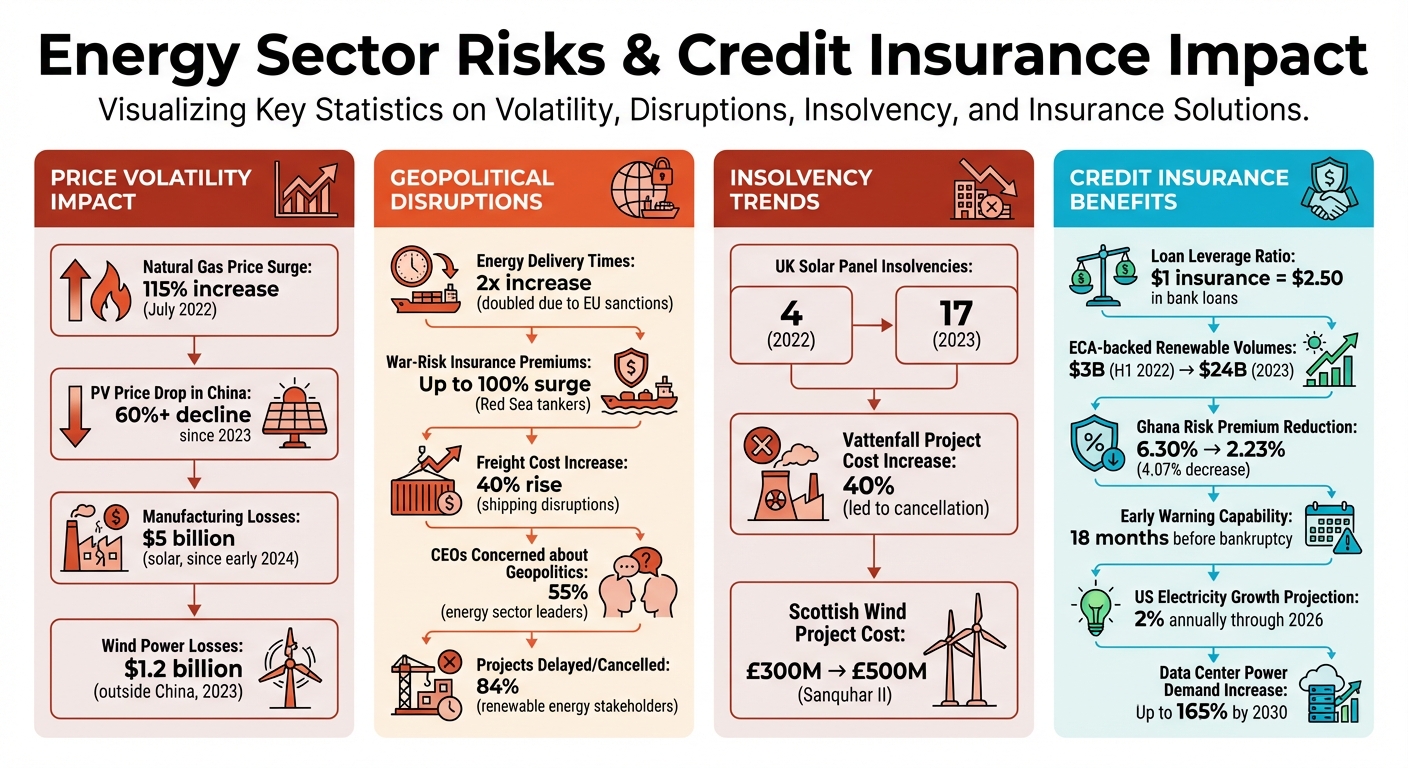
Key Energy Sector Risks Impacting Credit Insurance: Statistics and Trends
Main Risks in the Energy Sector That Affect Credit Insurance
Price Volatility and Financial Consequences
Fluctuating energy prices pose a major challenge for credit insurers. When prices surge or plummet, the value of trade receivables can quickly exceed credit limits, creating what insurers call "inflated exposures". This is especially tricky for energy trading contracts that rely on mark-to-market accounting. These price swings impact not only fossil fuels but also renewable energy projects, each with its own set of risks.
For instance, low oil prices can lead to severe financial strain for producers, sometimes pushing them toward insolvency. A clear example is Noble Corporation PLC, an offshore drilling contractor that filed for bankruptcy in July 2020 after years of declining oil prices and high operating costs. Moody’s EDF-X Early Warning System had flagged the company’s credit risk as "Severe" 18 months before the filing. Noble eventually restructured and emerged from bankruptcy in February 2021.
Renewable energy, while promising, comes with its own volatility. The intermittent nature of wind and solar power can lead to oversupply or even negative pricing, which can hurt the financial stability of energy offtakers. Additionally, rapid advancements in technology often render older projects inefficient or overpriced compared to newer installations. This is a problem for projects tied to long-term repayment plans that span 18 to 20 years, complicating underwriting and claims management for credit insurers.
Geopolitical Disruptions to Energy Supply Chains
Geopolitical events and conflicts can wreak havoc on energy supply chains, introducing unpredictable credit risks. For example, the EU’s 19th sanctions package against Russia in October 2025 reshaped global oil flows, forcing longer shipment routes and doubling delivery times. Even companies adhering to the sanctions faced increased reinsurance costs due to the complexity of verifying ownership structures.
War-risk insurance premiums for tankers navigating the Red Sea surged by up to 100% during recent crises, while freight costs rose by as much as 40% due to disruptions at critical shipping chokepoints. These issues are not hypothetical – 55% of CEOs in the energy, natural resources, and chemicals sectors identify geopolitical complexities as their top concern.
Political instability adds another layer of risk. In August 2023, Gabon initiated a $500 million "debt-for-nature" swap to fund marine conservation. However, just two weeks later, a military coup ousted President Ali Bongo, creating immediate uncertainty for investors in these projects. As Michael Creighton points out:
"Just because these projects are nature-positive, it doesn’t mean that credit and political risks don’t exist".
Trade protectionism further complicates the situation. Unpredictable tariffs on liquefied natural gas and renewable energy components force companies to constantly adjust their sourcing strategies. A staggering 84% of renewable energy industry stakeholders report that geopolitical challenges have caused significant delays or even project cancellations. These disruptions amplify existing financial vulnerabilities, increasing the likelihood of insolvencies and project failures.
Insolvency Rates and Project Cancellations
The energy sector, especially renewables, has seen a surge in financial difficulties. Lower barriers to entry in the renewable market have attracted many new players, some of whom lack the financial resilience to weather market volatility.
On the manufacturing side, falling photovoltaic prices in China – down over 60% since 2023 – have led to cumulative losses of around $5 billion since early 2024. Meanwhile, wind power manufacturers outside China reported losses of approximately $1.2 billion in 2023. In the UK, insolvencies in the manufacture of electronic components and boards (including solar panels) jumped from 4 in 2022 to 17 in 2023.
Rising development costs have also led to more project cancellations. In 2023, Swedish energy company Vattenfall canceled a 140-turbine offshore wind project in the North Sea after costs climbed by 40%. Similarly, Community Windpower shelved its Sanquhar II onshore project in Scotland when costs soared from £300 million to £500 million. Even projects that move forward often face financial strain. For example, Taiwan’s Yunlin offshore wind farm restructured its €2.9 billion debt in August 2023 to avoid collapse due to cost overruns. These long-term projects, which often span 10 to 25 years, make it difficult for credit insurers to predict the ongoing solvency of counterparties.
These trends underscore the need for flexible and forward-looking credit insurance strategies to navigate the evolving risks in the energy sector.
How Credit Insurance Reduces Energy Sector Risks
Tailored Policies for Energy Businesses
Specialized credit insurance policies are crafted to address the unique challenges faced by energy companies. When market disruptions caused trading conditions to spiral, businesses with these tailored policies were able to maintain operations despite extreme volatility. These customized solutions help manage heightened default risks during price fluctuations, shielding companies from unexpected counterparty failures.
Accounts Receivable Insurance is designed specifically for the diverse needs of the energy sector – whether a company is involved in oil and gas, renewable energy, or utilities. These policies address everything from the complexities of LNG tariffs to long-term Power Purchase Agreements (PPAs) that can extend over decades. Madeleine Whiteley from Aon highlights the value of these solutions:
"Those who had embedded credit insurance as a key part of their credit risk management strategy could trade and make the most of opportunities in this volatile environment, with the confidence of the credit insurance market behind them".
In addition to mitigating risks, these policies serve as tools for growth. They empower energy firms to offer more competitive payment terms and handle larger transactions that might otherwise pose too much risk. For every $1 of credit insurance coverage, banks have been able to provide approximately $2.50 in loans to companies.
Pre-Claim Interventions and Risk Assessments
Advanced warning systems play a critical role in helping energy companies spot potential issues before they escalate into losses. With cutting-edge credit models, businesses can detect severe risks as early as 18 months before a potential bankruptcy filing. These systems have proven their worth by alerting companies to major risks well in advance of significant disruptions.
Insurers also provide ongoing analysis of industry trends and buyer payment behaviors, offering clients real-time updates on deteriorating conditions. This proactive approach allows businesses to adjust credit terms, request additional collateral, or even pivot their partnerships before defaults occur. By using scenario-based Probability of Default (PD) models, companies can evaluate how their risk exposure might shift under different conditions. These preemptive strategies complement the global protection that credit insurance offers in today’s interconnected markets.
Coverage for Domestic and International Markets
Credit insurance extends its reach to both domestic and international projects, providing comprehensive protection for energy companies. Accounts Receivable Insurance safeguards businesses against buyer insolvency, bankruptcy, and prolonged payment defaults, whether the operations are U.S.-based or abroad. For international ventures, particularly in emerging markets, insurers often collaborate with Export Credit Agencies (ECAs) to expand coverage. For example, ECA-backed renewable energy volumes surged from roughly $3 billion in the first half of 2022 to $24 billion in 2023. A case study from 2021 illustrates how political risk insurance reduced Ghana’s country risk premium by 4.07% (from 6.30% to 2.23%), making projects that were previously unfeasible financially viable.
Additionally, insurance solutions provide cost-effective alternatives to traditional Letters of Credit (LCs). Tools like On-Demand Payment bonds and surety bonds free up working capital, enhancing liquidity for energy trading and infrastructure projects. This flexibility is especially critical during market disruptions, allowing companies to maintain operations while managing risks across multiple counterparties.
Benefits of Credit Insurance for Energy Sector Businesses
Cash Flow Protection and Financial Stability
Credit insurance serves as a safety net for energy companies, shielding them from sudden payment defaults and disruptions in the market. Even during periods of volatility, businesses with credit insurance policies in place have been able to maintain operations, knowing their financial exposures are secure.
This type of insurance goes beyond merely covering non-payments. It reduces bad debt and unlocks capital that would otherwise be tied up in reserves or traditional collateral agreements. This improved liquidity is crucial, especially for companies where a single large default could threaten their ability to meet financial obligations. With this added stability, energy businesses can focus on smarter credit management and seize growth opportunities.
Improved Credit Management and Growth Opportunities
For many energy firms, credit insurance is becoming more than just a risk management tool – it’s a key driver for growth. By securing their receivables, businesses can access additional financing, enabling them to tackle larger deals and expand into new markets with greater confidence.
As Madeleine Whiteley, a senior manager, puts it:
"Typically, credit insurance and insurance in general is seen as a risk mitigant, but more and more we’re seeing it as a tool for growth".
Insured receivables also allow companies to offer more competitive payment terms, improving credit management and opening doors to new opportunities. This is especially valuable when entering markets with less-established business relationships. Better credit management not only supports expansion but also lays the groundwork for critical investments in renewable energy projects.
Support for Energy Transition Projects
Credit insurance plays a vital role in helping energy firms navigate the shift toward renewable energy. By reducing financial uncertainties, it lowers capital costs and enhances the bankability of renewable projects. For example, export credit agency-backed renewable energy volumes jumped from around $3 billion in early 2022 to $24 billion in 2023.
This type of insurance also protects developers against risks such as offtaker defaults in long-term Power Purchase Agreements. It gives lenders the confidence to finance projects in emerging markets, where essential minerals like lithium and copper are sourced. With global power demand from data centers alone expected to rise by as much as 165% by 2030, energy businesses need reliable financial tools to manage these growing exposures.
Providers like Accounts Receivable Insurance offer tailored solutions, including customized policies, risk assessments, and claims management. These services help energy companies protect their cash flow, improve credit management, and confidently pursue growth in an evolving market.
sbb-itb-2d170b0
You can’t predict the weather, but you can insure for it: Credit insurance and the future of energy
Conclusion: Credit Insurance for Managing Energy Sector Risks
The energy sector has faced intense financial pressures recently, with natural gas prices skyrocketing by 115% and EU pipeline flows dropping by 45%. These shifts highlight the financial vulnerabilities energy companies encounter, especially during periods of extreme market volatility. Credit insurance acts as a safeguard, protecting businesses from counterparty defaults and helping manage risk during unpredictable price fluctuations.
Beyond risk management, credit insurance offers a financial advantage by unlocking working capital. For instance, every $1 of credit insurance coverage can support approximately $2.50 in bank loans. This efficiency is particularly timely, given that U.S. electricity consumption is projected to grow by about 2% annually through 2026.
As the energy transition gains momentum, credit insurance plays a key role in supporting long-term agreements like power purchase contracts, while also boosting investor confidence. A clear example is the dramatic rise in ECA-backed renewable energy volumes, which jumped from roughly $3 billion to $24 billion.
Accounts Receivable Insurance further strengthens energy companies by providing tailored credit protection. These policies include customized coverage, detailed risk assessments, and global claims support for both domestic and international operations. This comprehensive approach underscores the critical role of credit insurance in navigating today’s unpredictable energy markets.
FAQs
What energy risks matter most to credit insurers?
Key risks for credit insurers in the energy sector revolve around price volatility, geopolitical tensions, and the complexities of transitioning to renewable energy sources. These issues can shake financial stability and slow down the progress of energy projects, creating uncertainty for stakeholders.
How does price volatility change credit limits and exposure?
Price swings in the energy market directly impact credit limits and exposure. To navigate these fluctuations, energy companies often turn to active hedging strategies. These measures help mitigate financial risks, offering a way to stabilize operations in an unpredictable environment. By doing so, companies can better position themselves for steady growth, even in the face of market uncertainty.
What does credit insurance cover for overseas energy projects?
Credit insurance for overseas energy projects is designed to protect businesses from risks like non-payment, non-delivery, political unrest, and financial uncertainties in international energy deals. These policies are especially important in the energy sector, where companies often face challenges tied to geopolitical tensions and market fluctuations.