

Currency fluctuations can erode profits in global trade. Managing foreign exchange (FX) risk is essential to protect your bottom line. Here are 5 practical strategies to mitigate FX exposure:
- Forward Contracts: Lock in exchange rates for future transactions to stabilize costs and protect profit margins.
- Currency Diversification: Spread risk by using multiple currencies and aligning inflows with outflows.
- Matching Currency Flows: Align revenue and expenses in the same currency to avoid conversion risks.
- Risk-Sharing Agreements: Share FX risk with trading partners through pre-agreed terms.
- Invoicing Strategies: Choose the right currency for invoices to balance competitiveness and risk.
Each approach offers ways to manage volatility and improve financial stability in international trade. Below, we explain how these strategies work and how businesses can implement them effectively.
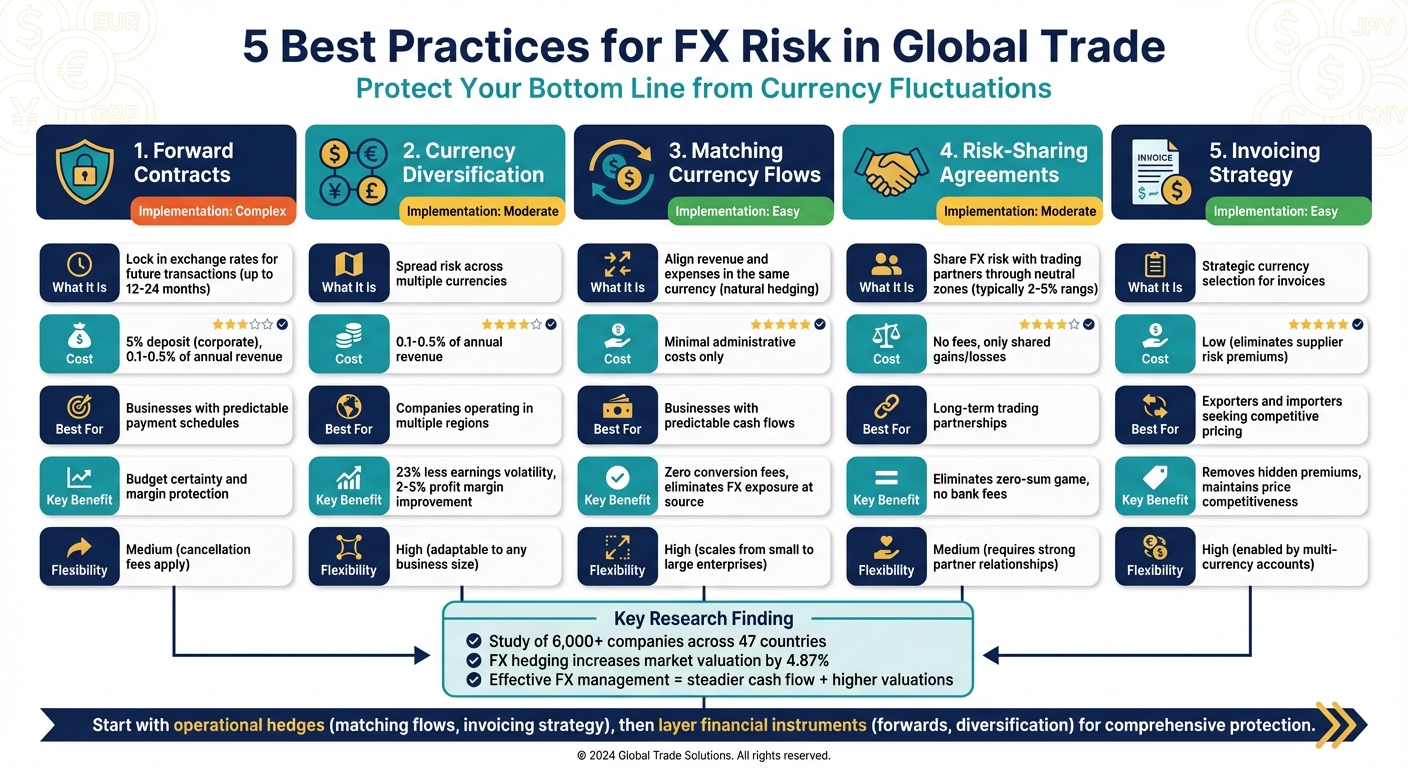
Comparison of 5 FX Risk Management Strategies for Global Trade
Foreign Exchange Risk and How To Manage Foreign Exchange Risks (Currency Risk & FX Risk Management)
sbb-itb-2d170b0
1. Forward Contracts and Rate Locking
A forward contract is a binding agreement that lets businesses exchange a specific amount of currency at a fixed rate on a future date – up to 12 or even 24 months ahead. This tool is invaluable for shielding businesses from unpredictable currency fluctuations that might occur between quoting a price and receiving payment, ensuring greater stability in global trade.
How Forward Contracts Reduce FX Risk
By locking in exchange rates, businesses can plan budgets, forecast costs, and safeguard profit margins, no matter how volatile the foreign exchange (FX) market becomes. The risk starts as soon as a price is quoted in a foreign currency; delaying action until invoicing leaves businesses vulnerable to market shifts.
"Hedging late means you’re reacting to risk instead of managing it proactively."
– Amesika Baeta, Regional Director, Export Development Canada (EDC)
Take Marina Beck, for example. In 2024, her Canadian company, Wine Alliance, used forward contracts through OFX to navigate the fluctuating costs of foreign grapes. By securing rates ahead of the wine-buying season, she shielded her business from currency swings tied to harvest conditions, ensuring she could meet vendor payments without impacting her bottom line.
Simple Setup for Businesses
Setting up a forward contract is a straightforward process. Most providers don’t charge a flat fee; instead, they include costs in the "spread" – the difference between the buying and selling rates. The forward rate itself is calculated by tweaking the spot rate based on the interest rate differences between the two currencies.
Before diving in, businesses should assess their FX exposures. This involves identifying their contracted payables, receivables, and projected cash flows. Many employ "tiered hedging", which means aggressively hedging certain exposures (like signed contracts) while taking a lighter approach with less predictable ones. For instance, if sales forecasts range between $10 million and $13 million, a company might secure rates for $10 million, covering the lower end of expectations.
Flexibility for Businesses of All Sizes
Forward contracts are highly adaptable because they’re traded over-the-counter (OTC), allowing businesses to customize amounts and maturity dates to fit their needs. They come in three main types:
- Fixed forwards: Lock in a set amount for a specific future date.
- Window forwards: Allow transactions on any day within a set time frame.
- Flexible forwards: Enable multiple payments in smaller increments over the contract’s duration.
These options make forward contracts suitable for a wide range of businesses, from small importers and exporters to large-scale wine producers and global tech firms.
Balancing Cost and Commitment
Using forward contracts generally requires an upfront deposit – 5% for corporate accounts and 10% for personal accounts – without any additional flat fees, making them a cost-efficient alternative to currency options. However, if exchange rates shift adversely by more than 5%, businesses may need to provide additional funds to maintain the required deposit (a process known as a margin call).
The main trade-off is commitment. Once a forward contract is locked in, canceling it typically involves "close out" costs or cancellation fees. To maintain flexibility, many businesses hedge only a portion of their expected currency needs – say, 50% – with forward contracts, while managing the rest through spot transfers.
"The focus of any currency hedging program is typically on the reduction of risk, not on trading the market."
– Chris Braun, Head of Foreign Exchange, U.S. Bank
This tailored and efficient approach to managing currency risk sets the groundwork for exploring other strategies in FX risk management.
2. Currency Diversification
Currency diversification spreads risk across multiple currencies, helping businesses reduce the impact of fluctuations in any single market. Unlike solely locking in rates, this approach leverages a mix of currencies for added stability.
Effectiveness in Mitigating FX Risk
This strategy offers a buffer against market swings, especially for companies operating in regions like the US, Europe, and Southeast Asia. Studies reveal that businesses with formal hedging policies experience 23% less earnings volatility. Additionally, a five-year study of over 6,000 companies in 47 countries found that managing FX risk effectively correlates with steadier cash flow and higher market valuations.
"Currency volatility can have both positive and negative impacts on a business… if the business’s home currency becomes weaker against the country where it sources or manufactures goods, the cost of those materials increases."
– Steven Dooley, FX and Macro Strategist, Convera
One of the most efficient methods is natural hedging – earning and spending in the same currency. For example, a business selling in Europe and paying European suppliers in euros avoids currency conversion altogether. Even partial alignment can help. If a company collects $50,000 in revenue and pays $30,000 in expenses in the same currency, only the remaining $20,000 needs to be converted.
Ease of Implementation for Businesses
Currency diversification is accessible for businesses of all sizes. Multi-currency accounts make it easier by allowing companies to hold funds in different currencies and decide when to convert, avoiding unfavorable automatic bank rates. This flexibility lets businesses wait for better exchange rates or pay international suppliers directly, bypassing extra conversion fees. Additionally, offering local pricing in customers’ native currencies builds trust, boosts conversion rates, and diversifies income streams.
Scalability for Businesses of Different Sizes
Currency diversification adapts to businesses at any stage, from startups dealing in USD to global enterprises managing multiple currencies. Larger organizations can centralize FX management through cash-pooling structures, which consolidate surplus liquidity across different currencies and legal entities. For smaller businesses, even simple multi-currency accounts can provide meaningful protection without requiring complex systems.
Cost-Effectiveness
Natural hedging through currency diversification reduces costs by cutting out transaction fees and avoiding expensive derivatives. The cost of hedging typically falls between 0.1% and 0.5% of annual revenue. Strategic measures, such as aligning currency inflows and outflows, can deliver similar risk reductions at a fraction of the cost. Businesses that adopt a comprehensive FX risk management strategy can see profit margins improve by 2% to 5%. By focusing on operational strategies rather than costly financial tools, currency diversification offers strong returns with minimal adjustments.
3. Matching Currency Flows
Matching currency flows, or natural hedging, is a straightforward way to manage foreign exchange (FX) risk by aligning the currency you earn with the currency you spend. For instance, if your business collects $50,000 in U.S. dollars and pays $30,000 to suppliers in the same currency, you avoid both conversion fees and exposure to fluctuating exchange rates. This method directly safeguards profits by ensuring that incoming and outgoing funds are in sync. Let’s break down how matching currency flows help reduce FX risk, why it’s practical, and how it can be scaled for businesses of all sizes.
Effectiveness in Mitigating FX Risk
By keeping revenues and expenses in the same currency, businesses can shield their profit margins from the unpredictability of exchange rate movements. Research involving over 6,000 companies across 47 countries highlights that robust FX risk management strategies, including natural hedging, lead to steadier cash flows and higher valuations.
"A natural hedge is all about balancing the money a company receives in a foreign currency… with the money it spends in that same currency." – Megan Doyle, American Express Business Class
Take Toyota as an example: the company reduces yen-dollar volatility by operating manufacturing facilities in both Japan and the U.S.. Similarly, a Brazilian exporter might choose to borrow in U.S. dollars, aligning loan repayments with dollar-denominated export revenues.
Ease of Implementation for Businesses
While the concept of matching flows is simple, timing mismatches can create short-term liquidity challenges. Multi-currency accounts can help businesses hold funds in specific currencies, allowing them to pay suppliers directly without needing to convert currencies.
"Internal hedging isn’t always practical, however, because timing issues can replace currency risk with alternative forms of uncertainty." – Steven Dooley, FX and Macro Strategist, Convera
For newer companies with unpredictable payment cycles, coordinating currency flows can be more challenging than for established businesses with steady cash flow patterns.
Scalability for Businesses of Different Sizes
This approach works for businesses of all sizes, from small exporters to large multinationals. Smaller businesses can start by opening foreign currency accounts in their key trading currencies. Mid-sized companies often benefit from consolidating their banking relationships, which improves visibility and control over currency movements. Larger corporations can take it a step further by using advanced tools like cash-pooling and Treasury Management Systems. These systems can cut manual processes by 60% and improve the timing of hedging decisions by 40%.
Cost-Effectiveness
Natural hedging is inherently cost-efficient because it relies on existing revenue and expense flows. Unlike derivatives, this method avoids additional fees, premiums, or collateral requirements, leaving only minimal administrative costs. It’s a practical and economical way to manage FX exposure without adding unnecessary complexity.
4. Risk-Sharing Agreements
Risk-sharing agreements offer a way for trading partners to handle foreign exchange (FX) risk together. Unlike traditional hedging, which can lead to one party benefiting at the expense of the other, these agreements ensure both sides share the financial impact when exchange rate fluctuations exceed a pre-determined range, often called a neutral zone.
Take this example: A U.S. company (ABC) agrees to purchase 10 turbines from a European supplier (EC) for €10 million. They settle on a base rate of €1 = $1.30, with a neutral zone between $1.25 and $1.35. If the exchange rate moves to $1.38 – beyond the neutral zone – both parties split the $0.08 difference from the base rate. This means ABC pays $1.34 million per turbine instead of $1.38 million, effectively reducing its cost by 2.9% while sharing the currency movement’s impact.
"By fostering cooperation between the two parties, currency risk sharing eliminates the zero-sum game nature of currency fluctuations, in which one party benefits at the expense of the other."
– Investopedia
Effectiveness in Mitigating FX Risk
This method offers a buffer against currency volatility, especially for business-to-business transactions where there’s a significant gap between invoicing and payment. By sharing both gains and losses, companies can better predict profit margins without relying on complex financial instruments. To make this work, realistic thresholds – typically within a 2%–5% range – are set to manage minor fluctuations while protecting against larger swings.
Ease of Implementation for Businesses
Risk-sharing agreements work well alongside natural hedging strategies, providing a straightforward way to manage FX risk through clear contractual terms. These agreements don’t require complicated financial instruments but instead depend on negotiation. Their success relies on the strength of the relationship between buyer and seller and the inclusion of a clear price adjustment clause. This clause should outline the base exchange rate, neutral zone, and how adjustments will be calculated. By leveraging existing business relationships, companies can reduce FX risk without needing additional financial products.
"These agreements are not standardized, and so the presence of such an agreement and its terms will depend on the ability of one of the counterparties to bargain with the other."
– Investopedia
Scalability for Businesses of Different Sizes
While risk-sharing agreements are an option for businesses of all sizes, their practicality depends on the trust and rapport between trading partners rather than the size of the company. These agreements are particularly effective with long-term partners who value transparency and shared responsibility. Larger companies with established supply chains may find it easier to negotiate such terms, but smaller businesses can also benefit when working with repeat customers who prioritize long-term collaboration.
Cost-Effectiveness
Risk-sharing agreements are an affordable alternative to traditional financial products like options or forwards. Since they are based on contracts between trading partners, there are no bank fees, premiums, or collateral requirements. Additionally, they eliminate the need for ongoing derivative reporting. The only financial impact comes from sharing profits or losses when exchange rates move beyond the agreed range.
"Alternative risk management solutions to derivatives… provides users the benefit of managing the associated FX risk without having to undertake the operational burden of a full-fledged risk management program."
– Xavier Szebrat, Director, Senior Securities Sales Manager, Bank of America
5. Invoicing Strategy and Currency Selection
The currency you choose for invoicing plays a key role in determining your exposure to foreign exchange (FX) risk. Opting for USD eliminates your FX risk entirely, but it can lead foreign suppliers to add a risk premium to their prices. For instance, in 2010, a wholesale distributor in the southeastern U.S. importing machine tools from China shifted from paying in USD to CNH. This change allowed them to negotiate better pricing and avoid the hidden risk premium. This approach works well alongside other hedging techniques, aligning pricing with market conditions.
"By assuming and subsequently managing currency risk, a U.S. exporter can mitigate the risk outside of their core business, remain competitive at home and abroad, and ultimately, achieve greater financial results."
– Ashley Conrad, Managing Director and Head of ICG Regional Foreign Exchange Sales, U.S. Bank
Effectiveness in Mitigating FX Risk
Invoicing in USD completely eliminates FX risk, but it can impact your competitiveness. For example, a stronger dollar – like its recent 7% increase against the euro – makes U.S. exports more expensive for foreign buyers. On the other hand, invoicing in the buyer’s local currency helps maintain price competitiveness and gives you control over when and how to convert payments. This strategy complements hedging techniques, reinforcing a comprehensive FX risk management framework.
Ease of Implementation for Businesses
Modern banking tools have made multi-currency invoicing almost as simple as billing in USD. Banks often handle automatic conversions for incoming foreign currency wires, meaning you don’t need to maintain separate accounts in different currencies. Dual-currency invoicing features on these platforms can also make hidden premiums more transparent, simplifying supplier payments. Multi-currency accounts let you hold funds in various currencies, avoiding unnecessary conversions and enabling payments when exchange rates are most favorable.
Scalability for Businesses of Different Sizes
For smaller businesses, invoicing in USD may initially seem like the easiest option. However, as companies expand globally, adopting multi-currency strategies becomes essential. With cross-border payments forecasted to surpass $250 trillion by 2027, even smaller exporters need to embrace flexible invoicing options. Multi-currency tools, including cloud-based financial platforms, make it easier for businesses to track transactions in real time and automate currency conversions when rates are advantageous.
Cost-Effectiveness
Invoicing in the buyer’s local currency not only reduces FX risk but also cuts down on cost premiums. Suppliers often build a buffer – sometimes adding several percentage points – to protect themselves from currency fluctuations when invoicing in USD. Paying in the vendor’s local currency eliminates this markup and simplifies reconciliation, as the credited amount matches the invoice exactly. This natural hedging approach doesn’t require extra fees – just align your inflows and outflows.
Comparison Table
Different strategies offer distinct advantages – Matching Currency Flows operates at the structural level, aligning revenues and expenses in the same currency to minimize exposure before it arises. On the other hand, Forward Contracts are financial tools that secure a specific exchange rate for a future transaction, typically for periods ranging from three days to one year.
While operational matching addresses risk at its source, forward contracts tackle it after exposure. Studies confirm that foreign exchange (FX) hedging reduces cash flow volatility, lowers systematic risk, and enhances market value. Research on U.S. companies found that FX hedging increased market valuation by 4.87%.
"The focus of any currency hedging program should be on the reduction of risk, not on trading the market."
– Chris Braun, Head of Foreign Exchange, U.S. Bank
| Feature | Matching Currency Flows (Natural Hedge) | Forward Contracts (Financial Hedge) |
|---|---|---|
| Type | Operational/Internal Strategy | Financial/External Instrument |
| Mechanism | Aligns revenues and expenses in the same currency | Locks in a future exchange rate with a bank |
| Cost | Low direct cost; may require structural business adjustments | Includes forward point costs and bank spreads |
| Accounting | Simplifies accounting; reduces remeasurement needs | Often involves complex "Hedge Accounting" |
| Flexibility | Provides long-term structural protection | Customizable for specific dates and amounts |
| Primary Goal | Protects profit margins at the source | Reduces earnings and cash flow volatility |
This table highlights the key differences between the two strategies, offering a clear comparison to help shape your risk management approach. The choice between operational hedges and financial instruments should align with your specific operational priorities.
For practical application, start with operational hedges by matching sourcing and sales currencies. If additional coverage is needed, consider layering forward contracts incrementally – such as hedging 20% of exposure over four quarters – to cushion currency fluctuations.
Conclusion
Developing a solid FX risk management framework is crucial for navigating the complexities of global trade. A well-rounded strategy combines multiple approaches tailored to your business needs. In fact, a five-year study of over 6,000 companies in 47 countries revealed that FX hedging is linked to reduced cash flow and return volatility, lower systematic risk, and increased market value.
Start by implementing operational strategies like natural hedging – aligning currency inflows with outflows – before incorporating financial tools such as forward contracts or options. This layered approach, blending natural hedges with targeted financial instruments, captures the essence of effective FX risk management. As John Trefethen, Director & Co-Founder at HedgeStar, aptly puts it:
"Resilient risk management hinges on a comprehensive, adaptable framework. Corporate treasurers need a system that can evolve alongside fluctuating market conditions".
Your strategy should align with your business’s stage of growth. For newer companies, simple invoicing practices and basic forward contracts may suffice. Larger, more established organizations often require automated multi-currency systems supported by formal governance policies. A formal FX policy is essential – it should outline your risk tolerance, financial goals, and decision-making processes.
Keep in mind that no hedging strategy should remain static. Regular reviews during reporting cycles are necessary to ensure your approach continues to shield profit margins as market dynamics shift. Collaboration across departments – finance, accounting, and procurement – is key to consistent execution.
The aim isn’t to eliminate all currency risk or engage in speculation. Instead, it’s about minimizing volatility and safeguarding your bottom line, while maintaining the agility needed to compete globally. A well-integrated FX framework not only stabilizes cash flow but also strengthens your competitive position. Take the time to assess your current strategy, address any gaps, and adopt measures that protect your profitability in an ever-changing marketplace.
FAQs
How do I know how much FX exposure to hedge?
To figure out how much FX exposure to hedge, begin by examining your foreign currency risks. This includes items like receivables, payables, and other balance sheet entries in foreign currencies. Then, forecast how exchange rate fluctuations might impact these balances. Don’t forget to factor in predictable cash flows and any upcoming transactions. With this analysis, you can determine the right amount to hedge, aiming to reduce risk while keeping the costs of hedging in check.
When should I use a forward contract versus natural hedging?
To secure an exchange rate for a future date, you can use a forward contract. This guarantees a set rate, giving you certainty and shielding your business from adverse currency swings – perfect for situations where fixed payment dates are involved.
Alternatively, natural hedging can help manage currency risk without needing a formal agreement. This approach relies on balancing your foreign currency inflows and outflows. It’s most effective when your business naturally aligns these flows. However, if the timing of these inflows and outflows doesn’t match up, the effectiveness of this method can be reduced.
What’s the biggest risk of using forward contracts?
Locking in a specific exchange rate with forward contracts can be a double-edged sword. While it provides certainty, it also means a company could miss out on better rates if currency values shift in their favor. On top of that, even with this type of hedge, there’s still a chance of incurring losses if the market takes an unfavorable turn.