
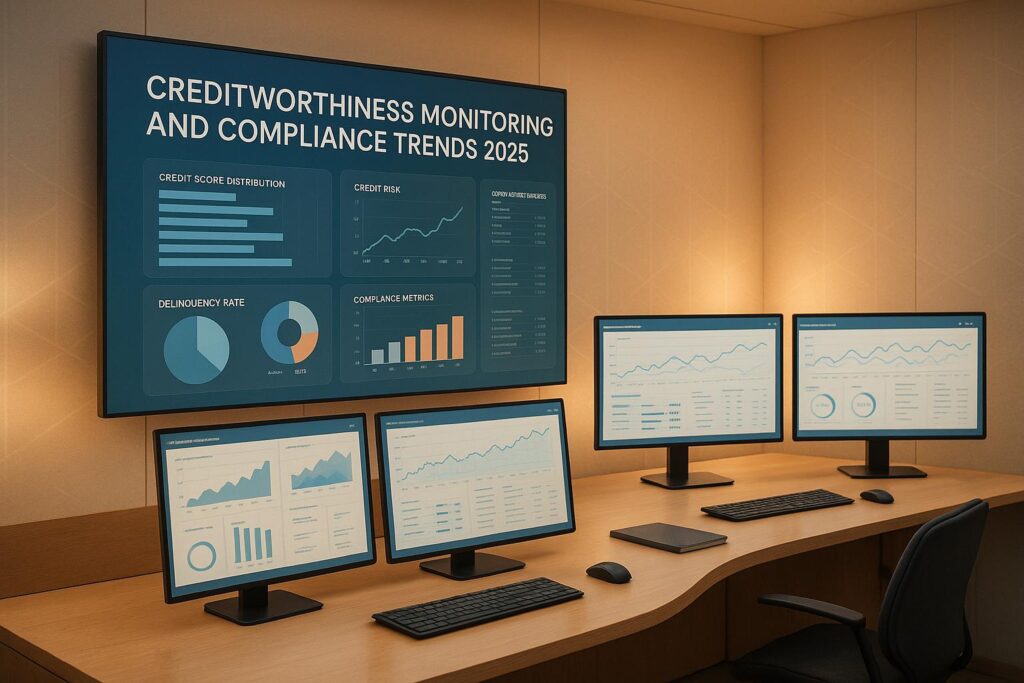
In 2025, managing credit risk is more complex than ever. With consumer debt nearing $18 trillion and interest rates still high, businesses must prioritize real-time credit monitoring to safeguard cash flow and meet stricter regulatory requirements. Traditional annual reviews are no longer sufficient – companies are now adopting AI-driven tools to track customer financial health, predict risks, and comply with evolving standards like the Basel Committee’s updated credit risk principles.
Key takeaways:
- AI in Credit Monitoring: Predicts defaults with 96% accuracy, reducing default rates by 20% and cutting costs by 15%.
- Consumer Credit Trends: Super-prime and subprime tiers dominate, requiring tailored risk strategies.
- Sector-Specific Risks: Real estate and auto finance face higher delinquencies, while personal loans and credit cards show improved performance.
- Regulatory Focus: U.S. regulators demand fair lending practices, transparency in AI models, and robust governance.
- Accounts Receivable Insurance: Protects against customer non-payment risks and supports cash flow stability.
To thrive in this environment, businesses must implement real-time credit monitoring, use predictive analytics, and strengthen compliance frameworks. Tools like accounts receivable insurance also play a critical role, offering financial protection and improving access to financing.
HDIW | Credit risk models & the AI act
Key Trends in Creditworthiness Monitoring for 2025
As the financial landscape evolves, three major forces are reshaping how U.S. credit risk is assessed. Interest rates, though slightly easing, remain high. Consumer debt has reached unprecedented levels, and the credit spectrum is dividing into two distinct groups. These shifts demand a more dynamic approach to credit monitoring, moving beyond traditional annual reviews or static scoring models. Together, these economic changes are redefining credit risk tiers and creating unique challenges across various sectors.
Macroeconomic Influences on Credit Risk
The cost of borrowing continues to weigh heavily on both individuals and businesses in 2025. While the aggressive interest rate hikes of recent years have leveled off, rates remain high enough to pressure borrowers with floating-rate debt or those seeking refinancing. This strain is particularly visible in sectors like mortgages, auto loans, and corporate borrowing.
Higher debt servicing costs directly increase the likelihood of defaults, especially in rate-sensitive industries such as real estate, automotive, and leveraged corporate sectors.
Adding to the complexity, the labor market is showing signs of cooling. Unemployment remains relatively low, but wage growth has slowed, and layoffs have occurred in sectors like technology, finance, and certain manufacturing industries. For credit managers, this means keeping a close eye on both financial data and the health of industries tied to their portfolios. Modern credit monitoring now includes stress-testing receivables against potential rate shocks, unemployment increases, and sector slowdowns. This proactive approach helps identify risks before they manifest in payment defaults.
Polarization of Credit Risk Tiers
Macroeconomic pressures are also driving a growing divide in credit quality. In 2025, the middle ground of creditworthiness is shrinking, with more consumers falling into either the super-prime or subprime categories. This polarization is reshaping how businesses manage credit decisions and risk.
According to TransUnion, the percentage of super-prime U.S. consumers rose from 37.1% in Q3 2019 to 40.9% in Q3 2025, adding approximately 16 million borrowers to this tier. At the same time, there has been significant growth in the subprime segment, leaving fewer consumers in the middle tier – where traditional, uniform credit policies once applied.
This divide presents unique challenges for monitoring. Super-prime borrowers, while financially strong, are not immune to stress. Job losses in high-income sectors, volatile investment portfolios, or exposure to troubled industries like commercial real estate can lead to rapid financial deterioration. Monitoring these accounts requires focusing on macroeconomic stress indicators rather than relying solely on past payment behavior.
Subprime and near-prime borrowers, on the other hand, demand a different strategy. Early-warning signs such as missed payments, sudden spikes in credit utilization, changes in employment, or shifts in cash flow patterns are critical for distinguishing resilient borrowers from those at risk of delinquency.
Lenders are adjusting to this polarization with tailored strategies. For example, credit card issuers are expanding offerings in both the super-prime and subprime segments while managing risk through smaller initial credit limits. Unsecured personal loan balances reached a record $269 billion in 2025, growing 26% year-over-year, with serious delinquencies increasing by just 2 basis points.
For businesses extending trade credit, static credit policies are no longer effective. Differentiated approaches, such as shorter payment terms or collateral requirements for higher-risk accounts, are becoming standard. Meanwhile, super-prime customers often benefit from more favorable terms. Automated systems that flag changes in credit scores, payment patterns, or external risk indicators are vital for identifying shifts in borrower behavior early.
Sector-Specific Credit Insights
Beyond broad economic trends, credit performance in 2025 varies significantly by industry, requiring sector-specific monitoring strategies. Key sectors like housing, auto finance, and consumer credit products each present unique challenges.
Housing-Linked Portfolios
Mortgage delinquencies have risen year-over-year, with the 60+ days past due rate reaching 1.36% in Q3 2025, up from 1.24% a year earlier. FHA loans account for most of these delinquencies, while VA loans saw the largest year-over-year increase, jumping 35%. These trends reflect the combined strain of higher interest rates, elevated home prices, and stretched affordability, particularly for borrowers who recently purchased or refinanced.
Businesses tied to real estate – like construction firms, building material suppliers, and property management companies – must adopt more granular monitoring practices. This includes tracking regional home price indices, vacancy rates, and refinancing activity alongside traditional financial metrics.
Auto Finance
The auto finance sector presents a mixed picture. Delinquencies for loans 60+ days past due reached 3.52% in Q3 2025, up slightly from 3.50% a year earlier. However, loans originated in 2024 are showing higher delinquency rates compared to pre-pandemic levels, especially among prime and below-prime borrowers. High vehicle prices and ownership costs continue to challenge affordability, even as inventory constraints ease.
For businesses in the automotive supply chain – such as parts suppliers, dealerships, and repair shops – credit monitoring should include vintage-level performance data, FICO band analysis, and distinctions between new and used vehicle loans.
Credit Cards and Personal Loans
Credit cards, private label cards, and personal loans have shown stabilizing or improving delinquency trends. Despite strong origination growth in both super-prime and subprime segments, lenders have managed risk through smaller credit limits and frequent reviews. The 90+ days past due delinquency rate for consumers dropped to 2.37% in Q3 2025, down 7 basis points year-over-year. These results highlight the effectiveness of tighter underwriting and enhanced monitoring practices.
Small Businesses
Small businesses remain particularly vulnerable. Rising interest rates, wage pressures, and lingering supply chain issues are squeezing margins and weakening debt service capacity. Credit risk varies widely by industry, with discretionary consumer-facing businesses and construction-related trades facing more pressure than essential services. Regional economic conditions also play a significant role in shaping risk.
For companies extending trade credit to small businesses, high-frequency monitoring is now critical. Metrics like business bank account cash flows, trade credit payment behavior, and sector-specific indicators (e.g., retail foot traffic or freight volumes) provide earlier warning signs than quarterly financial statements. Dynamic credit limits tied to receivables performance help mitigate risks before they escalate into defaults.
Supply Chain-Dependent Industries
Industries reliant on complex supply chains face unique challenges, including cost volatility and demand fluctuations. While overall performance appears stable, there is significant variation among firms. Those struggling to manage higher input costs are more likely to face financial distress. Companies in these sectors are enhancing monitoring by mapping risks across suppliers and buyers, tracking days sales outstanding trends, and using external credit data to identify emerging issues.
Regulatory Developments Impacting Credit Monitoring
The regulatory environment for monitoring creditworthiness has become increasingly stringent in 2025. These changes underscore the importance of adaptable credit monitoring practices. With updated international standards, tighter U.S. regulations, and concerns tied to AI, institutions must now adopt continuous, model-driven oversight to stay compliant.
Basel Committee Updates on Credit Risk Management
The Basel Committee on Banking Supervision has raised the bar for how banks manage credit risk throughout a loan’s lifecycle. The updated principles emphasize continuous monitoring, accurate risk grading, and quick responses to signs of weakening exposures. Banks are now expected to identify and address deteriorating credit conditions promptly, which may involve more frequent reviews and closer management of borrowers with declining ratings.
For U.S. banks adhering to Basel standards, this means implementing more detailed borrower segmentation, faster rating adjustments, and formalized watchlist criteria. Robust internal rating systems must tie into broader frameworks like portfolio limits, capital planning, and provisioning. These systems require ongoing validation, independent review, and alignment with changing economic and sector-specific conditions.
The practical effects are far-reaching. Institutions need to adopt risk-based monitoring, where high-risk borrowers or those showing signs of deterioration are reviewed more frequently. Negative rating shifts, covenant breaches, or underperformance compared to peers should trigger placement on a watchlist. Senior management must regularly review these watchlists, complete with documented action plans and timelines.
These expectations aren’t limited to banks. Large corporations providing trade credit are also under pressure – from their banks, rating agencies, and trade credit insurers – to implement structured monitoring frameworks. These include regular customer reviews, defined exposure limits, and clear action steps for struggling buyers .
U.S. regulators have similarly refined their supervisory focus to align with these international standards.
U.S. Regulations and Supervisory Guidance
In 2025, U.S. regulators are zeroing in on fair lending practices, model risk management, and the ethical use of alternative data .
The Consumer Financial Protection Bureau (CFPB) has increased its scrutiny of how credit monitoring impacts protected classes. Its analysis of consumer credit trends emphasizes that monitoring practices must avoid creating disparate impacts on these groups, particularly as lenders incorporate non-traditional data like cash-flow histories and transaction records . This oversight extends beyond loan origination to include decisions about credit line reductions, repricing, collections, and account closures.
The Federal Reserve has pointed out that while alternative data can make credit decisions more inclusive, it also raises concerns about transparency and potential bias. To address this, banks must ensure strong governance and validation for models using such data. Similarly, the Office of the Comptroller of the Currency (OCC) and the Federal Reserve require banks to demonstrate how AI-driven models work, justify their key variables, and explain decisions clearly to both regulators and affected consumers.
Enhanced governance is especially critical for AI-driven credit monitoring models. These models must be conceptually sound, trained on representative data, and regularly updated to reflect changing economic and portfolio conditions .
Fair lending risks are a particular focus. Regulators are examining whether monitoring actions – like credit line reductions or increased collections – disproportionately affect certain demographic groups, even if initial underwriting was neutral . They are also scrutinizing whether alternative data introduces bias and whether consumers receive clear, compliant notices explaining adverse decisions . To address these concerns, institutions are expected to use fair-lending analytics, such as disparate-impact testing, for ongoing account management decisions, not just at the origination stage .
These regulatory priorities translate into specific compliance measures, outlined below.
Practical Compliance Requirements
To meet these regulatory demands, institutions must strengthen their credit monitoring frameworks with several key components.
Early-warning systems should incorporate defined risk indicators, such as payment behavior and covenant breaches, with clear thresholds and escalation protocols . At the portfolio level, regulators expect to see concentration analysis, scenario-based loss projections, and watchlist migration reports integrated into capital and allowance planning.
Institutions must document their selection of indicators, data sources, override policies, and back-testing processes to show how early-warning flags correlate with actual credit deterioration . For commercial and trade credit portfolios, this includes integrating macroeconomic and sector-specific indicators, as well as aggregating exposures across related entities.
Tiered watchlists are another critical requirement. These watchlists should classify problem credits by severity, with clear criteria for entry and exit based on internal ratings, early-warning triggers, and other factors . Each watchlisted borrower should undergo a comprehensive credit review, covering financial analysis, collateral reassessment, sector outlook, and a detailed action plan. This plan might include restructuring, collateral enhancements, exposure reductions, or transferring the account to a workout team.
Supervisors also expect regular watchlist committee meetings, with minutes documenting participation from risk, business, and finance teams. These meetings should ensure accountability for implementing remediation steps. For U.S. institutions, aligning these processes with frameworks like CECL, stress tests, and capital planning demonstrates that watchlist outputs are integrated into broader risk management practices.
Effective model governance is essential for credit monitoring. This includes a full life-cycle approach covering model inventory, tiered risk assessments, design standards, independent validation, and ongoing performance monitoring . Regulators review documentation on model soundness, data sources, performance metrics, and validation reports highlighting any limitations and corrective measures . Policy documents must address manual overrides, intervention rules, and usage limits for high-risk models, including complex machine-learning tools in consumer portfolios. Strong governance also requires clear roles for model owners and validators, regular reporting to boards or risk committees, and alignment of monitoring outputs with capital, provisioning, and pricing strategies.
For companies extending trade credit, these regulatory changes create indirect pressures. Banks and insurers are tightening their expectations for counterparty credit-risk practices . Large corporates are now expected to have structured monitoring frameworks with regular reviews, defined exposure limits, and clear action steps for struggling buyers . In high-risk sectors, there’s an increasing focus on portfolio-level concentration analysis, stress testing receivables, and enforcing governance over limit overrides and write-offs .
Some businesses are turning to credit insurance solutions – like those offered by Accounts Receivable Insurance – to meet these expectations. By integrating such solutions into their credit risk frameworks, companies can demonstrate to banks, auditors, and rating agencies that they have robust risk transfer mechanisms. This not only aligns with regulatory guidelines but also strengthens overall compliance efforts.
sbb-itb-2d170b0
Technology Advances in Credit Monitoring
Artificial intelligence (AI) and machine learning are reshaping credit monitoring in 2025. Banks and lenders are moving away from manual, reactive processes toward automated systems that can predict and address risks before they escalate. This shift is largely driven by stricter regulations and the measurable improvements AI delivers in managing credit risks.
AI-Driven Credit Monitoring
Modern credit monitoring platforms now pull data from a variety of sources, going beyond traditional inputs. These systems incorporate transactional data, payment patterns, credit bureau reports, and alternative data sources. This approach helps lenders maintain accurate borrower profiles and respond swiftly to changing risk factors.
The results speak for themselves. Machine learning models can predict defaults with 96% accuracy, reducing default rates by 20% while cutting operating expenses by 15%. AI’s ability to process vast amounts of data quickly and uncover hidden patterns far outpaces traditional methods.
Real-time monitoring is a game-changer, replacing outdated periodic review cycles. AI-powered early warning systems track critical risk indicators – like missed payments, declining sales, or industry stress – allowing lenders to act before loans turn problematic. Additionally, the use of trended data, which captures shifts in borrower behavior and credit metrics over time, gives lenders the tools to identify early signs of financial trouble. For example, in Q3 2025, lenders using advanced tools and trended data managed to grow credit card originations across super prime and subprime segments while maintaining lower delinquency rates.
The growing reliance on alternative data in underwriting has also improved risk assessments, particularly for borrowers with limited credit histories. By integrating multiple data sources, lenders achieve a more comprehensive view of creditworthiness across different economic cycles.
As consumer behavior polarizes – with growth in both super prime and subprime credit segments – AI-powered systems allow lenders to craft precise, tier-specific strategies. For instance, unsecured personal loan originations saw a 26% year-over-year increase in Q3 2025, with fintechs gaining market share in the super prime segment while also expanding in non-prime tiers.
The market is responding to these advancements with significant investment. The global credit risk management software market is projected to grow from $1.4 billion in 2023 to $2.6 billion by 2028, reflecting a compound annual growth rate of 12.7%. Meanwhile, the credit risk assessment market is expected to reach $23.97 billion by 2032, highlighting its growing importance as businesses prioritize data-driven strategies.
That said, AI’s adoption also introduces new challenges, particularly around model risk and explainability.
Model Risk and Explainability
While AI provides powerful tools, it also brings risks that require careful oversight. Regulatory bodies increasingly demand that AI-driven credit decisions be transparent and auditable. Banks need to establish governance frameworks to ensure AI models are not only effective but also understandable, with clear documentation of how credit decisions are made.
Strong governance practices – such as periodic model validation and independent reviews of credit decisions – are essential for managing risks. Regulatory bodies like the Federal Reserve emphasize the importance of validating AI models to ensure they perform accurately across diverse borrower groups and economic scenarios.
Another critical issue is the potential for AI models to perpetuate biases present in training data, which could lead to discriminatory lending practices. To address this, banks must implement rigorous testing and validation protocols to identify and reduce bias, ensuring fair and compliant credit decisions.
Maintaining audit trails of model inputs, validation results, and decision rationales is also crucial. This documentation allows regulators and internal compliance teams to review how credit decisions are made, ensuring they are based on sound analysis rather than opaque algorithms. Explainability is key to ensuring AI-driven credit monitoring systems can withstand regulatory scrutiny and align with compliance standards.
New regulatory requirements, such as those under Basel III, have pushed banks to adopt advanced credit risk monitoring systems that emphasize forward-looking risk identification, scenario planning, and comprehensive reporting. These demands highlight the need for robust systems capable of meeting stringent compliance expectations.
Comparison of Traditional vs. AI-Powered Monitoring
The differences between traditional and AI-powered credit monitoring are stark. Understanding these contrasts can help institutions evaluate their current systems and identify areas for improvement. The table below highlights key distinctions:
| Feature | Traditional Credit Monitoring | AI-Powered Credit Monitoring |
|---|---|---|
| Data Inputs | Static, periodic data (e.g., annual financials, credit scores) | Real-time, dynamic data (transactions, payment behavior, trended data, alternative data) |
| Responsiveness | Periodic reviews, often delayed | Continuous, real-time monitoring with early warning systems |
| Risk Identification | Reactive, after issues arise | Proactive, predictive analytics that flag risks early |
| Governance Focus | Rule-based controls, periodic audits | Continuous validation, bias testing, and regulatory alignment |
| Default Prediction Accuracy | Moderate, based on historical trends | High (96% accuracy), leveraging machine learning and large datasets |
| Operational Efficiency | Labor-intensive, slower processes | Lower costs (15% reduction) and faster decision-making |
Traditional systems are slower to detect emerging risks, relying on periodic reviews and manual processes. In contrast, AI-powered systems provide real-time alerts and early warning signals. While traditional methods focus on static data and rule-based controls, AI platforms emphasize continuous validation, bias monitoring, and explainability to maintain accuracy and compliance.
AI-powered platforms can also be customized to fit specific risk appetites and regulatory requirements, enabling more dynamic and borrower-specific strategies. These systems are particularly valuable for lenders operating across multiple regions, supporting faster decisions and more precise risk management.
For businesses offering trade credit, these advancements present both opportunities and challenges. As banks and insurers adopt sophisticated monitoring tools, they increasingly expect their corporate clients to implement similar frameworks to strengthen their risk management practices.
Implications for Trade Credit, Receivables Risk, and Insurance
The trends in credit monitoring and compliance shaping 2025 are having a direct impact on how businesses handle trade credit, assess receivables risk, and structure their insurance strategies. Companies offering extended payment terms to customers are navigating a more intricate environment – one marked by diverging credit quality, sector-specific vulnerabilities, and heightened regulatory expectations for risk management. To keep pace, businesses must adopt more advanced tools to protect receivables and support strategic growth, building on earlier discussions of regulatory and technological shifts.
Managing Trade Credit and Receivables Risk
In 2025, managing trade credit portfolios requires a more nuanced approach than traditional, one-size-fits-all credit policies. The credit landscape is becoming increasingly polarized, with growth concentrated in super prime and subprime segments, while mid-tier credit remains relatively steady. This divergence makes it risky for businesses to apply uniform credit terms across their customer base – it could either expose them to unnecessary risks or cause them to miss growth opportunities.
Payment data now demands closer, more proactive monitoring. Consumer credit health has generally improved, with the 90+ days past due rate dropping to 2.17%. Subprime credit card delinquencies also saw improvement, decreasing from 11.9% to 11.4% in Q3 2025. However, some areas, like auto lending, show slight increases in delinquency rates, with 60+ days past due edging up to 3.52%, compared to 3.50% in Q3 2024. Mortgage delinquencies have risen year-over-year as of April 2025, while other lending categories, including personal loans and bankcards, have shown better performance.
For accounts receivable managers, these patterns underline the need for cohort monitoring. Newer customer groups may carry higher default risks than historical trends suggest. Early-warning systems tracking metrics like 30+ days past due can help businesses identify issues early. Monitoring indicators such as days sales outstanding (DSO), aging buckets, order cancellations, and shifts in credit line utilization can guide timely adjustments to credit terms before problems escalate.
Sector concentration risk is another critical factor in 2025. Businesses heavily exposed to commercial real estate, discretionary retail, transportation, or smaller suppliers face elevated risk. State Street Global Advisors‘ 2025 credit outlook predicts overall stability in corporate credit markets but warns of pressure on real estate and private credit sectors due to higher interest rates and fiscal risks. In response, many companies are capping exposure to high-risk sectors and tightening credit terms.
Practical strategies are essential for managing these emerging risks. Businesses can implement tiered credit policies that adjust terms, limits, and collateral requirements based on risk grades. By leveraging external credit scores alongside internal payment behavior data, companies can reduce exposure to weaker risk tiers. Regular analysis of sector and customer concentrations helps set appropriate exposure limits. Formalizing credit monitoring processes – including maintaining detailed credit files, approval workflows, and documentation of limit changes – can improve risk management, ensure regulatory compliance, and enhance eligibility for insurance coverage and financing. These strategies naturally align with integrated insurance solutions designed to protect working capital effectively.
The Role of Accounts Receivable Insurance
Accounts receivable insurance has become a vital tool in safeguarding businesses against customer non-payment risks, including bankruptcy, prolonged default, and political disruptions that may affect buyers in both domestic and international markets. Modern policies now incorporate real-time credit data and compliance checks, such as know-your-customer (KYC), sanctions screening, and anti-money laundering (AML) protocols. These measures enable insurers to dynamically adjust buyer limits and policy terms based on continuous monitoring, often powered by AI-driven tools.
This type of insurance also promotes better credit practices. Policies often require companies to maintain minimum credit procedures, adhere to approved limits, and report overdue accounts promptly. Such conditions encourage businesses – especially mid-market firms – to adopt robust monitoring and documentation practices. Many insurers now offer portfolio analytics dashboards that provide insights into insured and uninsured receivables, sector and country exposures, and deteriorating buyer lists. Brokers further enhance this support by conducting risk assessments and managing claims, all informed by ongoing creditworthiness monitoring.
For U.S. businesses, accounts receivable insurance can also improve access to financing. Insured receivables are often viewed more favorably by lenders, who may apply lower risk weights or accept them as collateral more readily. This dual benefit – protecting against non-payment while enhancing working capital access – makes insurance a strategic asset.
The growing complexity of credit risk in 2025 has driven more businesses to adopt trade credit insurance. Demand for these policies has surged, particularly during periods of economic uncertainty and tightening credit conditions, as companies seek reliable ways to manage non-payment risks.
How Accounts Receivable Insurance Addresses Emerging Credit Challenges
Accounts Receivable Insurance provides tailored solutions to meet the credit challenges of 2025. These policies go beyond basic coverage by offering comprehensive risk assessments and proactive monitoring of customer financial health. This allows businesses to extend credit confidently while minimizing unexpected losses.
Given the polarization of credit quality and sector-specific risks, a one-size-fits-all approach no longer works. Instead, ARI offers customized policies aligned with each business’s unique risk tolerance and operational model. For example, companies with significant exposure to sectors facing challenges – such as mortgage-related or auto-related businesses – can secure policies with premiums and terms that reflect these heightened risks. On the other hand, businesses tied to improving sectors like personal loans and credit cards may benefit from more favorable terms.
Real-time data integration ensures continuous risk assessment throughout the policy period, helping businesses identify and address emerging risks before they escalate into claims. This proactive approach not only reduces the likelihood of claims but also strengthens relationships with customers through early intervention.
For businesses expanding into new domestic or international markets, ARI provides the protection needed to pursue growth opportunities without excessive risk. Coverage extends beyond non-payment to include political and currency-related challenges that can complicate cross-border trade.
ARI’s broker model ensures hands-on support throughout the policy lifecycle, from structuring and implementation to claims management. Brokers work closely with businesses to adjust policy terms as credit monitoring data reveals shifting risks. Additionally, ARI helps businesses meet evolving regulatory standards by providing detailed risk assessments and thorough documentation of credit evaluations – essential for both insurance claims and bank financing.
Conclusion
The landscape of creditworthiness monitoring in 2025 highlights a major shift toward data-driven approaches to managing risk. Businesses and lenders are steadily moving away from outdated, manual methods and adopting AI-powered platforms that leverage real-time data, predictive analytics, and early warning systems. This transition is reflected in the strong growth of the market, signaling that organizations are increasingly recognizing the importance of advanced, automated monitoring tools.
As discussed earlier, modern credit monitoring relies heavily on AI-driven technologies and strict compliance practices. Regulatory frameworks, such as those from the Basel Committee and U.S. supervisory guidance, now emphasize forward-looking risk management strategies, including scenario analysis and robust governance structures. These regulations demand transparency, auditable processes, routine validation of models, and comprehensive documentation. Additionally, the Federal Reserve’s focus on alternative data – like cash-flow metrics – has enhanced credit assessments across different economic conditions, underscoring the need for businesses to maintain reliable data infrastructure and governance systems.
In 2025, the U.S. consumer credit market presents a mixed but stabilizing picture. While delinquency rates have generally improved, there are notable variations across sectors, particularly in the mortgage market. This variability underscores the importance of businesses segmenting their portfolios based on product types, industry exposure, and customer demographics to better evaluate and manage risk.
In this dynamic environment, protective measures are more important than ever. As highlighted earlier, Accounts Receivable Insurance offers businesses a tailored solution to mitigate risks such as non-payment, bankruptcy, and political instability. These policies integrate real-time credit data and compliance checks, enabling proactive credit risk management. By safeguarding cash flow and improving access to financing, accounts receivable insurance has become a strategic tool for businesses aiming to enhance financial stability.
To thrive in this evolving credit monitoring landscape, businesses must prioritize upgrading their data infrastructure to support real-time integration, implement early-warning systems with clear triggers, and adopt predictive analytics backed by strong model governance. Segmenting portfolios by risk tiers and sector exposure can lead to more precise credit decisions, while thorough documentation and approval workflows ensure regulatory compliance and insurance eligibility. The impact of AI-powered monitoring is clear, with some institutions reporting reductions in default rates by as much as 20% and operating costs lowered by 15% through automation and predictive analytics.
The trends and regulatory changes shaping 2025 call for a careful balance between technological innovation, governance, transparency, and ethical practices. By investing in cutting-edge monitoring systems, maintaining clear documentation, and utilizing risk mitigation tools like accounts receivable insurance, businesses can effectively manage credit risk, sustain growth, and navigate the complexities of the financial landscape with confidence.
FAQs
How can AI-powered credit monitoring tools help businesses lower default risks and reduce costs?
AI-powered credit monitoring tools offer businesses a smarter way to stay on top of customer creditworthiness. By delivering real-time insights, these tools help companies make better-informed decisions about who they extend credit to. They sift through massive amounts of financial data to flag potential risks, such as late payments or the likelihood of defaults, giving businesses the chance to act before issues arise.
Automating the credit assessment process also brings practical benefits. It reduces the need for manual tasks, simplifies operations, and lowers administrative expenses. On top of that, AI tools improve accuracy and efficiency, cutting down on errors that could impact financial health. This means businesses can secure their cash flow while staying aligned with changing regulations.
What are the major regulatory changes in 2025 impacting credit monitoring, and how can businesses prepare?
In 2025, changes in regulations are set to transform credit monitoring practices, focusing on stricter compliance measures and greater transparency. These updates are likely to bring tougher reporting standards, heightened accountability for companies, and the integration of advanced technologies aimed at improving data accuracy and security.
To get ahead of these shifts, businesses should prioritize staying updated on regulatory developments, invest in reliable credit monitoring tools, and schedule regular compliance audits. Taking proactive steps like evaluating financial risks and considering tailored solutions, such as credit insurance, can provide an extra layer of protection against challenges in this evolving regulatory environment.
How can accounts receivable insurance strengthen a company’s credit risk management in today’s challenging financial landscape?
Accounts receivable insurance is a valuable tool for businesses looking to protect themselves from credit risks. It shields companies from financial losses caused by issues like non-payment, customer bankruptcies, or even political upheavals. By safeguarding outstanding receivables, this type of insurance helps maintain steady cash flow, even during unpredictable economic times.
Beyond providing financial coverage, it also includes practical tools such as risk assessments, ongoing monitoring of customer financial stability, and efficient claims management. These features empower businesses to extend credit with greater confidence, all while keeping potential risks under control.